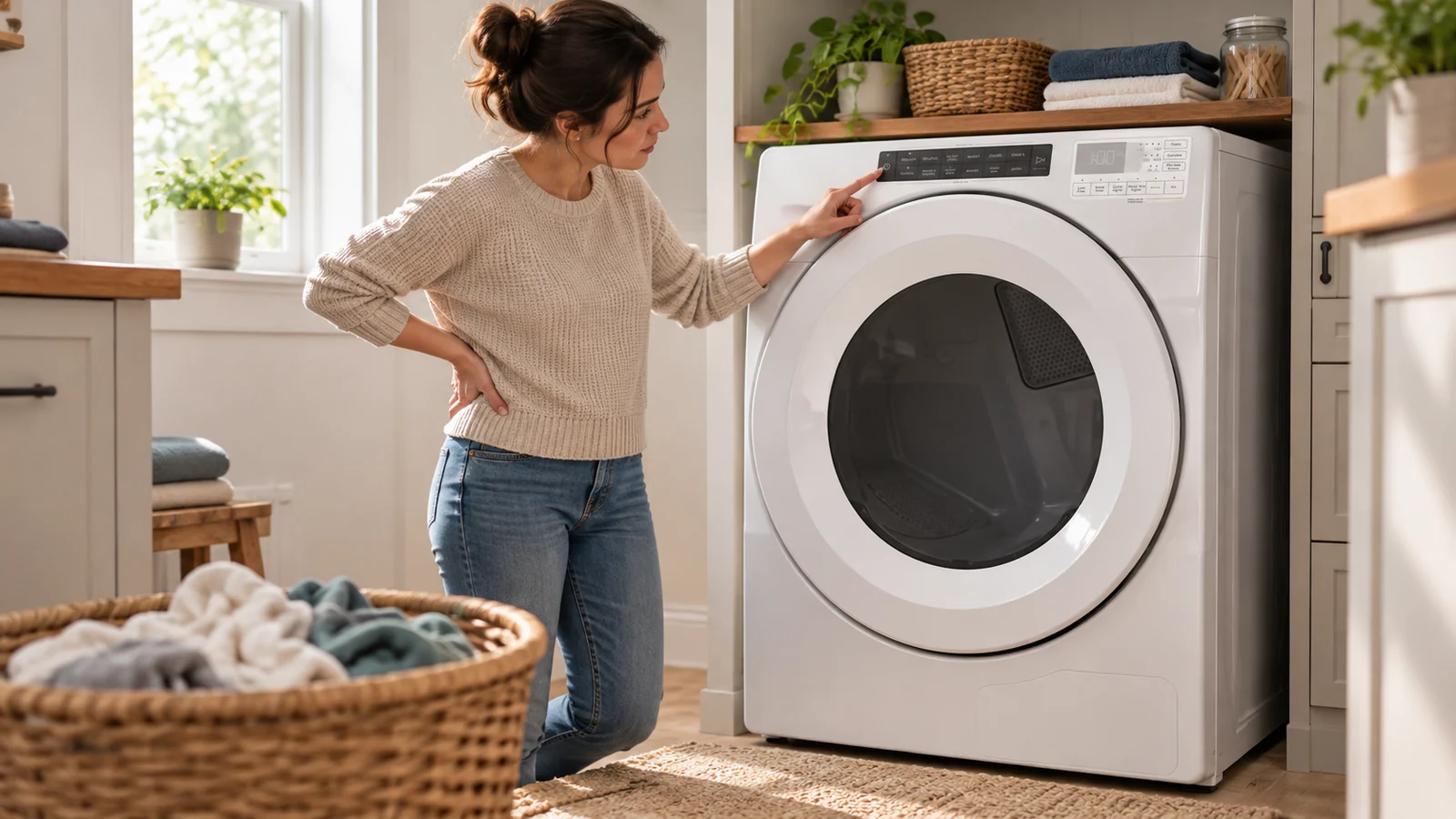
A dryer that tumbles but produces no heat can leave you with a full load of damp laundry. The cause might be as simple as an Air Fluff setting, or it might involve an electrical supply problem, a gas supply issue, or a component that needs professional service. The key is to find out whether your dryer makes any heat at all before assuming a part has failed.
Quick answer: Why is my dryer not heating?
If your clothes dryer is not heating, first confirm that a heated cycle is selected. Next, clean the lint filter and distinguish a complete loss of heat from slow drying with some heat. On a conventional electric dryer, a partially tripped double-pole breaker may allow the drum to spin without powering the heater. On a gas dryer, an interrupted gas supply can produce a similar symptom. Heating components, temperature controls, and internal wiring are possible causes if safe checks do not resolve the problem.
Start here: Check the cycle settings → determine whether any heat is produced → check airflow and load conditions → follow the guidance for your dryer type. Stop immediately if you notice gas odor, smoke, burning electrical smells, or repeated breaker trips.
Safety first: When to stop using the dryer
- Smell gas or suspect a gas leak? Leave the building immediately. Do not operate switches, phones, plugs, or appliances inside. From a safe location, call 911 or your gas utility's emergency number.
- Carbon monoxide alarm sounding? Get everyone outside and call emergency services from a safe location.
- Smoke, sparks, a scorched outlet, or burning electrical odor? Stop using the appliance; do not run another test cycle.
- Breaker trips again, dryer seriously overheats, or exhaust is badly obstructed? Keep the dryer off until the problem is professionally assessed or safely corrected.
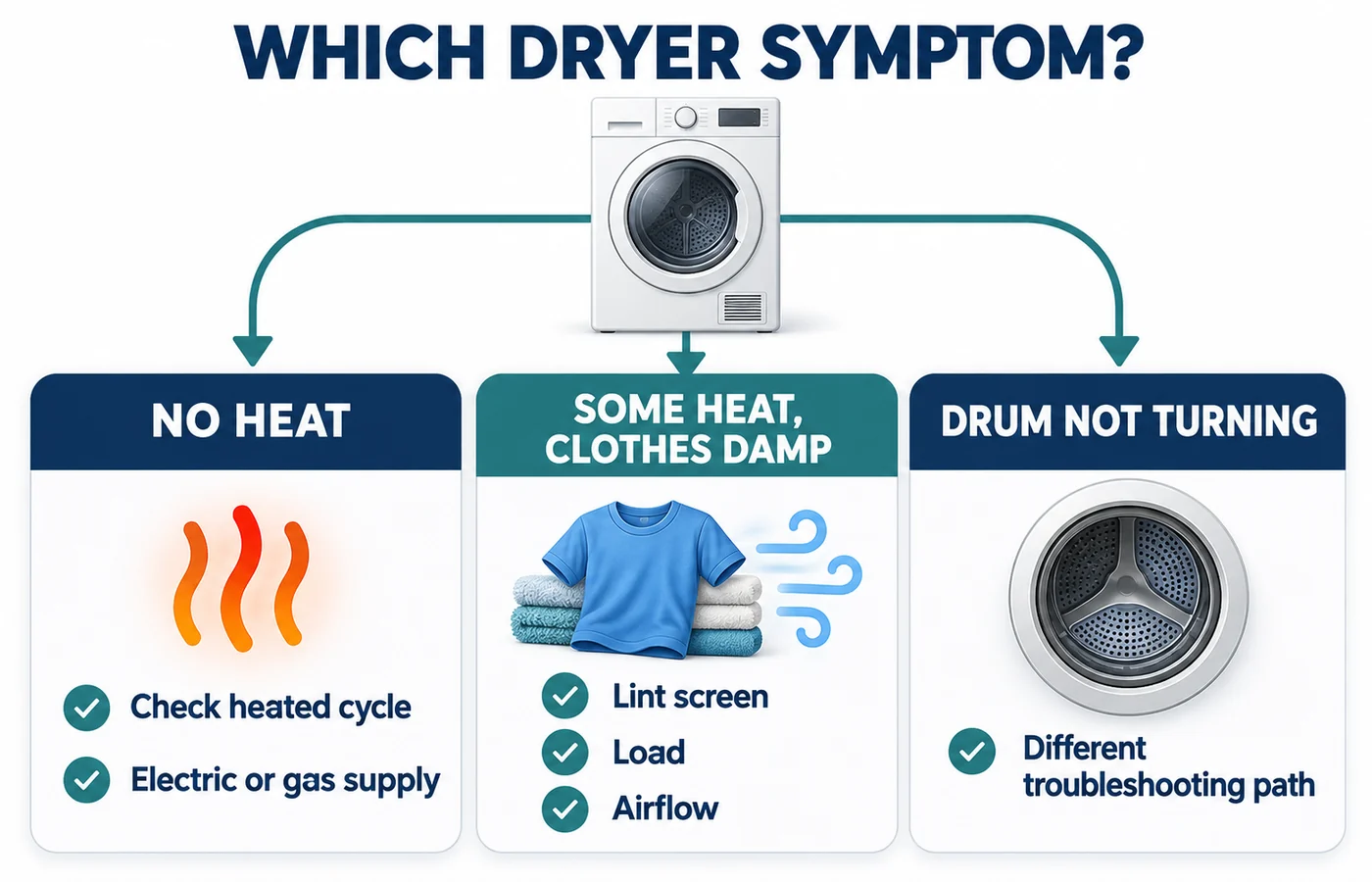
1. Is your dryer producing no heat, or is it drying too slowly?
These symptoms may look alike when you unload wet clothes, but they lead to different checks. A dryer with no heat at all deserves a different investigation from one that warms up but needs multiple cycles to finish a load.
| What you notice | What to consider first | Next step |
|---|---|---|
| Drum turns, but there is no warmth during a heated cycle | Cycle selection, electric power supply, gas supply, or heater-system fault | Check settings; then use the electric or gas section below. |
| Some warmth, but towels stay damp or drying takes much longer | Lint filter, exhaust restriction on a vented dryer, load size, very wet laundry, or sensor setting | Start with airflow and laundry conditions. |
| Dryer starts, then stops early or shows an error | Model-specific sensor, airflow, power, or control issue | Record the exact error code and consult the owner's manual. |
| Drum never starts | A separate no-start or no-tumble problem | Use a no-start troubleshooting guide rather than assuming the heater is bad. |
For some Whirlpool and Maytag models, the manufacturer suggests an empty-drum test using a heated Timed Dry cycle for about five minutes, then checking whether the inside feels warm after stopping and opening the door. This is an example, not a universal test for every dryer. Use only the procedure described for your exact model, and do not run the machine if there are safety warning signs. Heat-pump dryers in particular may warm up more gradually.
2. Five safe checks before suspecting a broken part
Check 1: Choose a cycle that actually uses heat
Look for Air Only, Air Fluff, No Heat, Cool Down, Delicates, Eco, or Energy Saver on the controls. Air-only settings intentionally tumble without heating. Other settings may use less heat or spend part of the cycle without heat. Choose a heated cycle appropriate for the fabric and follow your manufacturer's testing guidance. Do not judge the heat from a brief cool-down portion at the end of a normal cycle.
Check 2: Clean the lint filter
With the dryer stopped and cool, remove accessible lint from the screen as directed by the owner's manual, then reinstall it properly. A blocked screen reduces airflow and can contribute to poor drying or overheating. Never operate the dryer without the lint filter installed. A clean screen also does not prove that the exhaust duct is clear.
Check 3: Inspect visible airflow paths on vented dryers
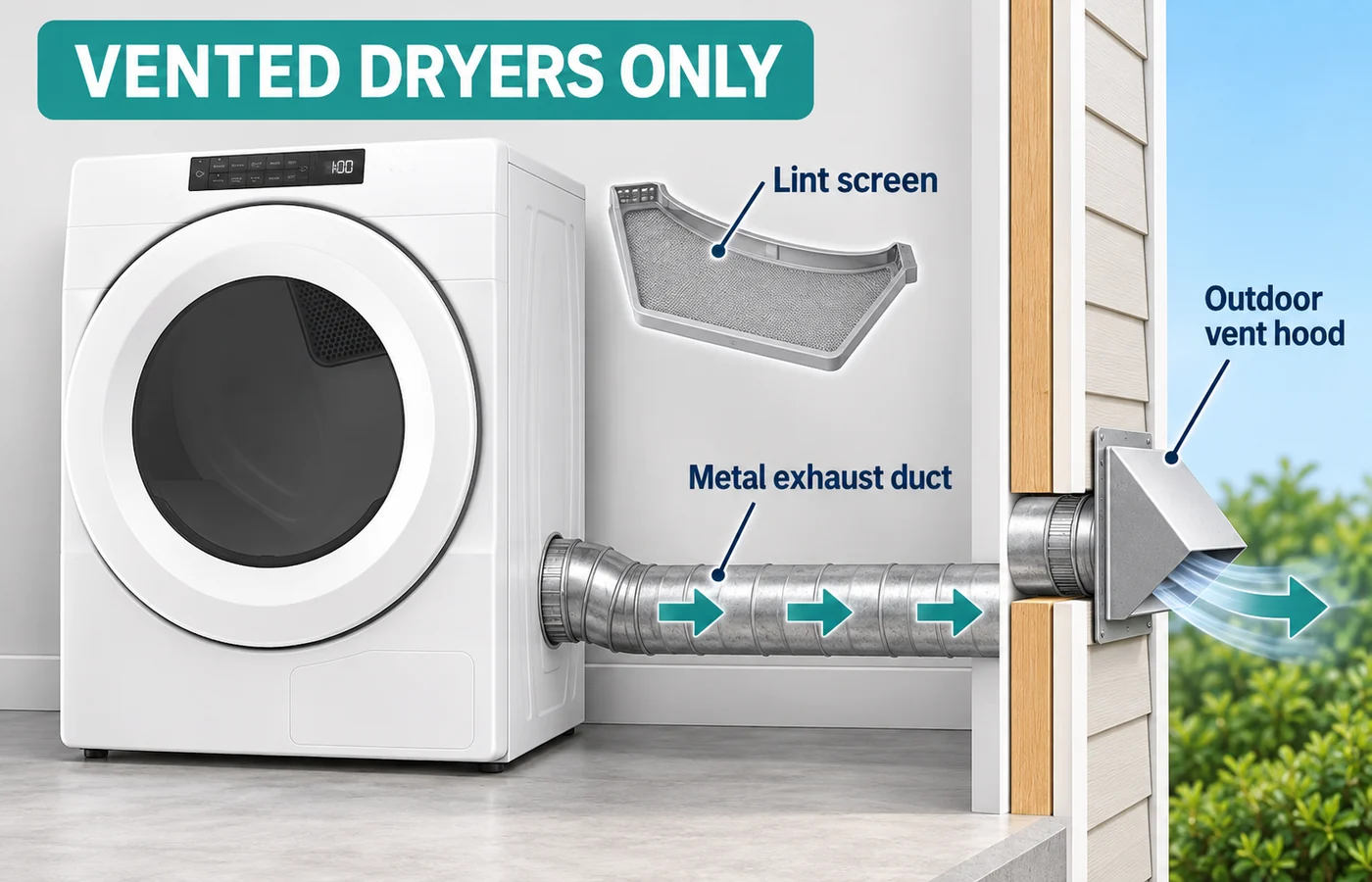
Look for items blocking the dryer intake, an obviously crushed or kinked exhaust connection, or an exterior vent flap obstructed by lint or debris. Only inspect areas you can reach safely, without moving heavy equipment unsafely or disconnecting utilities. If the vent runs through walls, a ceiling, or a roof, arrange professional inspection and cleaning instead of attempting a hazardous reach.
Vented dryers must exhaust as specified by their installation instructions. Do not operate one with the exhaust disconnected into an indoor room as a troubleshooting shortcut. If the machine has been overheating or the duct appears severely restricted, leave it off until the issue is resolved.
Check 4: Rule out a load or moisture-sensing problem
An overloaded drum can prevent clothes from tumbling freely. Laundry coming out of the washer dripping wet can take much longer to dry; an additional washer spin cycle may help. Very small loads, bulky bedding and mixed heavy/light fabrics may also confuse some automatic moisture-sensing programs. Review load size, selected dryness level and fabric recommendations before treating long drying time as a heater failure.
Check 5: Note your dryer type, model and any error code
Find the model number on the appliance label or in its documentation. Note whether it is a conventional electric dryer, a gas dryer, or a heat-pump/ventless model. Photograph any display code and look it up in the official model manual: an airflow warning on one brand cannot be assumed to mean the same thing on another.
3. Electric dryer not heating: Power supply or heater problem?
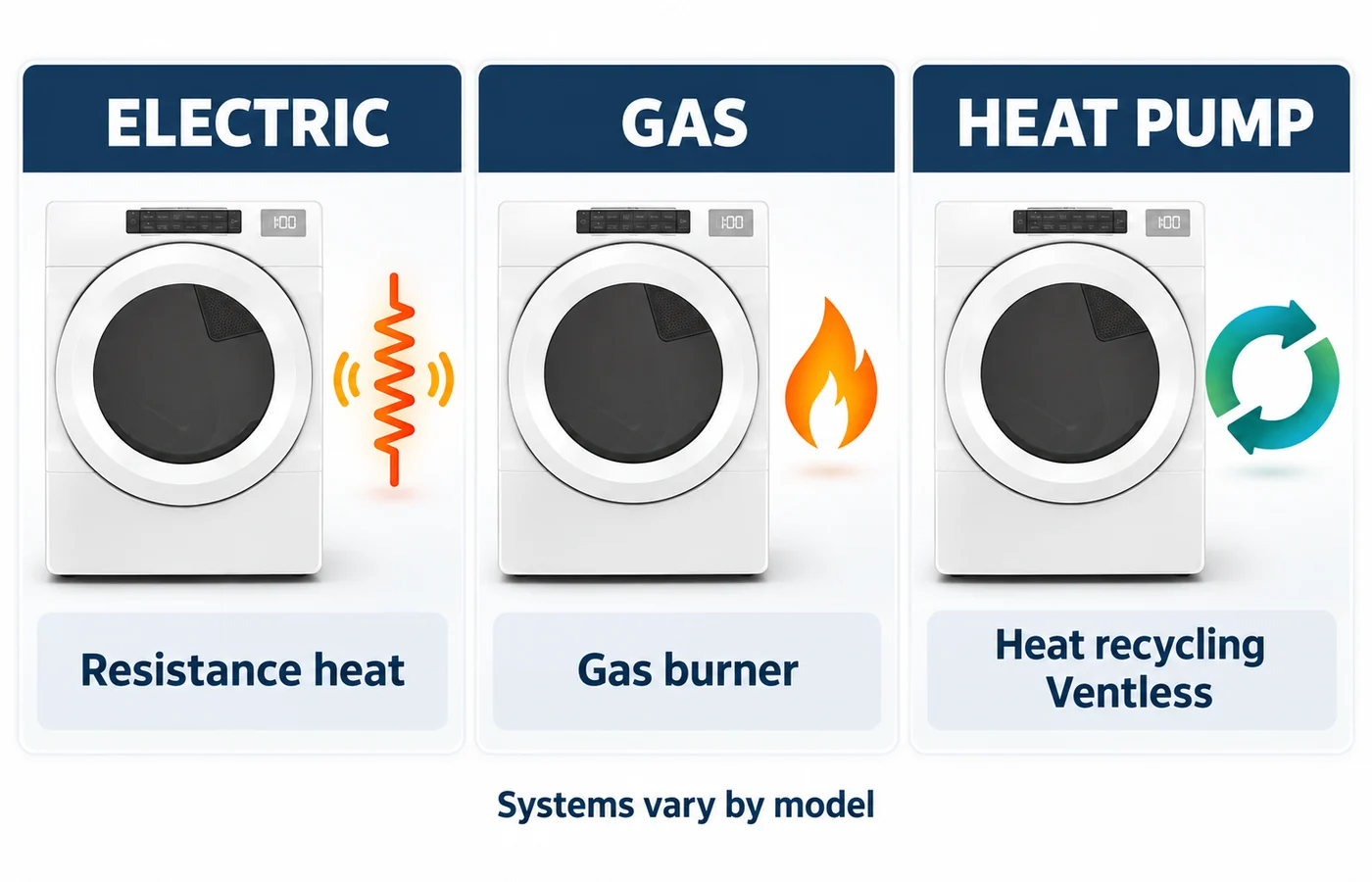
A conventional full-size electric resistance dryer in the United States commonly uses a dedicated nominal 208/240-volt supply for heating. Depending on the installation and model, the drum motor may still run when the heater is not receiving its required supply. That is why a dryer that spins without heating is not automatically a failed heating element.
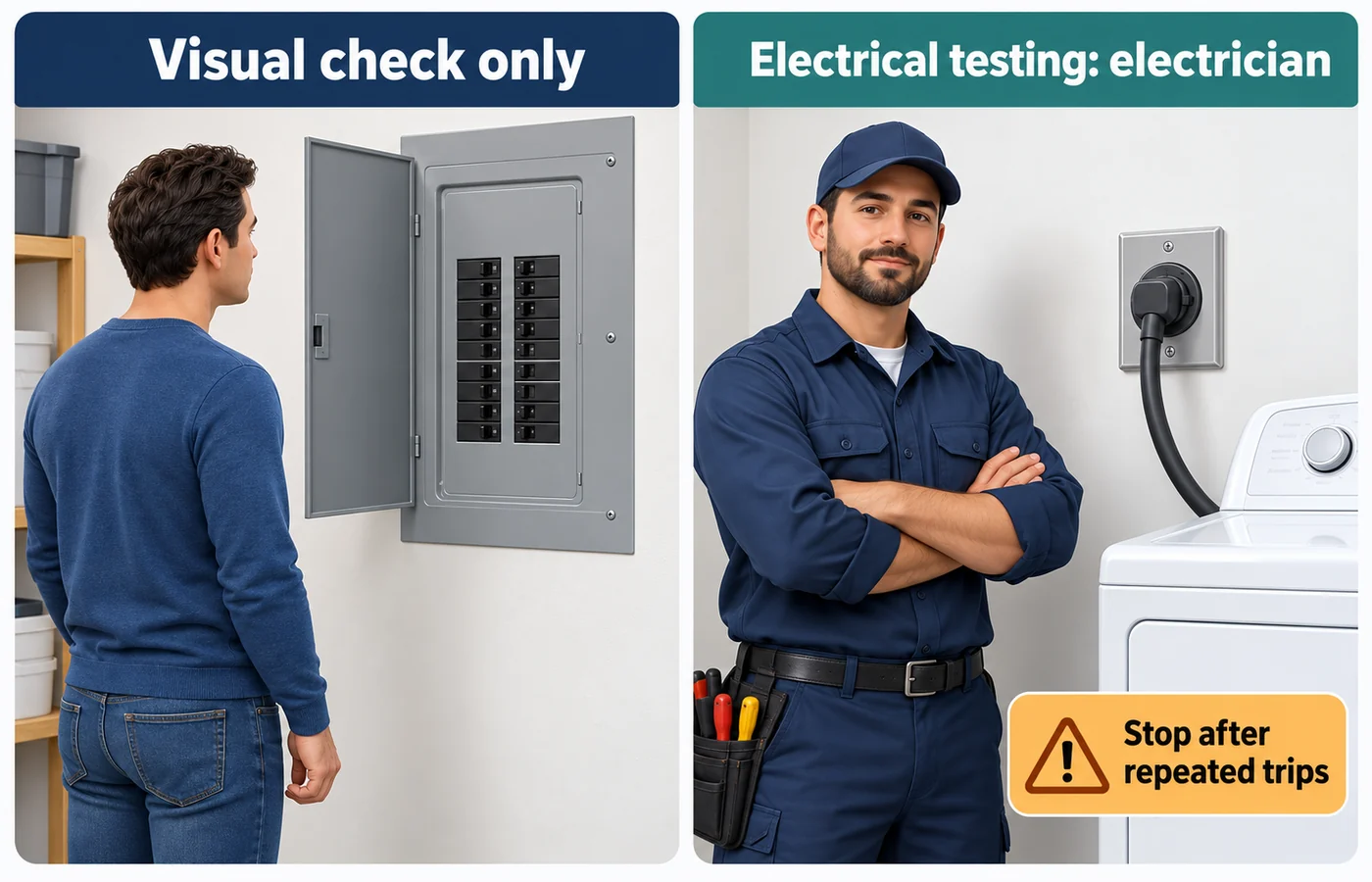
A partially tripped breaker can stop heat while the drum still spins
GE Appliances, Whirlpool and Frigidaire describe this situation in their official troubleshooting guidance. From the front of the electrical panel, and only if there are no signs of damage or repeated tripping, follow your dryer manual's instructions for checking the associated double-pole breaker. If an isolated breaker trip is addressed according to the manufacturer's instructions and the fault returns, stop: an electrician must investigate.
Do not open the dryer terminal cover, inspect exposed wiring, probe the outlet with a multimeter, or assume every dryer uses the same breaker rating. Some compact and heat-pump models have different electrical requirements. A qualified electrician should verify the supply, outlet and cord condition when electrical faults are suspected.
What if the supply and settings seem normal?
The heating element, heater relay, thermostat, thermal cutoff, internal connections or electronic controls may require diagnosis. Those components can cause similar symptoms and cannot reliably be identified by touch, sound or guesswork. Arrange appliance service rather than ordering a heating element on the assumption that it must be defective.
4. Gas dryer not heating: What can be checked safely?
A gas dryer generally uses electrical power for its controls and drum motor but uses a gas burner for heat. It may tumble normally even if the burner receives no gas. Start by confirming the cycle setting and whether there is an interruption to the home's gas service.
If the appliance was recently installed, moved or serviced, consult the installation instructions. If a gas shutoff valve is clearly identified, readily accessible and there is no suspected leak, its position may provide a clue—but do not force a valve, move the dryer to reach gas piping, undo fittings, or attempt to relight or repair the burner system. If you are uncertain, contact the gas utility or a qualified service professional.
For homes using propane, an empty LP tank or disrupted supply can prevent heating. Gas ignition components such as the igniter, flame sensor, burner assembly or valve coils may also fail; diagnosing these components is professional work. Do not attempt a flame test, defeat an interlock or run the dryer while gas-ventilation issues are unresolved.
5. Which dryer parts can cause a no-heat problem?
These are possible faults after cycle, supply and external airflow checks. The names may sound similar, but the parts serve different functions and vary by model. This table is for understanding a technician's diagnosis, not for dismantling an appliance.
| Component | What it does | Where it applies |
|---|---|---|
| Heating element | Produces heat using electrical resistance; a failed element can leave the dryer cold. | Conventional electric resistance dryers |
| Thermal fuse | One-time thermal safety device. Depending on the model, an open fuse may stop the motor or interrupt the heat path. | Model-dependent electric and gas designs |
| Thermal cutoff / high-temperature limit | Protects against excessive temperatures; design and reset/replacement behavior vary. | Model-dependent heating circuits |
| Operating thermostat / thermistor | Helps the dryer sense or regulate temperature; a malfunction can affect heat control. | Varies by dryer model |
| Heater relay / control board | Controls when heating is energized; failure may stop heat even when the drum runs. | Models that use those controls |
| Igniter, flame sensor or gas valve coils | Support ignition and gas-burner operation. | Gas dryers only |
Important: A thermal fuse is not the same thing as a thermal cutoff, and neither has one universal failure symptom. Do not bypass, bridge, reset by improvised means, or defeat any thermal safety device. If a safety device opens, the cause of overheating or inadequate airflow also needs to be investigated.
6. What if you have a heat-pump or ventless dryer?
Heat-pump dryers use a different heating process from conventional electric resistance dryers. Many operate at lower temperatures and may take longer to feel warm. A drum that feels relatively cool at the beginning of a cycle is not, by itself, proof of a broken machine.
Instead, check the correct program, filter maintenance, condensate collection tank or drain, and any model-specific heat-exchanger maintenance instructions. Most heat-pump dryers are ventless, so the advice to inspect an outdoor exhaust flap usually does not apply. If the unit still fails to dry after approved maintenance or displays a heat-pump-system fault, arrange authorized appliance service. Refrigerant and compressor work is not a homeowner repair.
7. Why does my dryer run but not heat?
The drum motor and the heating system are not the same thing. If the drum spins yet a properly selected heated cycle produces no warmth, first consider the electrical supply on a conventional electric dryer or the gas supply on a gas dryer. If those checks do not explain the symptom, a qualified technician may need to investigate heating or temperature-control components.
This symptom is narrower than the full range of dryer-not-heating complaints: some machines are warming up but drying slowly, while others stop early or display ventilation warnings. Describing exactly what the drum and controls do will help a repair professional avoid unnecessary parts replacement.
8. When should you call an electrician, appliance technician or gas utility?
Qualified electrician
Call for repeated breaker trips, suspected incomplete 208/240V supply, a damaged cord or receptacle, or other fixed-wiring concerns. Never test live outlet voltage yourself as a general DIY step.
Appliance service technician
Call when safe external checks fail, a heater or thermal safety part is suspected, the dryer has persistent fault codes, or access to internal panels would be required.
Gas utility or qualified gas professional
Contact for interrupted gas service or uncertain gas connections. If there is a suspected leak, evacuate and use the utility's emergency line or 911 from a safe location.
Is it worth repairing a dryer that does not heat?
Before deciding to replace the dryer, consider its age, overall condition, warranty status, the technician's written diagnosis, the total repair estimate and the cost of an appropriately sized replacement. A settings problem or vent-cleaning issue is very different from a major electrical or heat-pump-system repair. Avoid spending money on guessed replacement parts before the actual failure is identified.
9. How to reduce future dryer heating and fire-safety problems
- Clean the lint filter before or after every load, and keep it fitted during operation.
- For vented dryers, keep the exhaust path and exterior flap clear; arrange periodic vent cleaning and sooner service if drying performance declines.
- Keep boxes, laundry and cleaning products away from the dryer and any ventilation openings.
- Follow fabric-care labels, correct load sizes and your dryer manufacturer's maintenance directions.
- Do not leave the dryer operating when you leave home or go to bed.
- Have installation, gas connections, internal servicing and electrical repairs performed by qualified professionals.
The U.S. Fire Administration's clothes dryer fire-safety guide and the NFPA clothes dryer safety guidance provide additional prevention advice.
Frequently asked questions
Why is my dryer not heating up even though it runs?
The drum may work while the heater does not. On a conventional electric dryer, a partial loss of 208/240V power is one possibility; on a gas dryer, the gas supply or burner system could be involved. Check the selected cycle first, then follow the safe checks for your dryer type.
Can a clogged dryer vent cause a dryer to stop heating?
Restricted airflow can cause poor drying and overheating; some designs may limit or interrupt heat for protection. However, a clogged vent is not proof that the heating element has failed. Stop using a dryer with a serious exhaust restriction and arrange appropriate cleaning or service.
Does a blown thermal fuse always make a dryer run without heat?
No. A thermal fuse can interrupt different circuits depending on the model. Some dryers will not start when a particular fuse opens, while others may lose heat. Correct identification requires the model's technical information and professional diagnosis.
How can I tell whether the heating element is bad?
You generally cannot tell from a cold drum alone. Supply, control and safety-device faults may produce a similar symptom. If cycle selection and safe checks are correct, have a qualified technician test the heating system rather than replacing the element on a guess.
Why is my dryer warm but not drying clothes?
Check the lint screen, vent restrictions on vented models, load size, how wet the laundry was after washing, and automatic sensor settings. Heat-pump dryers can also operate at lower temperatures than conventional dryers.
Can I keep using a dryer that has no heat?
Do not continue using it if you suspect overheating, exhaust blockage, a gas problem, smoke, damaged wiring or recurring breaker trips. Even without an obvious hazard, a dryer that repeatedly fails to heat should be assessed rather than run indefinitely while the cause remains unknown.
Should I reset the breaker if my dryer has no heat?
Only follow your model manufacturer's breaker guidance if there are no signs of electrical damage and the problem is an isolated event. Do not keep resetting a breaker that trips again. Have a qualified electrician check the circuit.
Manufacturer and safety references
Different models use different heating systems, error codes and electrical configurations. Refer to the owner's manual for your specific dryer before applying model-specific instructions.
- Whirlpool Product Help — Dryer Is Not Heating
- Maytag Product Help — Dryer Is Not Heating
- GE Appliances — Electric Dryer Runs But Does Not Heat
- GE Appliances — Gas Dryer Runs But Does Not Heat
- Frigidaire — Dryer Running But Not Heating
- LG — Dryer Not Heating, Not Drying or Taking Too Long
- Maytag — Parts of a Clothes Dryer
- ENERGY STAR — Heat Pump Dryers
- U.S. Fire Administration — Clothes Dryer Fire Safety
- National Fire Protection Association — Clothes Dryer Safety
- National Grid — Report a Gas Emergency
- CDC — Carbon Monoxide Poisoning Basics