If your refrigerator is not cooling, start by protecting perishable food and checking the actual temperatures. Then work through the controls, doors, airflow, and other safe checks before considering a mechanical failure. A refrigerator that lights up or makes noise is not necessarily keeping food cold.
First: protect your food
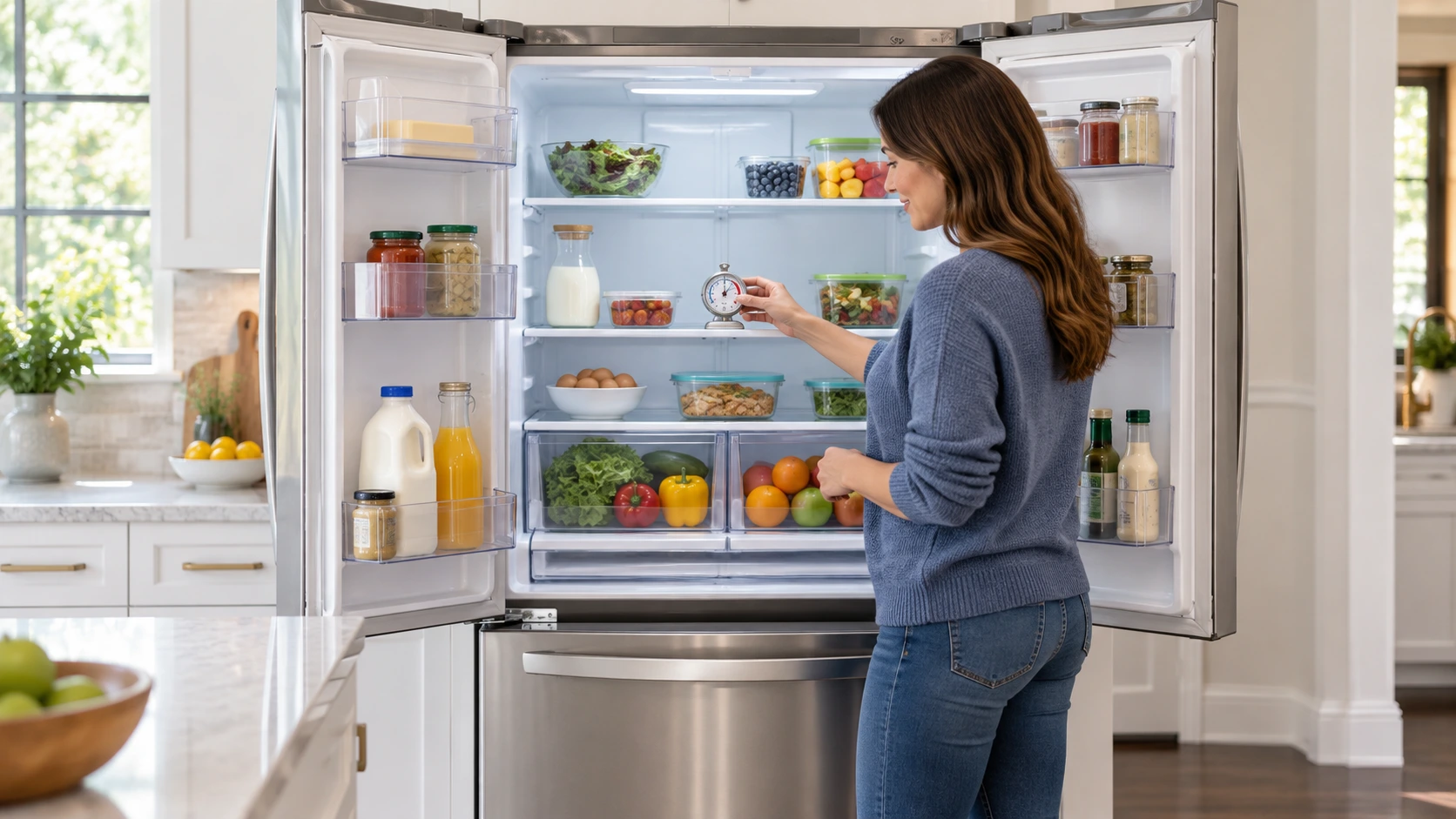
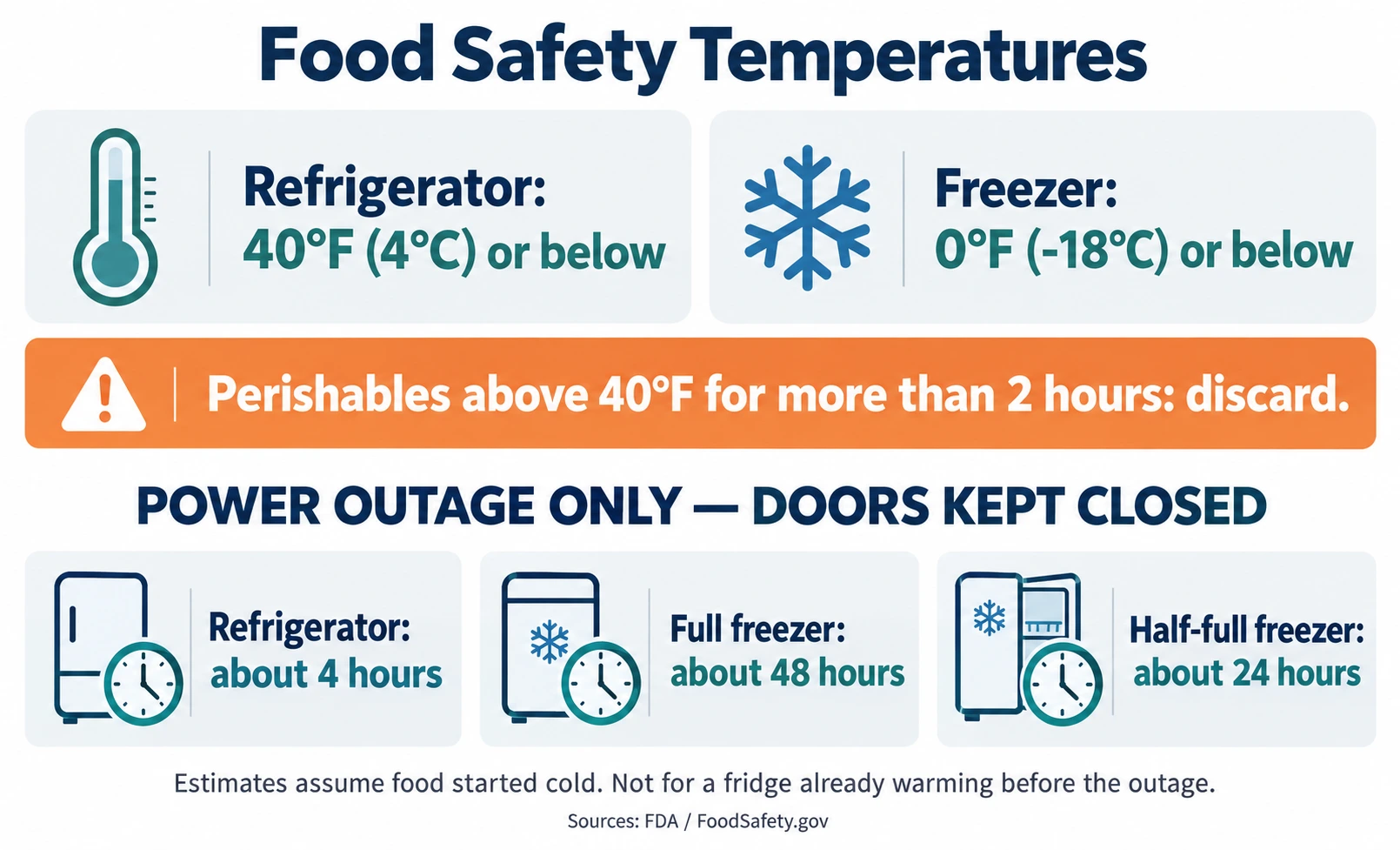
Keep the refrigerator at 40°F (4°C) or below and the freezer at 0°F (-18°C) or below. Use an appliance thermometer: the number set on the control panel is not necessarily the temperature of the food compartment.
If the refrigerator is too warm, move perishable food to a working refrigerator or an ice-filled cooler maintained at 40°F or below. Discard refrigerated perishables that have been above 40°F for more than two hours. If you cannot determine how long food has been warm, err on the side of discarding it. Do not taste food to check whether it is safe. See FDA refrigerator safety guidance and the FoodSafety.gov discard chart.
What kind of refrigerator cooling problem do you have?
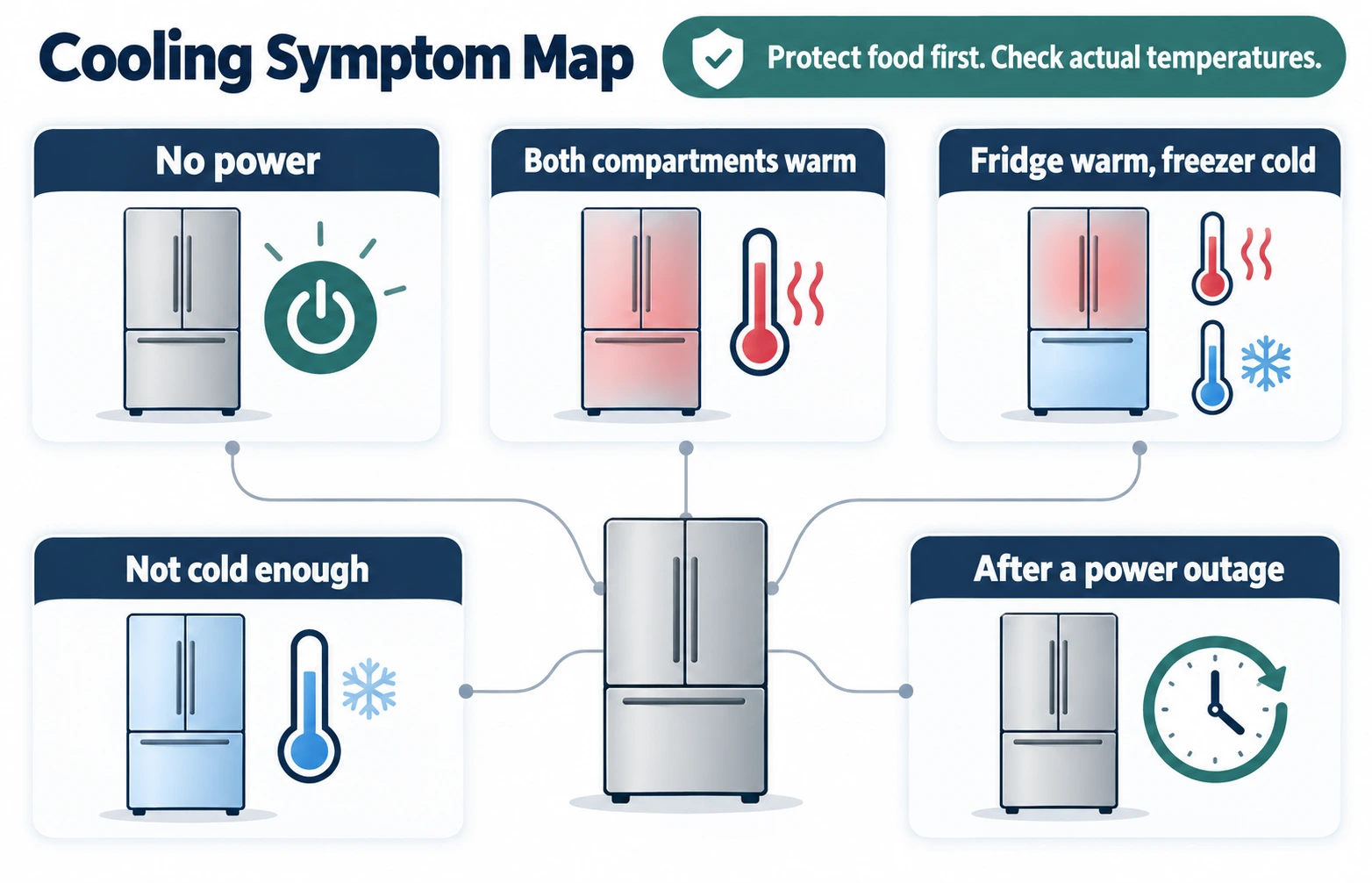
The most useful first step is to separate a power problem from a cooling problem and to determine whether one compartment or both are affected. Different refrigerator designs circulate cold air differently, so the pattern is a clue rather than a diagnosis.
| What you notice | Check first | What it could suggest |
|---|---|---|
| No lights, display, or obvious power | Power supply, plug if accessible, breaker, and model-specific controls | Supply interruption or electrical fault |
| Lights work, but both compartments are warm | Cooling Off/Demo mode, set temperatures, doors, and actual thermometer readings | Controls, restricted cooling, or an internal fault |
| Freezer is cold but refrigerator section is warm | Blocked vents, packed shelves, door closure, visible frost | Airflow, defrost, sensor, or fan-related problem on some models |
| Both sections cool, but not enough | Settings, repeated door openings, hot food load, room temperature, installation clearance | Excess heat load, poor airflow, or reduced cooling capacity |
| Cooling problem began after delivery or power loss | Installation instructions, cooling mode, safe food temperature, and elapsed recovery time | Normal recovery on some models or a persistent fault |
How to fix a refrigerator that is not cooling: seven safe checks
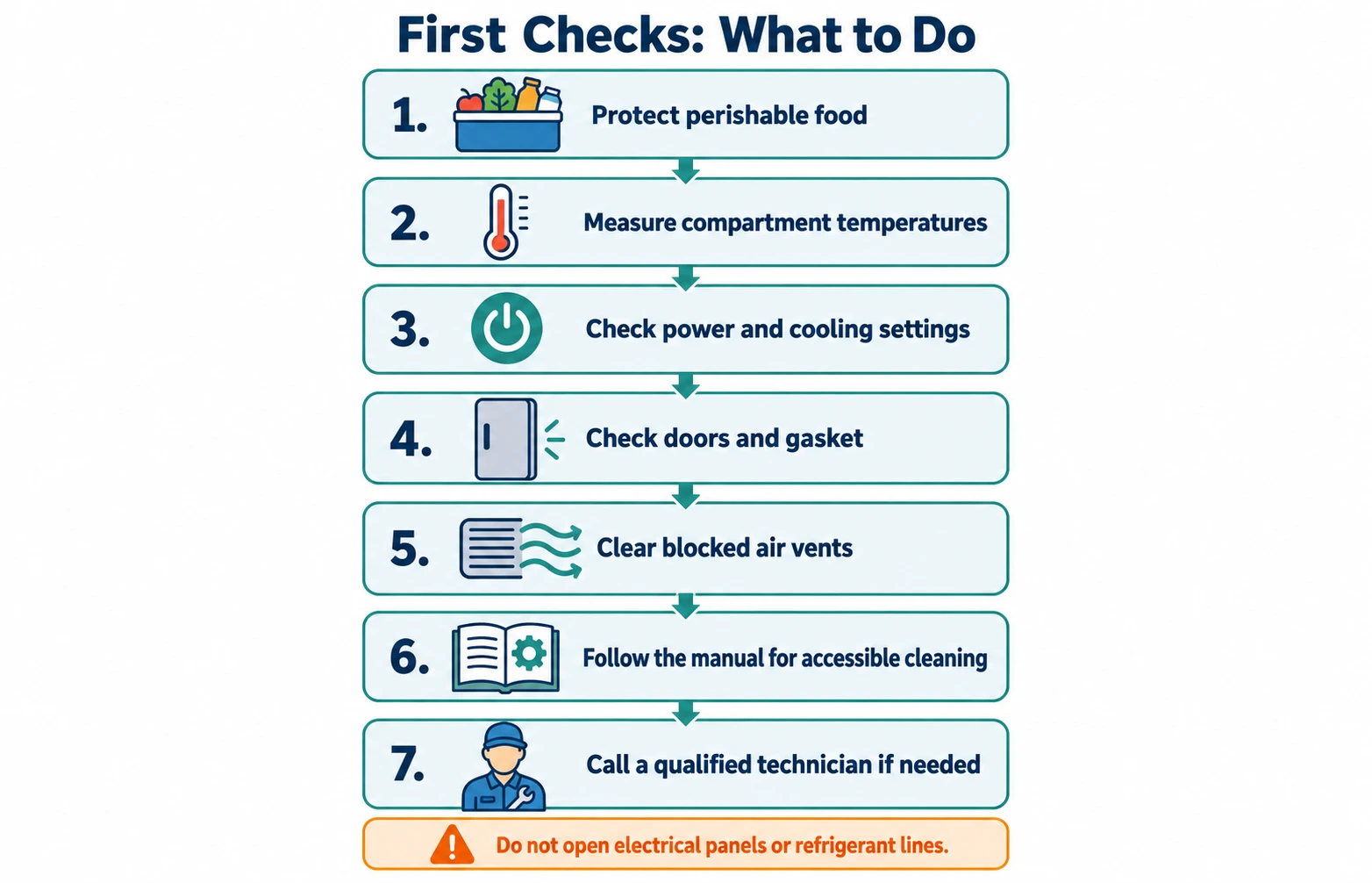
Start with things you can observe or adjust without opening electrical or mechanical compartments. Do not repeatedly switch power on and off as a substitute for diagnosis. If your model's instructions differ from this general checklist, follow its manual.
1. Check the power without exposing wiring
Look for the interior light or display. If both are dark, check whether other appliances have power and whether a household outage is occurring. Verify that the plug is seated only if it is readily accessible, dry, and safe to touch. Review the labeled circuit breaker or GFCI outlet only if you can operate it safely and your manual permits it.
Stop and seek qualified help if a breaker trips again, the receptacle or plug is scorched, a cord is damaged, or you smell burning. Do not remove outlet covers or access panels. A working interior light confirms some electrical power, not that the refrigerator is cooling.
2. Make sure cooling is enabled
Check that the temperature controls have not been switched off accidentally. Some refrigerators offer a Cooling Off, Demo, Showroom, or similar display mode that keeps the lights and controls on while disabling refrigeration. On certain Samsung models, the display may show “OF OF” or “O FF.”
Use the exact instructions for your model to exit this mode. Do not try random button combinations or assume every brand uses the same sequence. Samsung explains how Cooling Off mode works.
3. Measure the temperature and review the settings
Place an appliance thermometer in the fresh-food section and another in the freezer. Keep the doors closed long enough to obtain a useful reading, following your thermometer instructions. Common recommended control settings are about 37°F (3°C) for the refrigerator and 0°F (-18°C) for the freezer, although your model may use a dial, numbered levels, or separate drawer settings.
Adjust the set point according to the owner’s manual. On some numbered dials, a larger number means colder; on a temperature display, a lower degree setting means colder. Do not assume the control display shows the compartment's measured temperature. For food safety, the refrigerator must actually stay at 40°F or below.
4. Check the doors, drawers, and gaskets
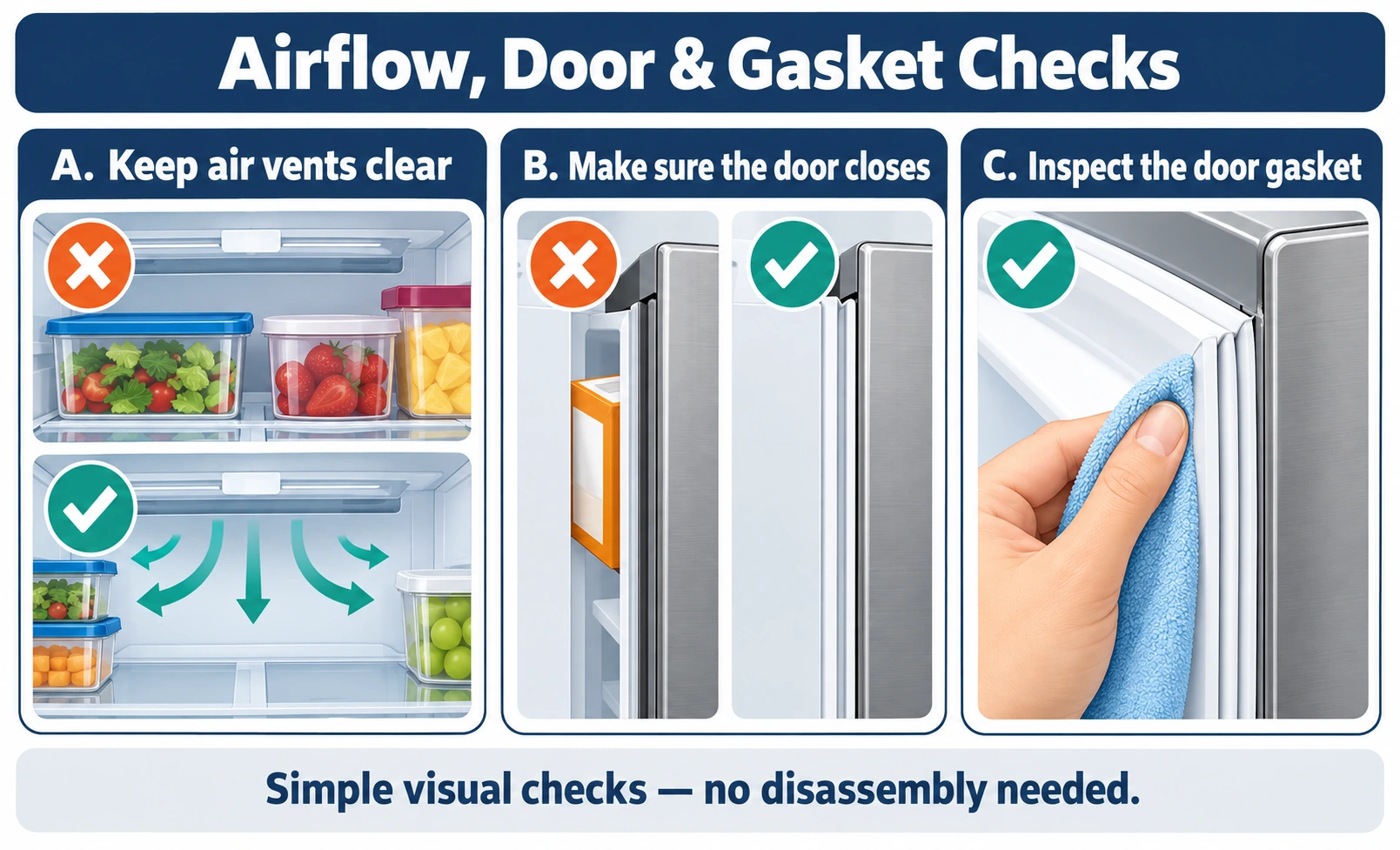
A tall container, shelf, ice buildup, or misaligned drawer may prevent a full seal. Close each door gently and inspect the gasket for debris, tears, gaps, or sections pulled away from their channels. Clean only the accessible gasket with materials allowed by the manufacturer; warm, mild soapy water is commonly recommended.
A simple paper or dollar-bill test can suggest a weak seal: close the door on the paper at several points and feel whether there is some resistance when pulling it out. This is a screening clue, not definitive proof that the gasket is defective. Frigidaire lists door-seal checks among its cooling troubleshooting steps.
5. Clear food that blocks visible air vents
Look for air outlets and returns visible inside the refrigerator or freezer. Move packages away from them and avoid packing food so tightly that air cannot circulate. On many models, cold-air distribution is essential to keeping the fresh-food compartment cool. A freezer that feels cold while the refrigerator is warm can be associated with poor airflow, but it does not automatically prove the evaporator fan has failed.
Do not remove an evaporator cover, insert tools into a vent, or scrape any visible ice. If there is a large frost buildup or a recurring blockage, record it for a service technician. See Whirlpool's airflow guidance.
6. Consider recent loading, the room, and installation clearance
A recently loaded refrigerator, frequent door openings, a hot kitchen, or restricted space around the cabinet can make cooling slower. Check the installation manual for required clearance and approved room-temperature range. Do not use a universal spacing rule: built-in, counter-depth, garage-ready, and other designs differ.
If the refrigerator was just installed or recently lost power, it may need time to stabilize. Some manufacturer support pages mention about 24 hours for newly installed units; recovery is model- and condition-dependent. Keep perishable food at safe temperatures somewhere else until the refrigerator is demonstrably cold enough.
7. Clean condenser areas only when the manual allows it
Dust buildup around accessible condenser areas can impair cooling on certain designs. But not all refrigerators need owner-performed condenser cleaning. Whirlpool notes that some models require no routine cleaning, while others should be serviced only by a technician.
Consult your model's instructions before doing anything. If the manual explicitly authorizes accessible cleaning, disconnect power first and use only its recommended method. Do not remove sealed rear mechanical covers, bend refrigerant tubing, or move a heavy refrigerator where it might strain a water line or injure you. Review Whirlpool's model-dependent condenser advice.
Why is my refrigerator not cooling? Common causes explained
If the external checks do not restore safe temperatures, the next possibilities often involve components that cannot be diagnosed from an article alone. These are patterns to discuss with a professional, not a list of parts to order.
Restricted airflow or a failed air-circulation component
Cold compartments depend on controlled air movement, but fan placement and airflow paths are model-specific. Food blocking a vent is a safe homeowner check. A malfunctioning fan, damper, sensor, or control may also produce uneven temperatures; testing or replacing these parts often requires opening electrical or interior panels and should be left to qualified service.
Heavy frost and a possible defrost problem
Excess ice on freezer walls, visible vents, or around a door can be linked to frequent warm-air entry, a gasket problem, or a malfunction in the automatic defrost system. In some refrigerator designs, ice can restrict airflow so the freezer seems cold while the fresh-food section grows warm. Frost by itself does not identify a failed heater, thermostat, or control board. Do not chip or scrape ice with sharp tools or open interior evaporator covers.
Dirty condenser area or a condenser fan issue
On models that rely on accessible condenser surfaces, dust can reduce heat release. A condenser fan or related electrical fault can also contribute to poor cooling. However, enclosure design varies and consumer cleaning is not always required or appropriate. If a model-approved external cleaning does not help, ask for service rather than reaching into a running machine compartment.
Temperature sensor, thermostat, or control trouble
The refrigerator uses controls and sensors to decide when cooling is needed. A problem in that system may cause intermittent or inadequate cooling, misleading display readings, or unusual cycling. The exact failure cannot be established from one symptom. Photograph any error codes and note the actual temperatures before contacting service.
Compressor, starting components, or sealed-system trouble
When the controls are properly set and both compartments remain too warm, a technician may investigate the compressor, its starting circuit, or the sealed refrigeration system. Clicking or buzzing does not by itself prove the compressor is defective. A brief quiet period may also be part of normal operation; GE notes that fans and compressors may pause during automatic defrost.
Do not attempt sealed-system repairs
Never puncture refrigerant lines, add refrigerant, open a compressor enclosure, bypass protections, or perform live electrical tests. Some household refrigerators use R-600a (isobutane), a flammable refrigerant. If tubing may have been punctured, avoid sparks or ignition sources, leave the area as appropriate, and seek qualified help. See the EPA's household refrigerant information.
Refrigerator not cooling after a power outage or new installation
Two situations deserve separate treatment because the refrigerator may be recovering from an interruption rather than suffering a permanent component failure. In both cases, food safety is determined by temperature and time, not by how long the manufacturer says the appliance may take to stabilize.
After a power outage
Keep doors closed as much as possible. If the refrigerator was properly cold before the outage and remains unopened, the FDA estimates about four hours of cold retention. A full freezer may hold temperature for around 48 hours; a half-full freezer, around 24 hours. These are approximations, not guarantees for a refrigerator already failing to cool.
Once power returns, measure temperatures. Review the FoodSafety.gov food-by-food discard chart and do not rely on smell or taste.
After delivery or installation
Confirm the setup instructions, room conditions, power, cooling controls, and required cabinet clearance. Some units need about a day or more to reach stable temperatures after installation or an extended shutdown; use the exact guidance for your model.
A still-warm refrigerator is not a safe place for perishable groceries while it stabilizes. Arrange alternate cold storage. If the unit remains warm beyond the manufacturer's expected recovery period, contact the installer or manufacturer.
When to stop troubleshooting and call for service
Call the manufacturer, an authorized appliance service provider, or a qualified refrigerator technician if any of the following apply:
- Both compartments remain above safe temperatures after basic controls, doors, and airflow have been checked.
- Ice buildup repeatedly returns, the refrigerator compartment stays warm despite a cold freezer, or an error code persists.
- You hear persistent unusual noises together with inadequate cooling; the sound alone is not a component diagnosis.
- The display is on but cooling does not resume after the model's expected recovery period.
- You notice smoke, hot or damaged wiring, a burning odor, repeated electrical trips, or possible punctured refrigerant tubing. Stop using the appliance and seek appropriate emergency or professional assistance.
Before calling, note the model and serial number (from an accessible identification label), the displayed set temperatures, measured refrigerator/freezer temperatures, when the problem started, whether the doors close correctly, any error codes, and whether there was a recent outage. This information is more useful than guessing which part has failed.
Frequently asked questions
Why is my refrigerator not cooling but the light works?
The light shows that at least part of the appliance has power. It does not confirm that cooling is enabled or functioning. Check the model's Cooling Off/Demo setting, the actual compartment temperature, door closure, and visible vents. If both compartments remain warm, seek professional diagnosis.
Why is my fridge not getting cold even though it sounds like it is running?
Motor or fan sounds do not prove that refrigeration is working. Incorrect settings, warm air entering through the door, blocked airflow, or an internal cooling fault may be involved. Measure temperatures and perform the safe external checks rather than identifying a bad compressor from sound alone.
Why is my freezer cold but my refrigerator warm?
Some designs depend on air movement between or within compartments. Blocked vents, excessive frost, door-seal problems, or internal fan, damper, or control faults may affect the refrigerator section. Clear accessible vents and inspect doors, but do not assume a specific fan has failed. A technician may be needed if the pattern persists.
Can I fix a refrigerator that does not cool without replacing parts?
Sometimes. Restoring an accidentally disabled cooling mode, changing an incorrect setting, closing a blocked door, or clearing a visible air vent can resolve certain problems. Other faults require professional diagnosis and repair. Do not replace parts based only on a generic symptom list.
How long should I wait after adjusting refrigerator settings?
Allow enough time for the measured compartment temperature to respond according to your model's manual. After a new installation, some manufacturers reference approximately 24 hours for stabilization. This is not permission to leave perishable food in a refrigerator that is warmer than 40°F.
Will unplugging my refrigerator fix a cooling problem?
Not necessarily. Unplugging does not repair a blocked vent, defective gasket, failed fan, or sealed-system problem. It can also clear useful error information on some models. Follow model-specific instructions rather than repeatedly power-cycling the appliance.
Should I clean the refrigerator coils?
Only if your manufacturer's instructions call for owner-performed cleaning and the area is safely accessible with power disconnected. Some models need no routine condenser cleaning, and others require professional service. Never open a sealed mechanical compartment or touch refrigerant tubing.
How do I know whether food in a warm refrigerator is safe?
Use an appliance or food thermometer and the time the food has been above safe temperature. The usual food-safety target is 40°F or below. Discard refrigerated perishables held above 40°F for more than two hours, and use the official food-by-food guidance for outages. If the duration is unknown, do not rely on smell or taste.
Reliable sources and manufacturer guidance
This homeowner guide draws on public food-safety advice and manufacturer support. Always use the owner’s manual for your exact model where a setting or maintenance procedure differs.
- U.S. FDA — Refrigerator Thermometers and Food Safety
- FoodSafety.gov — Food Safety During a Power Outage
- Frigidaire — Refrigerators Not Cooling
- GE Appliances — Refrigerator Not Cooling Enough
- Whirlpool — How and When to Safely Clean Condenser Coils
- Samsung — Cooling Off (Demo) Mode
- Samsung — When Not to Reset Your Refrigerator
- U.S. EPA — Refrigerants in Household Refrigerators and Freezers