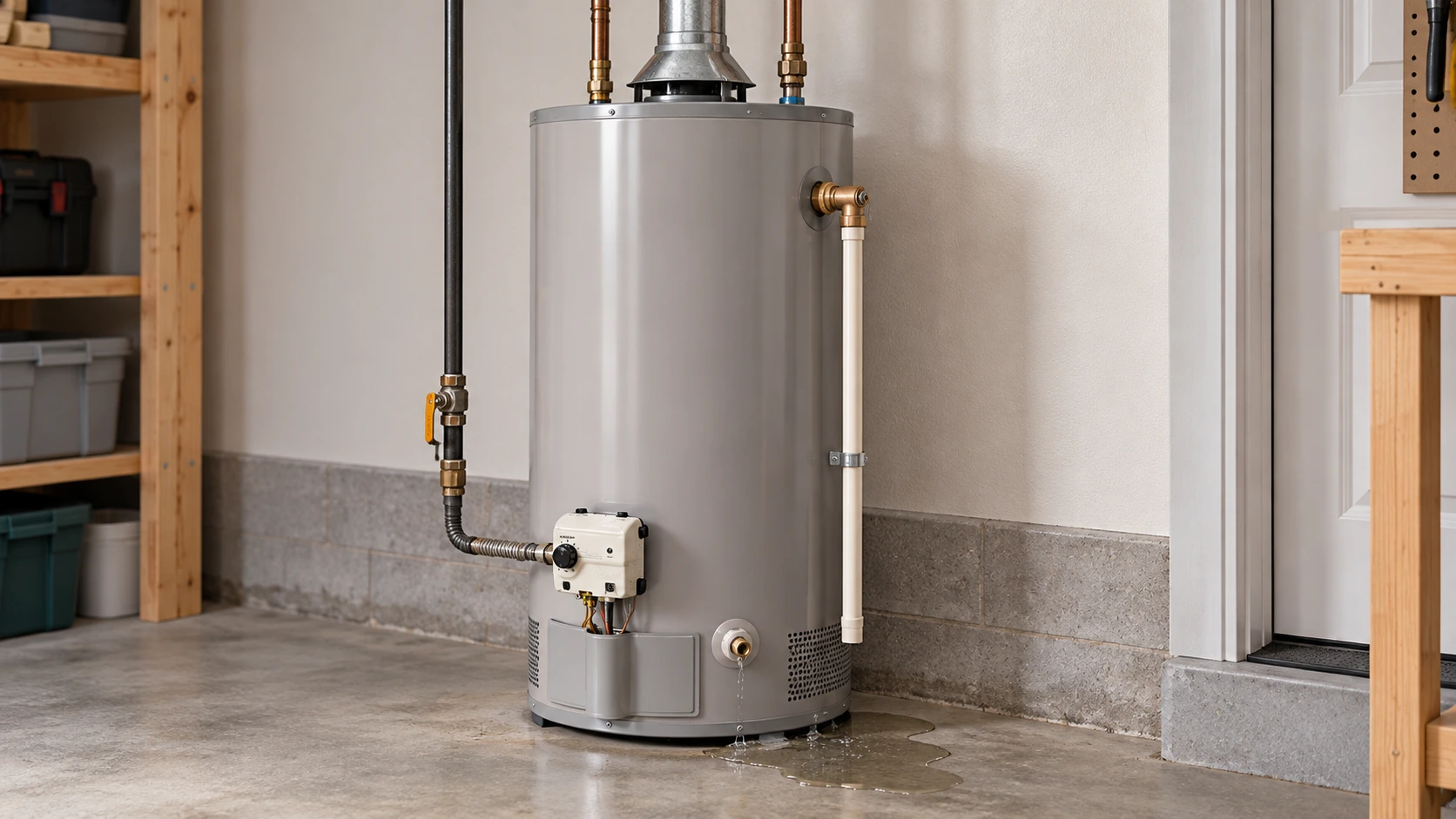
If your water heater is not heating, the problem might be a loss of power, a gas ignition issue, a control setting, or a failed component. But before assuming the heater needs repair, find out whether the problem affects one faucet or the entire home—and whether the water is completely cold or simply not hot enough.
Safety first: Know when to stop
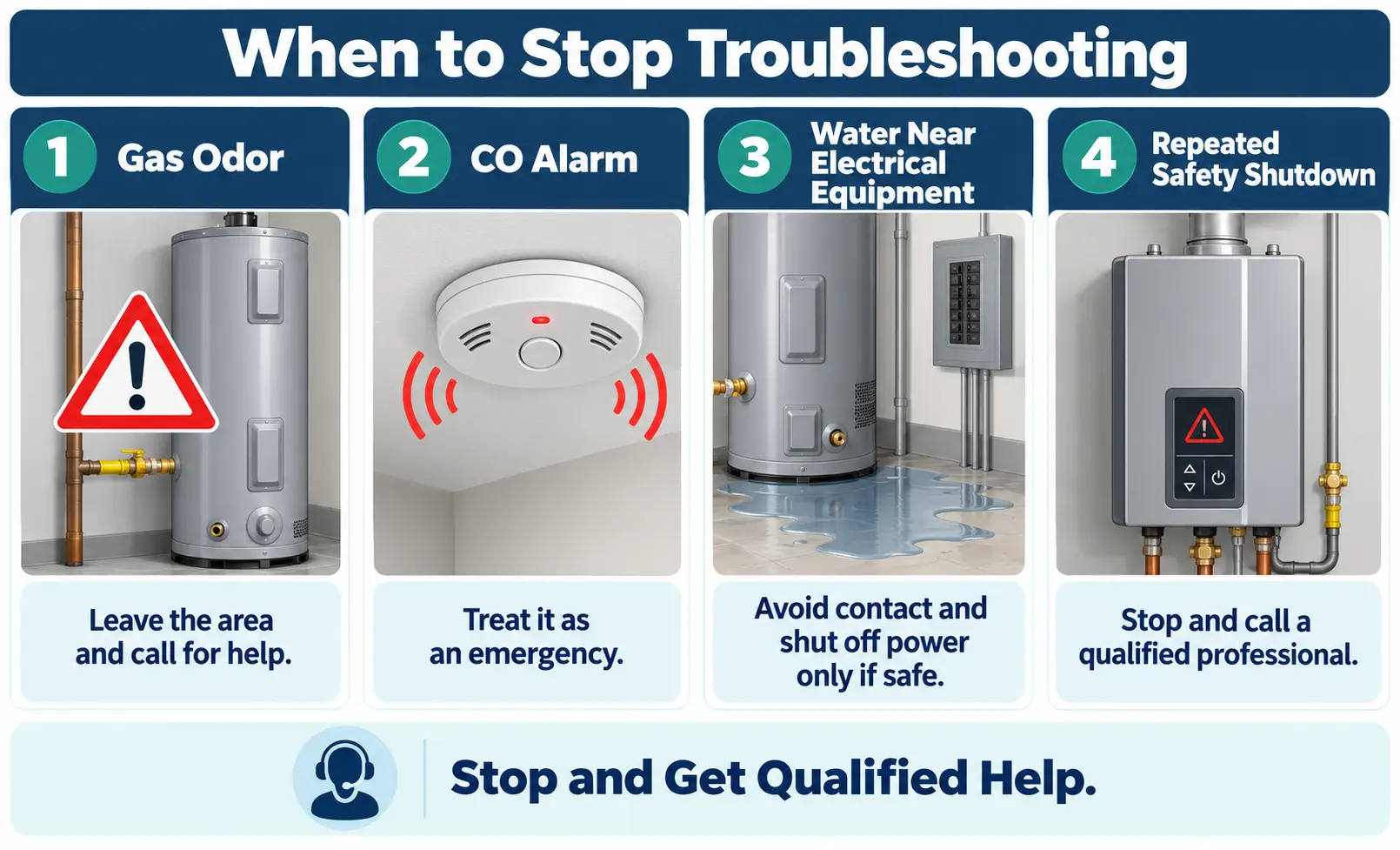
If you smell gas, leave the building immediately. Do not operate switches, phones, or appliances in the affected area; call 911 or your gas utility from a safe location. If a carbon monoxide alarm sounds, get outside and call emergency services.
Also stop if water is contacting electrical equipment, a breaker keeps tripping, you notice scorching or a burning smell, or water is discharging heavily from a relief pipe. Do not open electrical covers, work on gas piping, or bypass a safety control.
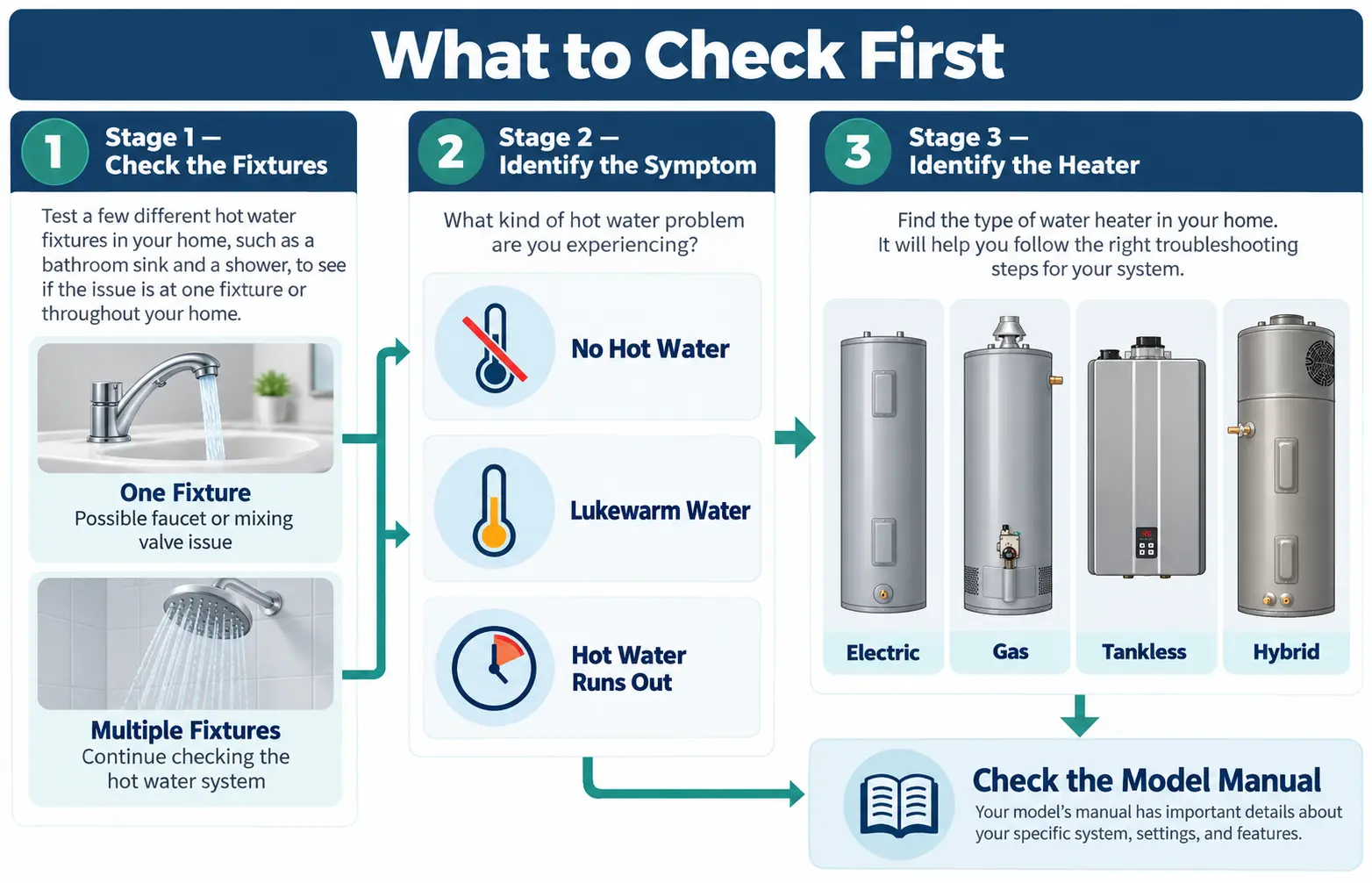
What to check first
- Try more than one hot-water faucet. A single affected sink or shower may have a fixture or mixing-valve problem rather than a failed water heater.
- Identify the symptom. Is the water cold everywhere, only lukewarm, or hot at first and then quickly cold?
- Identify the heater type. Electric tank, gas tank, tankless, and heat-pump models have different troubleshooting paths.
- Look for accessible status information. Note a display message, error code, pilot/status indicator, operating mode, or a visibly tripped breaker—without removing a cover.
- Use the exact model manual. If a safety cutoff, electrical component, or gas control appears involved, arrange qualified service instead of experimenting with resets.
Is the Water Heater the Problem? Start With Two Simple Checks
Begin at a kitchen or bathroom hot-water tap. Let it run long enough for previously cooled water in the pipe to clear, taking care to avoid unexpectedly hot water. Then compare it with another hot-water fixture in a different part of the home.
Only one fixture is affected: The heater may be working. A shower cartridge, thermostatic mixing valve, faucet, or localized plumbing problem could be limiting hot water. Do not replace a water heater based on a single cold shower.
Every fixture is affected: The issue is more likely to involve the water heater, a central mixing valve, or the home's hot-water distribution. Continue with the checks below.
Match the Symptom to the Likely Problem
The same phrase—water heater not working—can describe several different situations. This quick table helps narrow down the next step without assuming a specific failed part.
| What you notice | Possible explanation | Safe next step |
|---|---|---|
| Cold water at every hot tap | No power, no ignition, a safety lockout, or a heating/control fault | Check visible status and the correct model manual |
| Hot water at one tap but not another | Fixture cartridge, mixing valve, or localized plumbing issue | Compare other fixtures; have the affected fixture inspected |
| Water is warm, but not hot | Temperature setting, mixing, high demand, recovery time, or heating fault | Check accessible settings and recent water use |
| Hot water runs out unusually fast | High demand, undersized heater, sediment, or a partially functioning heating system | Allow recovery and note whether the problem repeats |
| Display shows an error code | A model-specific fault or protective shutdown | Record the exact code and consult the manufacturer's instructions |
| Breaker trips or heater repeatedly shuts off | Potential electrical fault or safety-control problem | Stop resetting and arrange qualified service |
Identify Your Water Heater Type
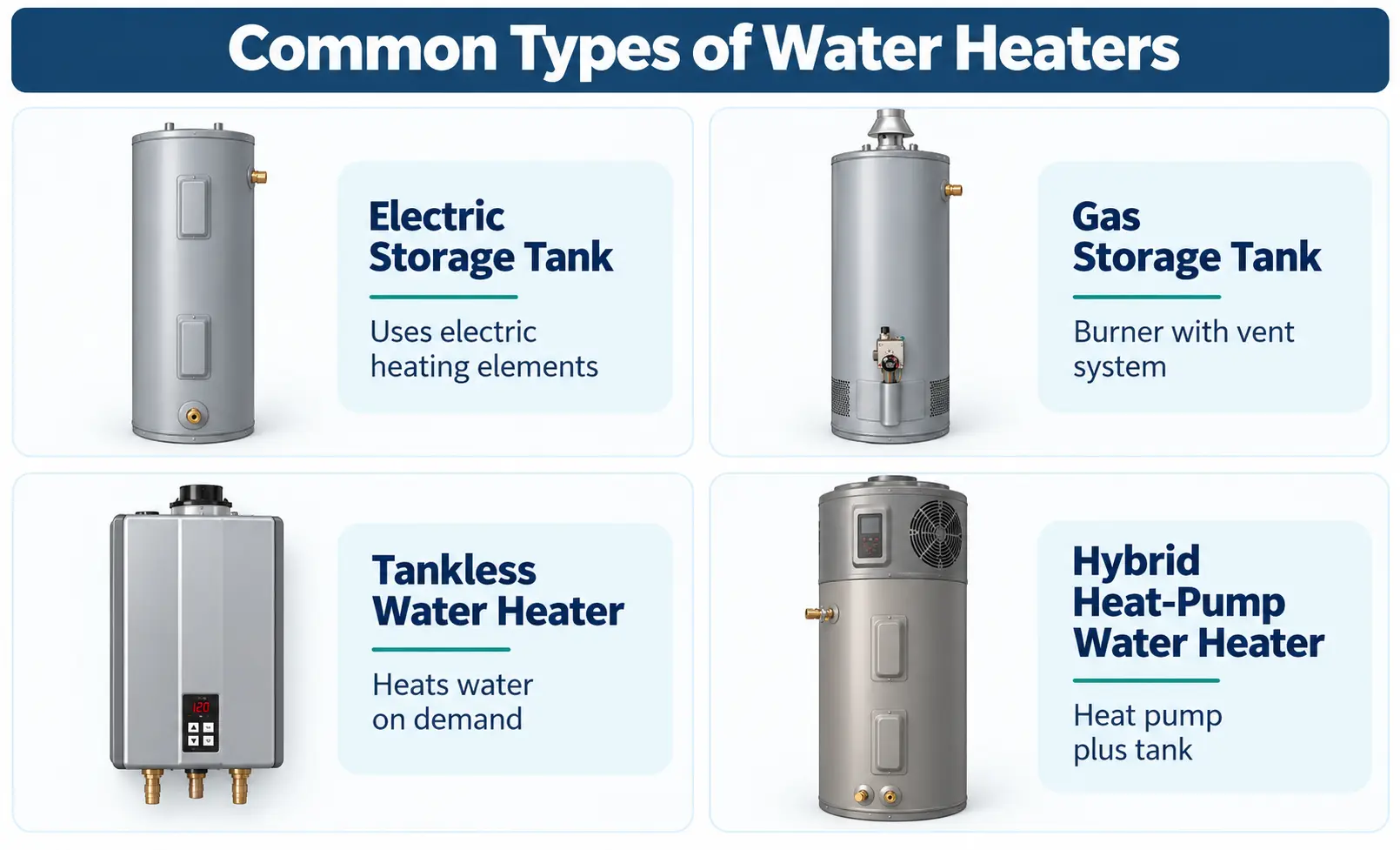
You do not need to remove any covers to identify the general type. The model label or the visible exterior is usually enough. If you are unsure, use the brand and model number to find the manufacturer's documentation.
Electric storage tank
Usually a cylindrical tank with electrical access panels and no combustion vent. Power supply, heating elements, thermostats, and a high-temperature cutoff can be involved.
Gas storage tank
Typically has gas-control equipment near the base and an exhaust-vent arrangement. Pilot or electronic ignition, gas supply, and controls can affect heating.
Tankless water heater
Heats water on demand and often has a display or error codes. Water flow, an electrical supply, ignition, and model-specific protections matter.
Heat-pump / hybrid heater
A storage heater with heat-pump equipment, often above the tank. Operating modes, air filters, recovery time, and electrical faults can change performance.
Electric Water Heater Not Heating
On a conventional electric tank water heater, the heating elements and thermostats work together to heat stored water. Manufacturer troubleshooting guides identify power loss, a faulty thermostat or element, and an open high-temperature safety cutoff as possible causes of no hot water.
Check for an obvious power interruption
If the heater has an accessible user display, see whether it is on and whether it shows an error. At the electrical panel, you can look for a breaker labeled for the water heater without opening the panel or touching wiring. A breaker that trips again, a hot panel, buzzing, scorch marks, or moisture near electrical equipment calls for an electrician or qualified service technician.
A breaker that appears normal does not prove power is reaching every heater component. Testing voltage requires electrical access and proper training; it is not a homeowner-level check in this guide.
Understand heating-element and thermostat faults
A failed heating element or thermostat can prevent a tank from heating or reduce the amount of usable hot water. Some two-element designs may provide a little hot water or unusually slow recovery when one part of the heating system is not functioning. The exact symptom depends on the heater design and which component has failed.
Do not remove insulation or access panels to test a heating element, thermostat, or wiring. A qualified technician can diagnose the part before deciding whether replacement is appropriate.
Do not treat the high-temperature reset as a routine fix
Many electric tanks have an Energy Cut Off (ECO), a safety device that interrupts heating when an unsafe temperature condition occurs. A tripped ECO can result in no hot water, but the cutoff may be responding to an underlying problem.
Because the reset on many models is behind an electrical access cover, do not open the unit simply to press it. Follow the exact manual and have the cause evaluated. Repeatedly restoring a tripped safety control is not a repair.
Gas Water Heater Not Heating
Gas tank heaters require a functioning gas supply and ignition system. Depending on the model, a pilot light, electronic ignition, gas control, temperature sensor, or protective shutdown may explain why the burner is not heating water.
Read the status light or display
Some gas controls use flashing lights to report normal operation or faults. Others show a message or have only printed lighting instructions. The meaning of a flash pattern is model-specific; do not assume a code found for one brand applies to another.
From a normal viewing position, note the displayed code or status-light pattern and check the instructions attached to the heater or in its manual. Do not remove burner covers, disconnect gas fittings, or manipulate concealed components to see whether a flame is present.
Pilot and ignition problems
For a model with a standing pilot, a pilot that is out may prevent the main burner from operating. Electronic-ignition models have different controls and should not be treated as though they have a pilot to relight manually.
Only consider an operator procedure that is explicitly provided for your exact model, and never attempt it if you smell gas, suspect venting trouble, see a damage or lockout warning, or do not understand the steps. Repeated ignition failures warrant service.
Gas controls and venting are professional territory
Low gas pressure, defective controls, combustion-air problems, and venting faults may also interrupt heating. Diagnosing or correcting these conditions can require gas-system and combustion testing. Contact a qualified service professional or your gas supplier instead of adjusting regulators, burners, pilot tubing, or vent pipes.
Do not ignore gas or carbon monoxide warnings
A gas smell requires immediate evacuation and a call from outside. A CO alarm requires everyone to get outside and emergency services to be contacted. Do not return until responders say it is safe. Carbon monoxide itself has no smell.
Tankless Water Heater Not Producing Hot Water
Tankless units heat water when there is sufficient demand. If the hot-side flow through the unit is too low, some models may not start heating or may stop heating during use. Exact activation thresholds differ by manufacturer and model.
First, note whether the problem occurs at every fixture or only at a low-flow faucet or shower. Check the unit's normal user display and record any error code. An accessible temperature or operating-mode setting may also help explain the behavior.
Do not assume that the absence of an error code means all parts are working. Manufacturer guidance identifies internal flow-sensing problems as one possible cause on certain models. Internal sensor, gas, venting, and heat-exchanger work should be referred to qualified service personnel.
If the heater works at one fixture but not another, ask a plumber to assess fixture flow, mixing behavior, and whether the installation matches the heater's requirements rather than immediately replacing the unit.
Hybrid or Heat-Pump Water Heater Not Heating Enough
Hybrid water heaters can operate in different modes. A vacation/away setting can intentionally reduce heating, while some efficiency-focused modes recover more slowly after large hot-water draws. Those conditions can feel like a failure even when the unit is following its settings.
From the normal user interface, check the selected mode, temperature setting, and any fault message. If the heater has an owner-serviceable air filter, consult the manual for safe maintenance. Do not remove sealed heat-pump panels or attempt refrigerant or electrical repairs.
If the selected mode is correct and hot water remains inadequate after the expected recovery period, the heater may need professional diagnosis.
Why the Water Is Warm but Not Hot Enough
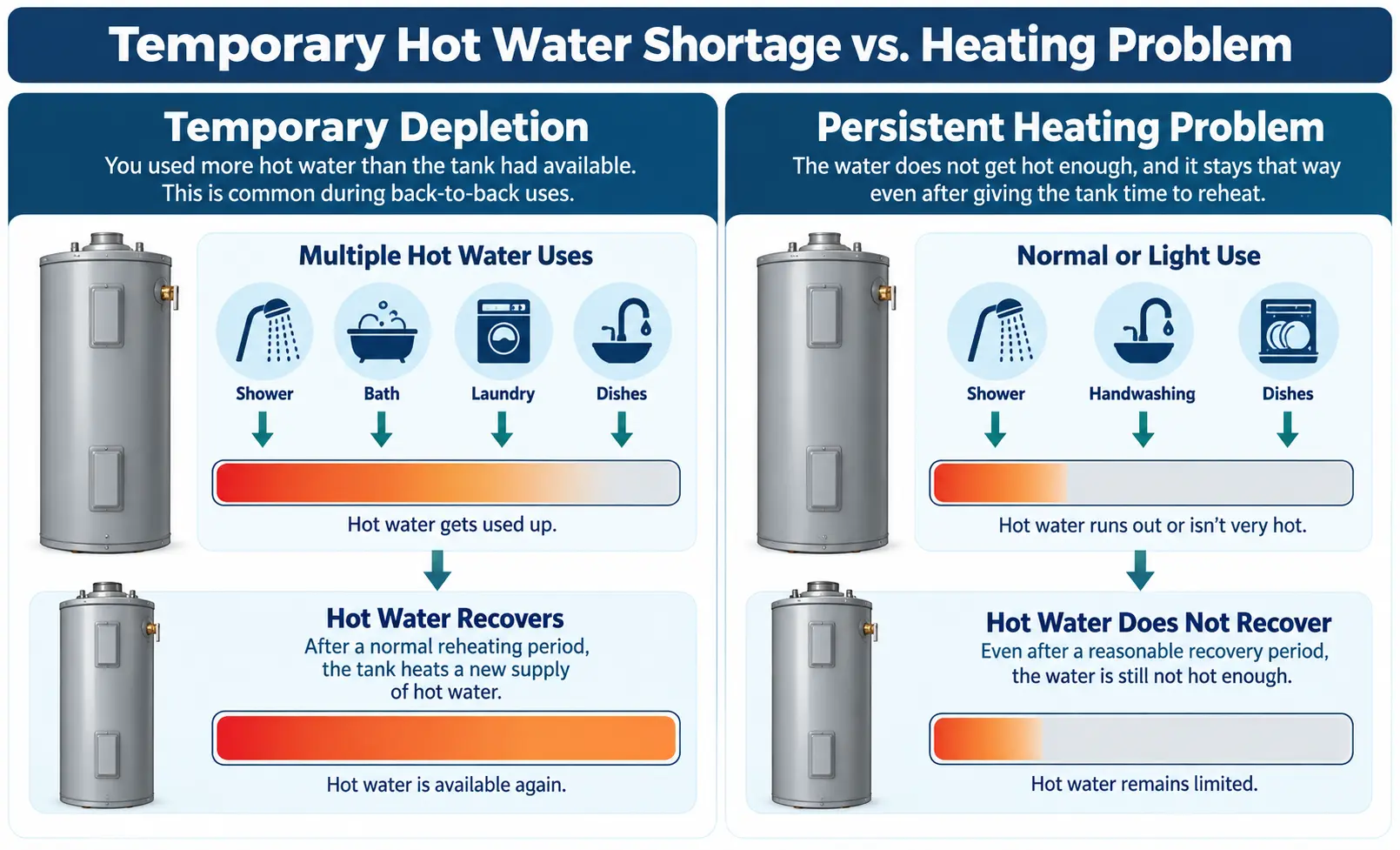
Not every water-heating problem is a complete shutdown. A tank that still produces some warmth can be experiencing a different issue than a heater that never heats at all.
Hot-water use exceeds the heater's capacity
Several showers, laundry cycles, or other heavy hot-water uses close together may temporarily exhaust a storage tank. Give the system its normal recovery time, then try again under lighter demand. If the same problem appears even after recovery, investigate other causes.
Temperature setting or mixing reduces outlet temperature
A low user-accessible temperature setting, an unintended vacation mode, or a faulty mixing valve can leave water lukewarm. Compare more than one fixture before blaming the tank. Never raise the setting aggressively just to overcome a suspected fault: hotter water increases scald risk.
The U.S. Department of Energy commonly recommends about 120°F (49°C) for many residential applications, but systems with specific sanitation, health, or mixing-valve requirements may need different professional guidance.
Reduced recovery or heat transfer
On storage heaters, a malfunctioning element, thermostat, sensor, or other control may slow recovery. Mineral deposits can also affect some systems, though sediment is not proof of the cause of a sudden total loss of hot water. Ask a professional to diagnose persistent problems rather than treating tank flushing as a universal fix.
Should You Reset a Water Heater That Is Not Heating?
Not automatically. “Reset” can mean different things: restoring a normal user setting, restarting a control after an outage, resetting a circuit breaker, or resetting a high-temperature safety cutoff. These actions do not carry the same risks.
| Situation | Recommended approach |
|---|---|
| Vacation/away mode was selected | Use the normal user interface and manual to restore the intended operating mode. |
| A power outage recently ended | Check for a normal display or documented restart behavior; allow the model's expected recovery time. |
| A breaker has tripped | Do not repeatedly reset it. If you see damage, smell burning, or find moisture, leave the area alone and get qualified help. |
| High-temperature ECO or safety lockout activated | Do not bypass or repeatedly reset a safety device. Have the cause diagnosed according to the model manual. |
| Gas ignition has repeatedly failed | Stop repeated attempts and arrange service. Follow emergency instructions immediately if gas is suspected. |
When to Call a Professional
Homeowner checks can identify the symptom and useful information for a service call. Repair should be handled professionally when it involves a component or condition you cannot safely access or verify.
- Call promptly if the breaker repeatedly trips, the heater displays a persistent fault, or the unit has no hot water despite normal accessible settings.
- Use qualified electrical service for internal wiring, heating elements, thermostats, voltage testing, and high-temperature cutoff faults.
- Use qualified gas service for pilot/ignition faults that do not resolve through the exact permitted user instructions, gas-control failures, and any combustion or venting concerns.
- Contact a plumber if only one fixture is affected, a central mixing valve may be involved, or a hidden plumbing leak is suspected.
- Address active leaks first. If you see water around the unit, refer to our water heater leaking guide for location-based observations and escalation.
Before you call, note the brand and model number, heater type, the last time you had normal hot water, whether every fixture is affected, and any displayed fault code. This information can help a technician arrive prepared.
Frequently Asked Questions
Why is my hot water heater not working all of a sudden?
A sudden loss of hot water may follow a power interruption, an ignition failure, or a safety-control shutdown. Check whether all fixtures are affected and record any status message before deciding what equipment needs service.
Why does my electric water heater have power but no hot water?
A lit display or normal-looking breaker does not prove the heating elements and controls are operating correctly. An element, thermostat, sensor, or safety cutoff may need diagnosis by a qualified technician.
How long should I wait after a power outage?
Recovery depends on tank size, heater type, incoming water temperature, and how much hot water is needed. Check the exact model's instructions rather than assuming every unit should heat in the same amount of time. If an error remains or recovery never begins, arrange service.
Why does one shower have no hot water when other faucets work?
The shower valve or cartridge may be limiting hot water, or the problem may be local to that fixture. Compare several taps and ask a plumber to check the affected shower before replacing the water heater.
Can sediment cause a water heater not to heat?
Mineral accumulation can contribute to reduced performance or slow recovery in some water heaters. It does not automatically explain every no-hot-water complaint. Identify whether power, ignition, settings, or other faults are involved first; follow the manufacturer’s maintenance instructions for the specific model.
Should I press the red reset button on my water heater?
Not as a routine first step. On many electric tanks, that button belongs to a high-temperature safety cutoff behind an access panel. A trip can signal an overheating condition that needs professional investigation. Follow the exact model manual and do not open electrical compartments just to reset it.
The bottom line
When a water heater is not heating, first determine whether the problem is at one fixture or throughout the home. Then identify the heater type, check only accessible user-facing information, and distinguish a temporary shortage from a true heating failure. Gas, electricity, scalding water, and pressure-related safety devices make internal repairs a job for qualified professionals.
This guide provides general homeowner information. Equipment designs vary. The instructions and safety warnings for your specific water heater take precedence.