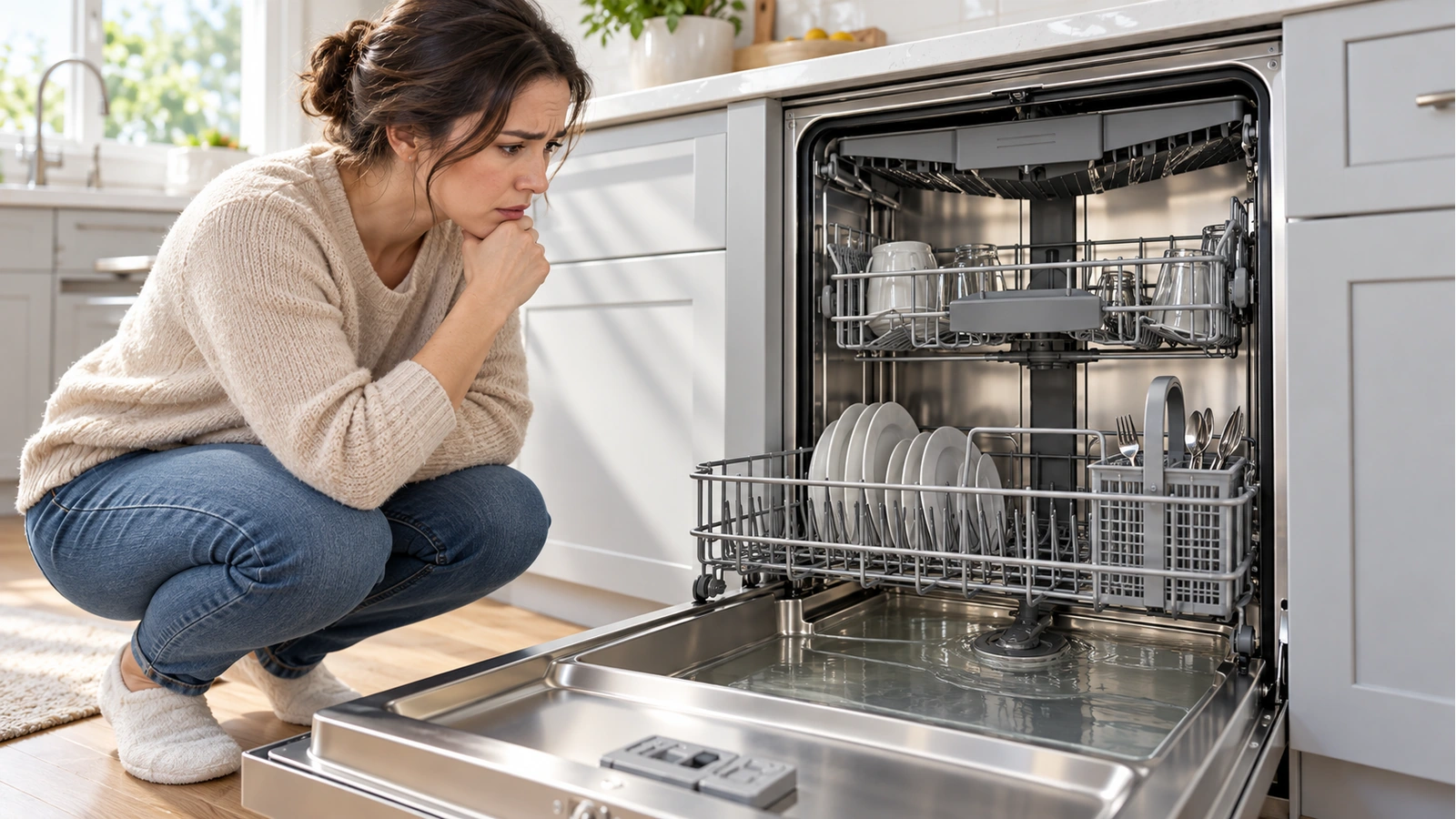
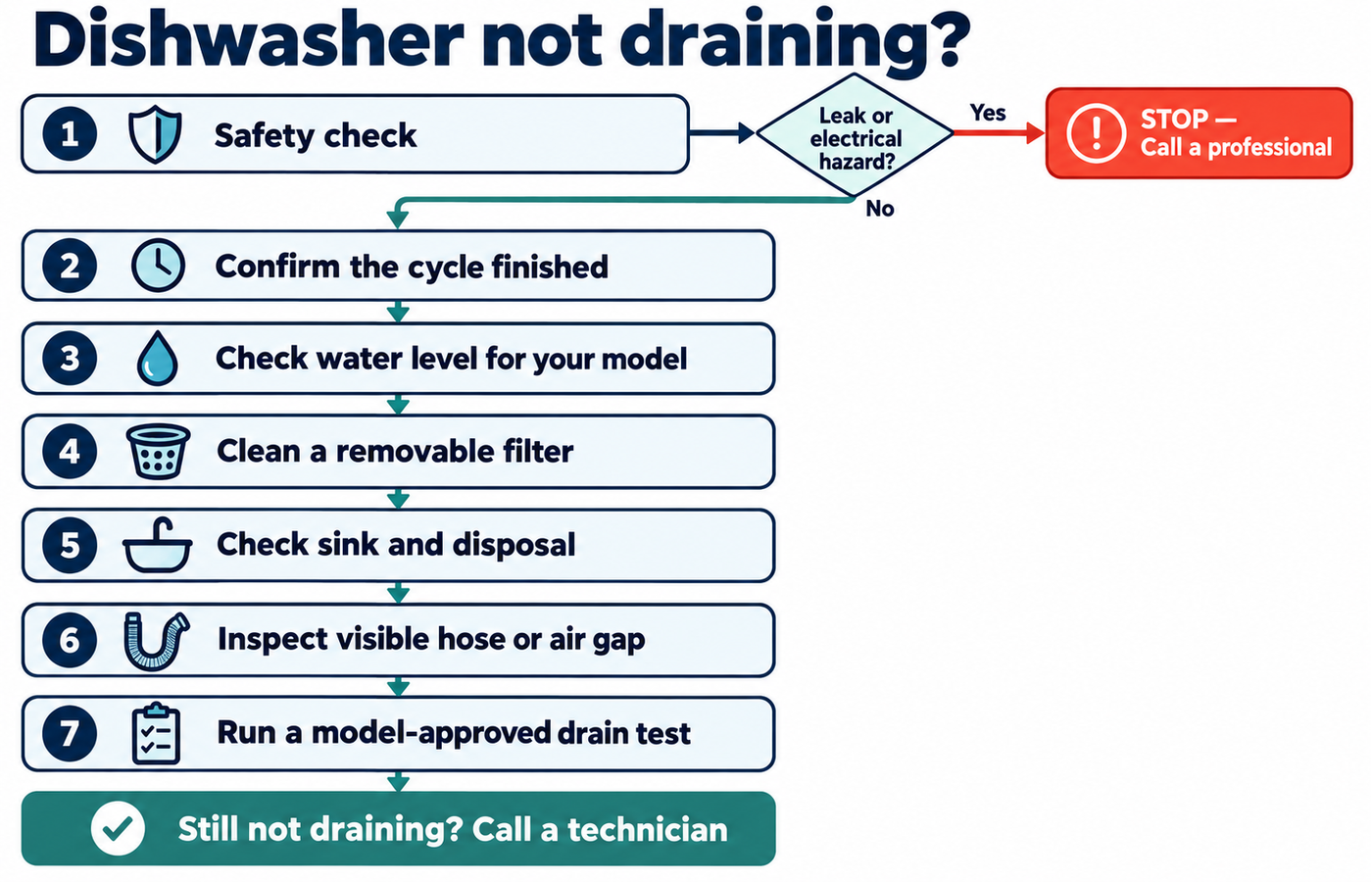
A dishwasher that is not draining may have a clogged filter, a kinked drain hose, a blocked sink or garbage disposal connection, or a problem with its drain pump. The right first step is not to take the machine apart: confirm that the cycle finished and that the water left behind is actually abnormal for your model.
Quick answer: what should you check first?
- Look for a paused cycle or a drain-related error code.
- Check whether your kitchen sink drains normally.
- Use your model's documented Cancel/Drain function if appropriate.
- With power isolated, inspect and clean a removable dishwasher filter.
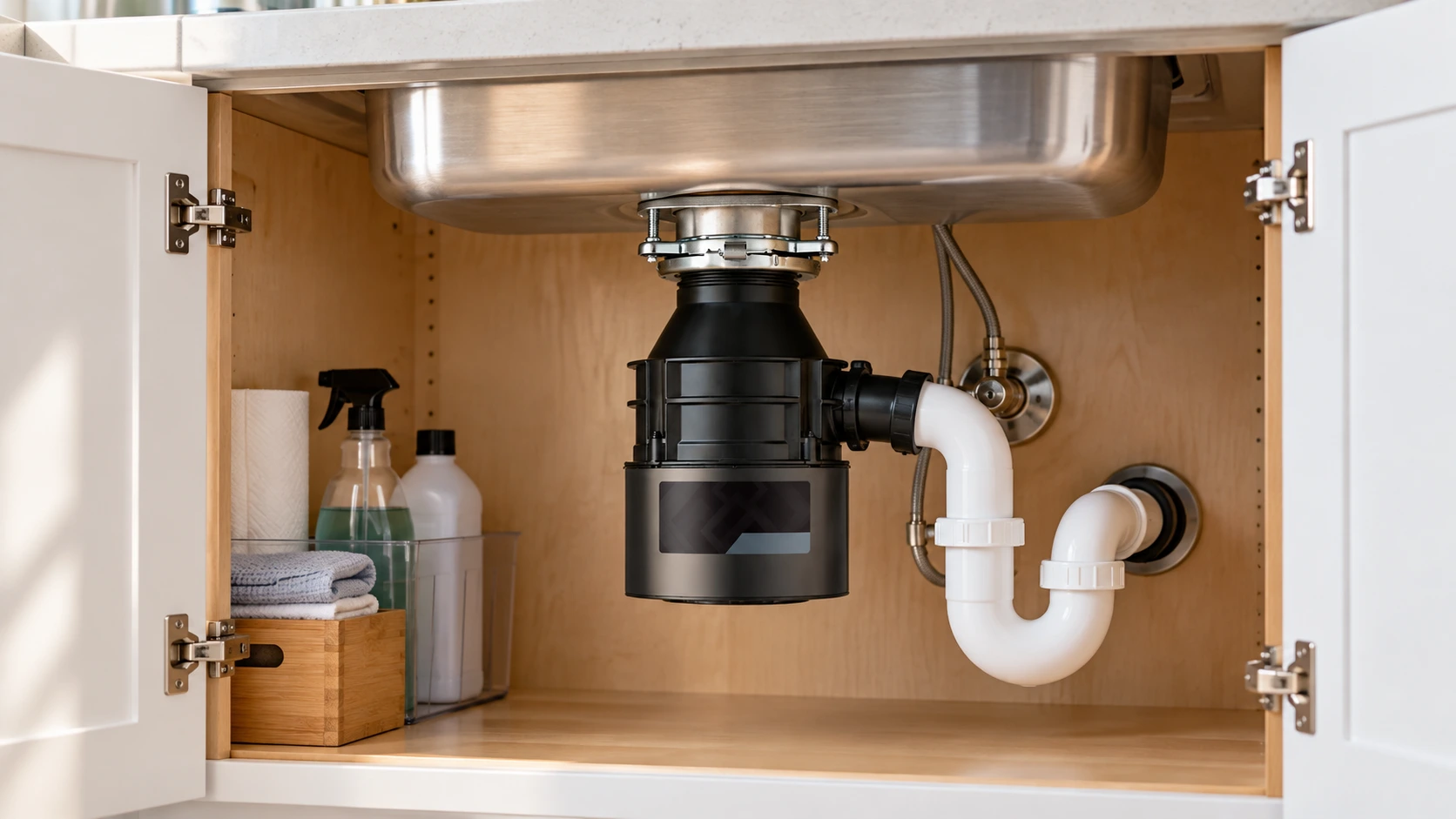
- Look under the sink for a kinked hose, blocked disposal connection, or clogged air gap.
Is Water at the Bottom of a Dishwasher Normal?
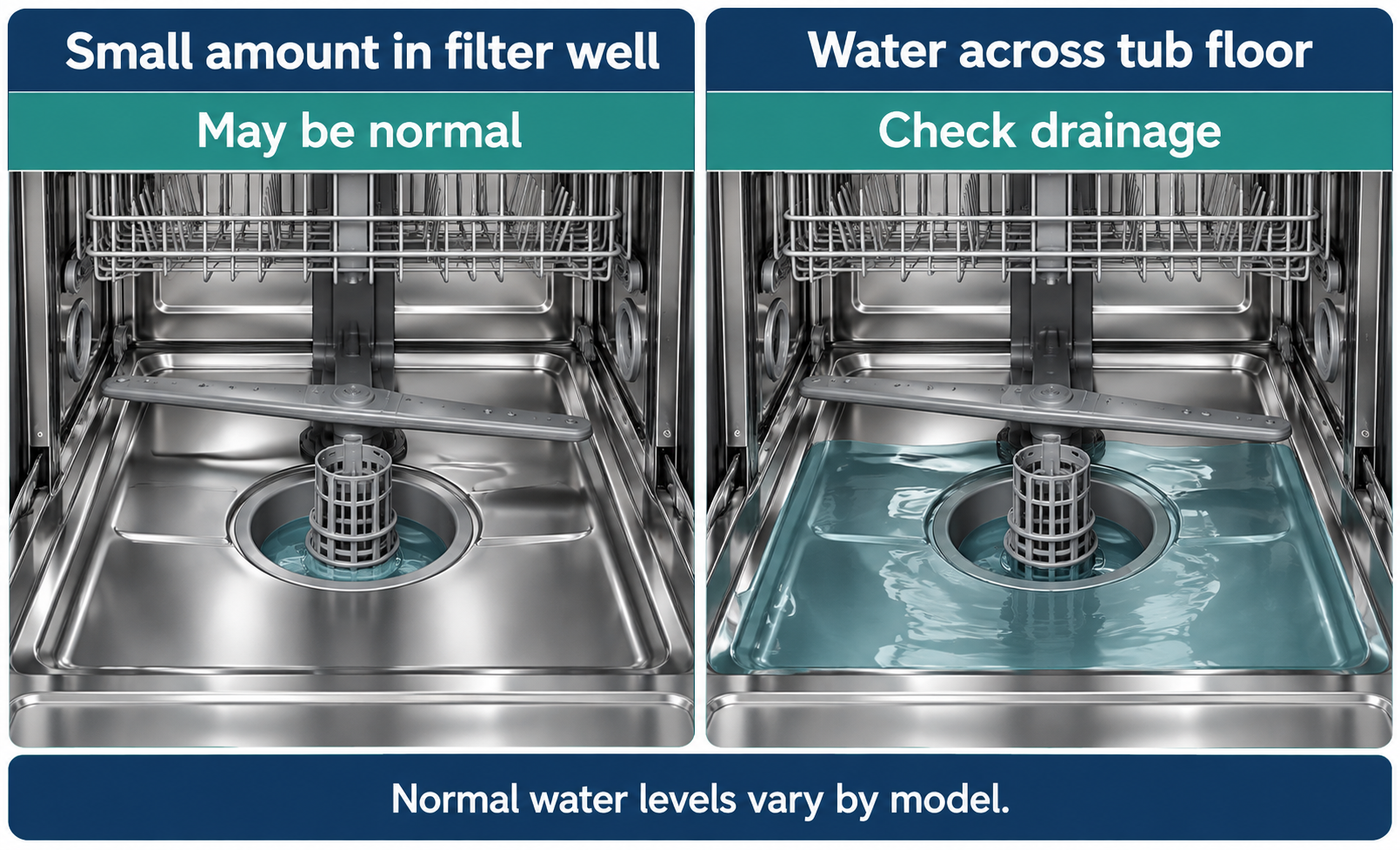
Sometimes. A small amount of clean water in the recessed filter or sump well can be part of the appliance's normal operation. For example, Whirlpool explains that some water remains in the filter area to keep seals from drying out. GE Appliances also distinguishes water in a sump from excess water covering the tub floor on certain filter-equipped designs.
Because dishwasher interiors vary, there is no universal water depth or cup measurement that proves a failure. Use your owner's manual and look for a change from the machine's usual behavior.
May be normal
A small amount confined to a recessed filter well, with no unusual odor, leak, error code, or change in cleaning performance.
Needs attention
Water spreading across the tub floor after a completed cycle, dirty water returning later, a recurring drain error, or water leaking out of the machine.
Before You Start: Safety and Supplies
Stop and arrange professional service if:
- Water is leaking onto electrical outlets, wiring, or the floor near electrical equipment.
- You notice a burning smell, smoke, exposed wiring, or a breaker that keeps tripping.
- The machine is actively overflowing, or a hose connection is leaking and you cannot safely contain it.
For hands-on cleaning, switch off the dishwasher at its circuit breaker or unplug it if the plug is safely accessible. Do not assume that a dark control panel means the appliance is electrically isolated. Let hot water and internal surfaces cool before reaching into the tub. If you cannot safely identify the power supply, stop and consult a qualified technician.
Have absorbent towels, a small cup or shallow container, a sponge, a flashlight, and protective gloves available. Locate the model number and owner's manual. Avoid blindly reaching into the sump: broken glass and other sharp debris can be hidden under water.
Dishwasher Not Draining? Follow These Checks in Order
These steps focus on observations and accessible maintenance. They are not instructions to pull the dishwasher from its cabinet, open electrical compartments, disconnect plumbing, or disassemble the pump.
1. Make Sure the Wash Cycle Has Finished
A paused or interrupted cycle can leave water inside without indicating a mechanical failure. Check whether the door was opened, the cycle was canceled partway through, or the display is showing an error. Record the exact code before resetting anything.
If the controls work and there is no leak or electrical concern, consult the manual for the appliance's Cancel/Drain or cycle-completion procedure. Some Bosch models, for example, pump residual water out after the specified Reset/Start control is held; other brands use different buttons and sequences. Do not guess a button combination or repeatedly reset a machine that reports a fault. Bosch's reset guidance provides an example, not a universal method.
2. See Whether the Kitchen Sink Drains Normally
Many built-in dishwashers discharge into the kitchen sink's plumbing, sometimes through a garbage disposal. If the sink is draining slowly, gurgling, or backing up, the restriction may be downstream of the dishwasher rather than inside it.
Run a modest amount of water into the sink and observe whether it empties freely, provided the sink is not already backing up. If the sink also has a drainage problem, address the household drain first. A plumber is usually the appropriate professional for a blocked sink branch or household drain line. Samsung's dishwasher guidance recommends this sink-side check.
3. Remove Excess Standing Water If It Blocks Inspection
Try the model-approved drain function first when it is safe to do so. If it cannot clear the water and you need access to a filter, switch off power before manually removing water. Place towels at the front of the appliance. Scoop excess water from the tub into a container, then use a sponge or clean baster to absorb water that is readily accessible in the filter area.
Do not tilt an installed dishwasher, put hands into an energized appliance, or detach a drain hose just to empty the tub. This is a short cleanup step to make inspection safer; it does not fix the cause of the drainage problem.
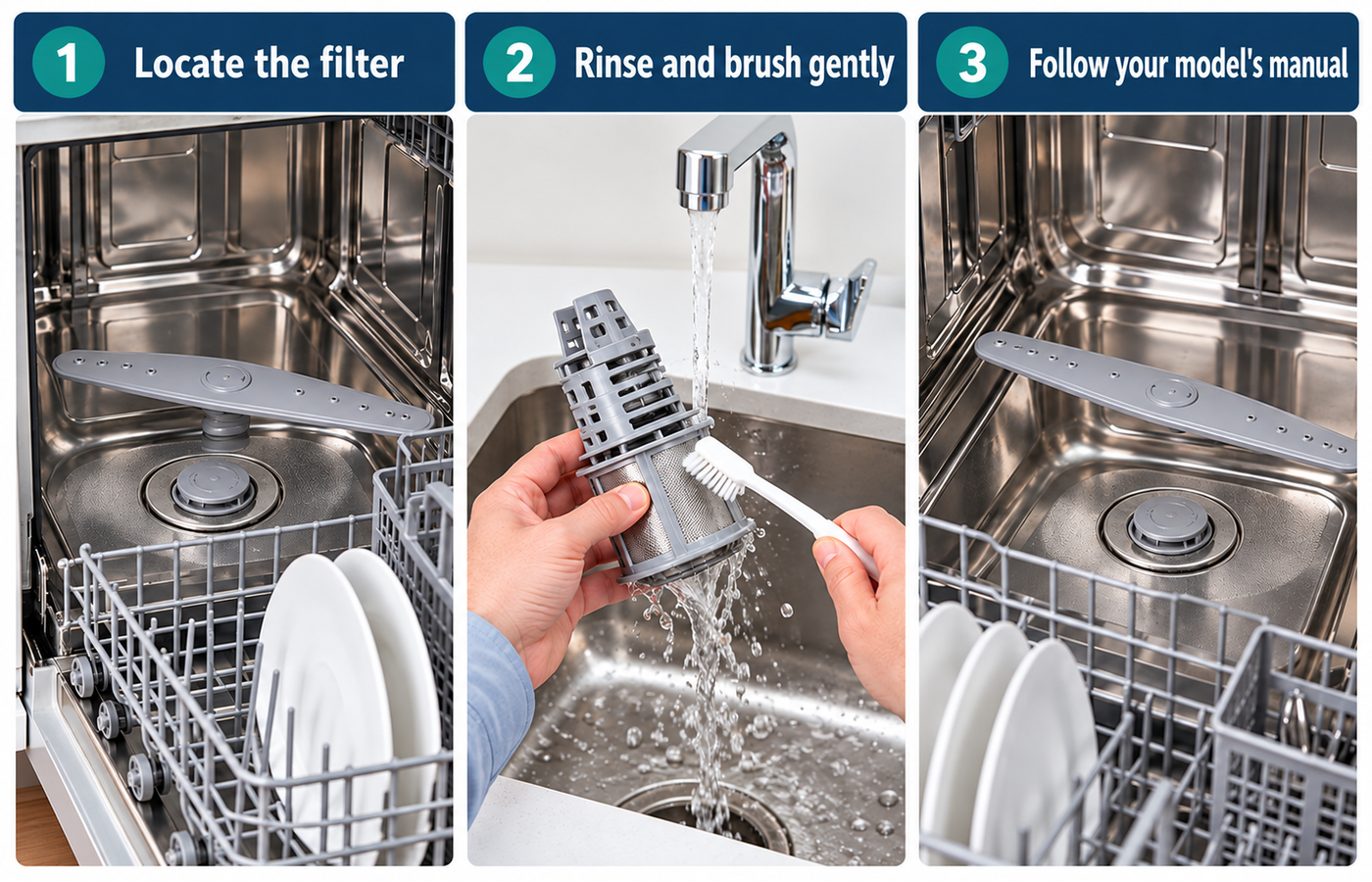
4. Check and Clean the Dishwasher Filter
A filter coated with food residue, grease, paper labels, or fragments of packaging can restrict drainage. Many dishwashers have a removable cylindrical or mesh filter beneath the lower rack, but other models have a different arrangement. The exact location and removal method depend on the machine.
- With power isolated and the tub cool, remove the lower rack to see the filter area.
- Follow the owner's manual to remove only components designated for homeowner cleaning.
- Rinse removable filters under running water; use a soft brush and mild soap only when consistent with the manufacturer's instructions.
- Use a flashlight to look for visible food debris or small objects in accessible areas. Do not probe blindly or force a pump cover open.
- Reinstall and lock the filter assembly exactly as directed before operating the dishwasher.
For certain Bosch machines, the manual permits removing a pump cover to check for obstructions. That does not mean every dishwasher has a homeowner-serviceable pump cover. If your manual does not authorize access, leave the pump assembly closed. See Bosch dishwasher drainage support and Samsung's filter reassembly precautions.
5. Check the Garbage Disposal and Its Dishwasher Inlet
If the dishwasher drains through a garbage disposal, a blockage at the disposal or its inlet can prevent water from leaving the dishwasher. A particularly important clue is a problem that began immediately after a new garbage disposal was installed. Some disposals ship with a knockout plug that must be removed from the dishwasher inlet when the dishwasher is connected there.
Check installation paperwork and ask the installer to confirm that the inlet is open. Do not reach inside a disposal or remove fittings while equipment is energized. If correcting the connection requires hose removal or plumbing changes, use a qualified installer or plumber. Whirlpool, GE, Frigidaire, LG, and Samsung all identify disposal connections as potential drainage trouble spots.
6. Inspect the Visible Drain Hose Under the Sink
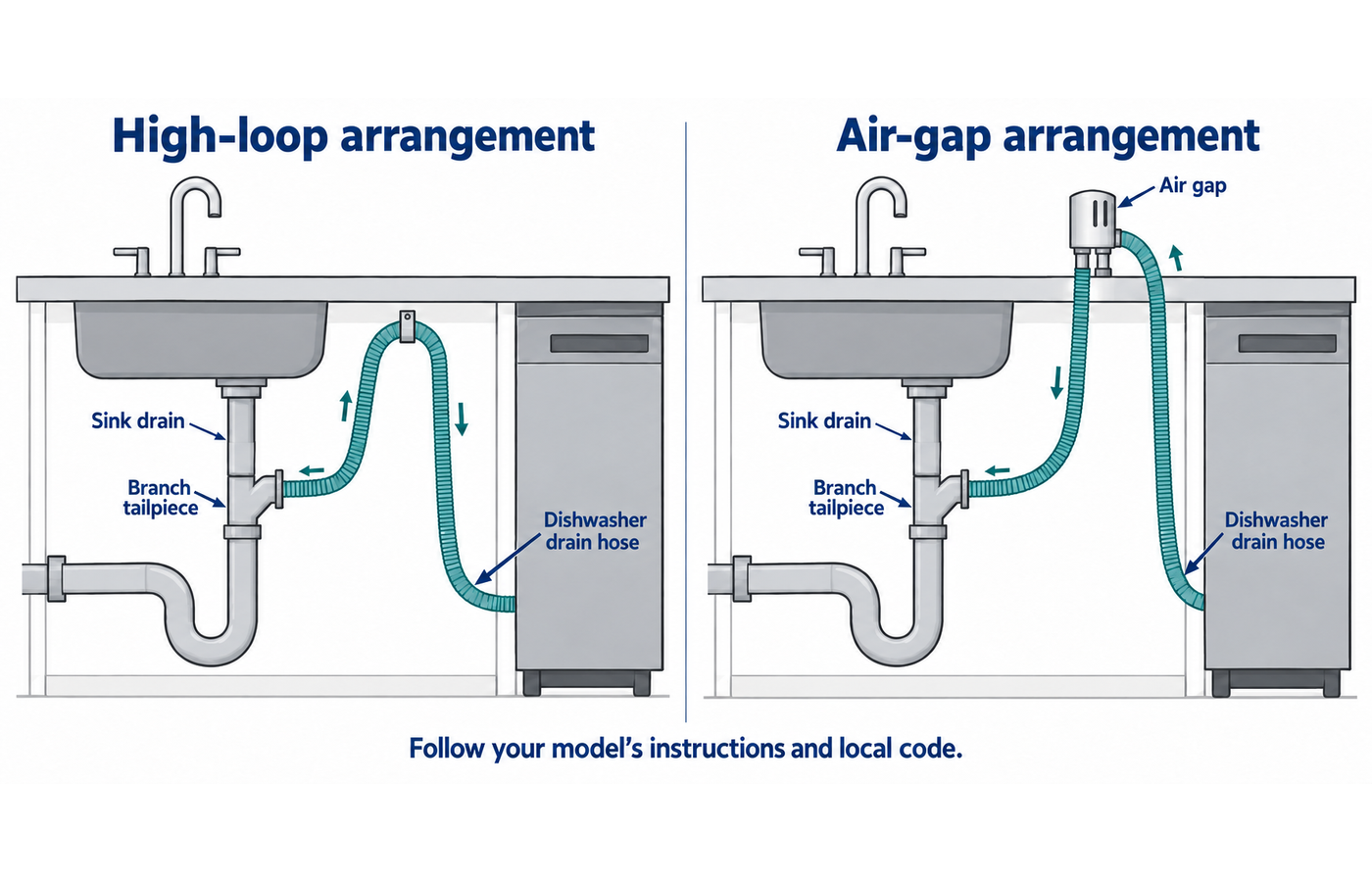
Look for the dishwasher's drain hose where it is accessible in the sink cabinet. It is often a flexible corrugated hose running toward the sink drain, air gap, or disposal. Check for sharp bends, crushing by stored items, and obvious kinks. If the visible hose is being pressed by a household item, remove the pressure without pulling on fittings.
The drain hose generally needs a manufacturer-approved route with a high loop and/or an air gap, depending on the model and local plumbing requirements. These details prevent drain problems and help protect against dirty sink water flowing back into the dishwasher. Do not apply a single height measurement to every installation. Consult the specific dishwasher installation manual and applicable local requirements before changing the routing.
7. Inspect the Countertop Air Gap, If You Have One
Some kitchens have a small air-gap fitting near the faucet. A clogged air gap can obstruct dishwasher drainage or cause water to discharge at the sink. Not every dishwasher installation includes one.
If there is an accessible air-gap cover, switch the dishwasher off and consult the air-gap or dishwasher instructions before lifting the cover and clearing visible debris. Avoid disconnecting hoses unless you know the installation procedure and can manage potential leaks. GE explains the purpose and cleaning of a dishwasher air gap.
8. Reassemble Everything and Test the Drain Once
Check that the filter is secured, all covers are replaced, and no towels or tools are in the tub. Restore power only after the appliance is ready for normal use. With no leaks or other hazards present, run the supported Cancel/Drain or an appropriate short cycle according to the owner's manual, then check for excessive water after completion.
If the machine still will not drain, stop repeating resets and washing cycles. Record any error message, whether the pump makes noise, and whether the sink drains normally. These observations will help a service technician pinpoint the next checks.
Common Reasons a Dishwasher Won't Drain
The same symptom can come from several parts of the drainage path. This table helps distinguish what you can reasonably observe from repairs that require a professional.
| Possible cause | Typical clue | Safer next step |
|---|---|---|
| Dirty or obstructed filter | Water remains after a completed cycle; visible food residue | Clean removable filters following the model manual. |
| Kinked or crushed hose | Slow or failed drain; recent cabinet work or installation | Inspect accessible under-sink hose; arrange service for damaged or hidden sections. |
| Sink or disposal blockage | Sink also drains slowly or dishwasher backs up when sink is used | Check sink drainage and seek plumbing help for a blocked household line. |
| Disposal knockout plug | Drainage failed right after installing a disposal | Ask the installer to verify the dishwasher inlet is open. |
| Blocked air gap or incorrect hose routing | Backflow, water at air gap, or problems after installation | Inspect accessible air gap; verify installation against manual and local requirements. |
| Pump obstruction or failure | Persistent water, unusual grinding or humming, possible drain code | Stop at manual-approved access; have an appliance technician diagnose the pump. |
| Check valve, sensor, or control issue | Drainage remains faulty after basic checks; recurring code | Schedule qualified appliance service; avoid electrical diagnostics. |
What Different Drainage Symptoms Can Tell You
Water remains after the cycle ends
Determine whether water is confined to the recessed filter well or spread across the tub floor. If excessive, check the completed cycle, filter, sink drain, and accessible hose in that order.
Water returns when the dishwasher is off
Dirty water reappearing after sink use suggests possible backflow or incorrect drainage routing. This is a clue, not a diagnosis. Have the hose, air gap, and sink connection checked.
A humming noise, grinding, or drain error appears
Noise and codes can accompany an obstruction or a component fault, but do not prove the pump has failed. Record the code and stop if abnormal noise continues after accessible maintenance.
Drainage failed after a new installation
Prioritize a pinched drain hose, improper routing, or an unopened garbage-disposal inlet. Ask the installer to review the connection before replacing appliance parts.
Why Is My Dishwasher Not Draining Even After I Cleaned the Filter?
A clean filter eliminates only one possible restriction. The sink drain, disposal inlet, air gap, or drain hose may still be obstructed. If water cannot leave the appliance through the hose, cleaning the filter alone will not solve the problem.
Also check that the removable filter and any manufacturer-approved cover were reinstalled correctly. Samsung notes that missing or incorrectly fitted removable parts can themselves contribute to drainage issues. If accessible checks do not help, a technician may need to inspect the pump, check valve, wiring, or control system.
Dishwasher Drain Error Codes: What They Mean
A code is a useful starting clue, not a universal diagnosis. Examples include an OE drain-related code on certain LG dishwashers and 5C, 5E, or SC on certain Samsung dishwashers. The meaning of a code, flashing-light pattern, and next step depend on the specific model and manual. LG's OE guide and Samsung's code guide provide brand-specific examples.
Write down the full code and model number before turning off power or resetting controls. A reset may erase helpful fault information without removing the blockage that triggered it.
What Not to Do When Your Dishwasher Won't Drain
- Do not pour household drain-opening chemicals into the dishwasher. GE warns they can damage rubber parts inside the appliance.
- Do not run the dishwasher without its required filters or covers. Incorrect reassembly can damage components or cause errors.
- Do not force an inaccessible pump cover, poke tools into an impeller, or perform live-voltage tests. Pump construction and approved user access vary by model.
- Do not disconnect a pressurized or wastewater hose without preparing for leaks. Call a plumber or installer if you are uncertain about the plumbing.
- Do not repeatedly reset the controls. Preserve fault information and address the cause instead.
When to Call a Technician or Plumber
Basic maintenance is a reasonable first step when the appliance is safe and the filter or sink connection is accessible. Arrange professional help if excess water persists after reassembly and one appropriate test, the same code keeps returning, the appliance grinds or hums unusually, or any electrical hazard or leak is present.
Call an appliance technician for
- Suspected drain-pump, motor, valve, or electronic faults
- Repeated appliance drain errors after safe checks
- Internal leaks or components that require panel removal
Call a plumber or installer for
- A kitchen sink that also backs up or drains poorly
- Incorrect drain-hose routing or air-gap installation
- A suspected blocked disposal inlet or leaking under-sink connection
Tell the professional when the problem began, whether the sink drains, whether a disposal was recently installed, which steps you completed, and any error code. Those details are more useful than guessing that the drain pump needs replacing.
How to Help Prevent Future Drainage Problems
- Scrape large food scraps, toothpicks, and paper labels off dishes before loading.
- Inspect and clean removable filters at the interval specified by your dishwasher's manufacturer.
- Use only dishwasher-approved detergent in the amount recommended for your machine and water conditions.
- Keep the sink drain and disposal functioning normally; watch for slow draining.
- Keep stored items from crushing the visible drain hose beneath the sink.
- Follow the model's maintenance instructions rather than using aggressive drain chemicals or improvised pump-cleaning methods.
Frequently Asked Questions
Why is my dishwasher not draining all the water?
First check whether the water is limited to the recessed filter area, which can be normal for some dishwashers. If significant water remains on the tub floor after a completed cycle, common causes include a clogged filter, a restricted hose, an obstructed sink connection, or a pump-related problem.
How do you drain a dishwasher with standing water?
Use the model's documented Cancel/Drain function if the machine is safe to operate. If that fails, isolate power, let hot water cool, and remove accessible standing water with a small cup, towels, and a sponge before checking the filter. This removes water for inspection; it does not repair the drainage fault.
Can you force a dishwasher to drain?
Some models provide a Cancel/Drain or Reset sequence that activates the drain pump. There is no single button sequence for every dishwasher, and a control command cannot clear a physical blockage or repair a failed pump. Refer to your owner's manual.
Can a garbage disposal stop a dishwasher from draining?
Yes. A clogged disposal or sink drain can obstruct the outlet. On a newly installed disposal, an unopened dishwasher-inlet knockout plug can stop drainage entirely. Have the connection checked by the installer if plumbing disassembly is required.
Why is my dishwasher not draining but the filter is clean?
Inspect the sink drainage, visible hose, disposal connection, and air gap next. If those checks reveal nothing, the fault could be in a pump, check valve, or control-related component that needs professional diagnosis.
Does a dishwasher need a high loop or an air gap?
The permitted installation depends on the manufacturer's instructions and applicable plumbing requirements. A high loop and an air gap are both used to address wastewater backflow, but their configuration is not a universal one-size-fits-all rule. Check the manual for your exact dishwasher and your local requirements.
Should I replace the drain pump if the dishwasher hums?
Not based on noise alone. A blocked drain path, debris in an approved access area, or a pump issue could produce an unusual sound. Stop running the machine if the noise continues and have the drain pump diagnosed rather than replacing it on a guess.
Manufacturer Guidance and Further Reading
This guide is general homeowner information. Appliance designs and permitted maintenance procedures vary. For exact filter access, drain functions, hose routing, and error codes, your model's owner's and installation manuals take priority.