Quick answer
If your dryer runs and the drum turns but the clothes stay cold, start with the heat setting and a short, model-approved heated cycle. A conventional electric dryer can sometimes tumble while its heater lacks the full electrical supply. A gas dryer may tumble without burner heat if its gas supply is interrupted. If the drum gets warm but laundry remains damp, airflow and drying performance are more likely starting points. Stop if you notice a burning smell, damaged wiring, a repeatedly tripping breaker, or any sign of a gas problem.
A dryer that runs but does not heat can be confusing: the display lights up, the drum rotates, and the timer counts down, yet the load comes out just as damp as it went in. The key is to separate a dryer that makes no heat at all from one that makes some heat but dries poorly. The safest next steps are different.
This guide focuses on the narrower problem of a dryer that starts and tumbles normally but does not produce heat. It covers common U.S. electric and gas dryers, explains why the motor can keep running when the heat source fails, and shows what you can check without opening the cabinet. For a wider look at dryers that will not heat, take too long, or show other symptoms, see our general dryer-not-heating troubleshooting guide.
First, confirm the dryer is running without heat
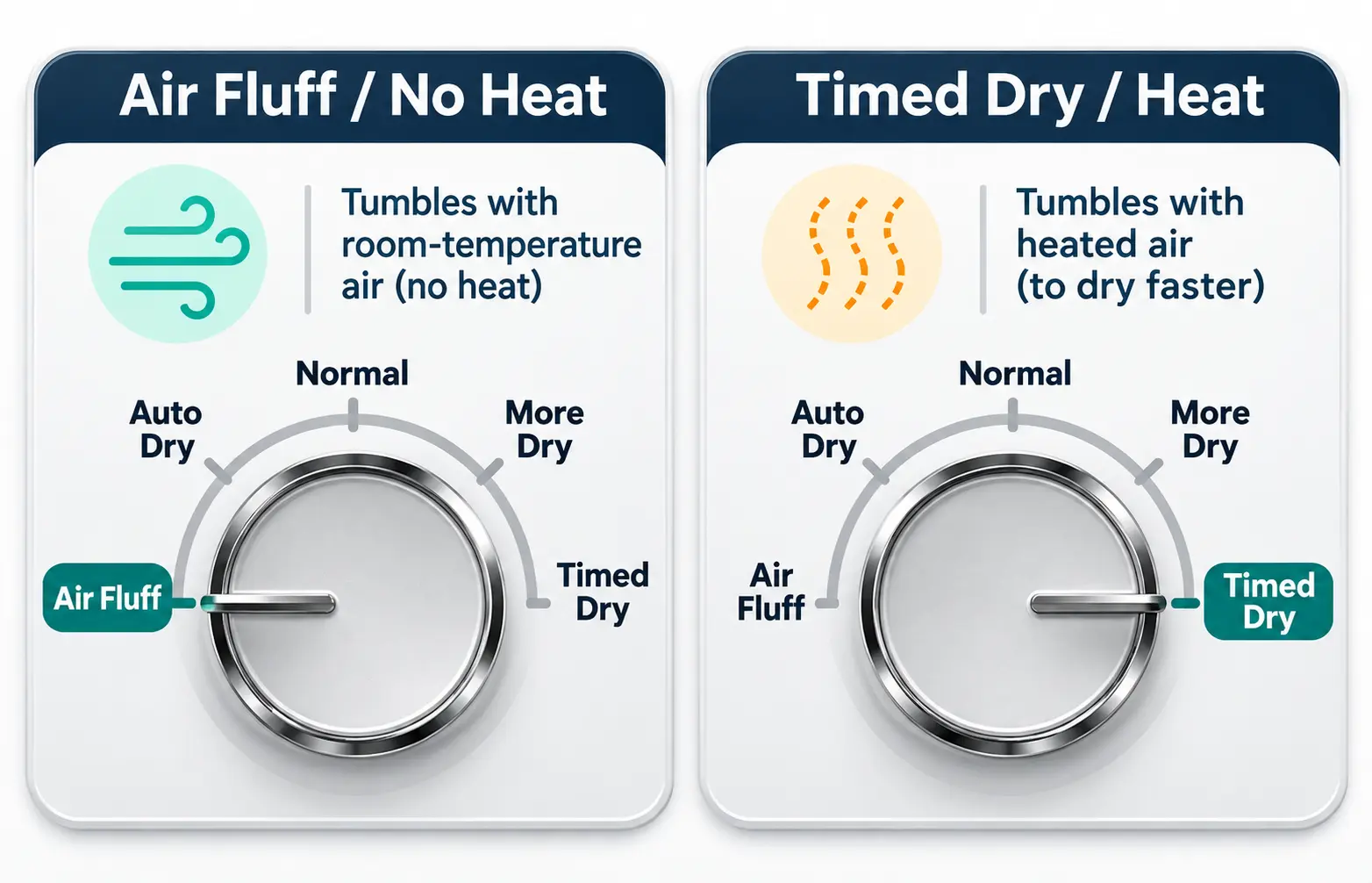
Before assuming a heating component has failed, check what the machine actually does. A cycle may include an intentional cool-down period, and settings such as Air Fluff, Air Only, or No Heat deliberately tumble clothes without warming them. On some models an energy-saving setting delays or reduces heat at the start of a cycle. A dryer that feels cool during one part of a program is not necessarily broken.
For many conventional models, a basic confirmation test is to remove the clothes, select a normal heated Timed Dry setting, and let the empty dryer operate briefly while you remain nearby. Whirlpool describes a five-minute empty-drum check for applicable dryers; Samsung specifies a shorter model-specific check for certain machines. Follow your own owner's manual for the test duration and controls. Stop the cycle, allow the drum to stop, open the door, and notice whether the interior air feels warmer than the room. Do not reach toward any moving component or heating area.
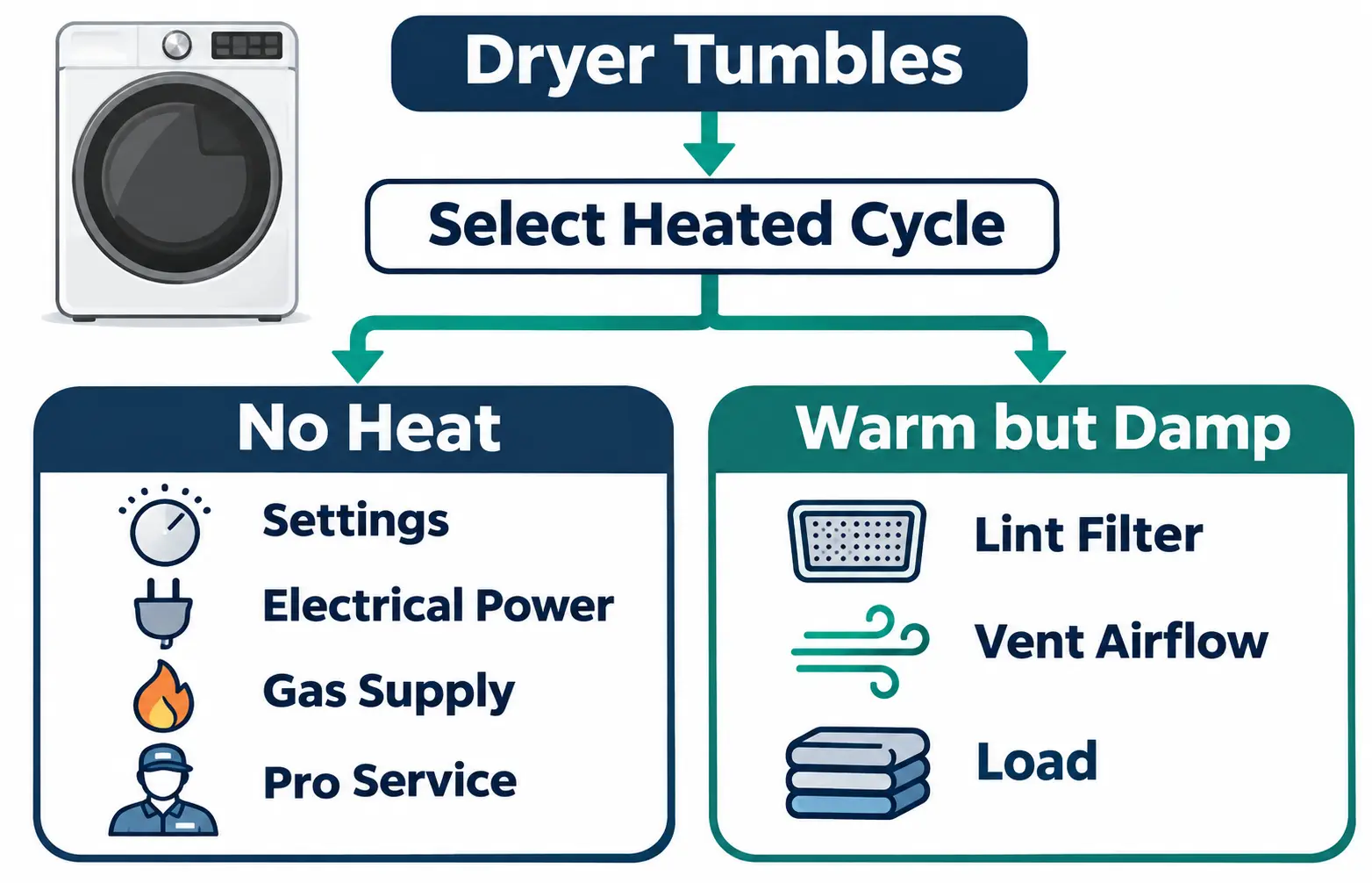
Still cool after a heated test
Treat this as a no-heat complaint. Start with settings and power or gas supply, then consider professional diagnosis of heating-system components.
Warm, but clothes remain wet
You may have a drying-performance problem rather than complete heat loss. Check lint, the vent route, load size, sensor settings, and the manual's airflow guidance.
Heat-pump and other ventless dryers use a different heating and moisture-removal system. They often run at lower temperatures, may have a cool phase, and generally do not have a conventional outdoor exhaust duct. Use the model-specific instructions rather than assuming the vented-dryer checks below apply.
Five safe checks before you call for repair
Work from the simplest explanation to the most consequential one. These checks do not require touching live electrical contacts, removing a burner cover, or taking apart the dryer.
1. Verify the cycle and temperature selection
Select a heat-producing cycle that your model permits for a test. Air Fluff, Air Only, No Heat, and many cool-down phases are supposed to feel cold. Some energy-saving or delicate settings provide less heat than a normal timed cycle. If a control panel has a separate temperature button, confirm it is not set to No Heat. Consult the manual if its indicator lights or cycle names are unfamiliar.
If a normal heated cycle produces warmth, the machine may not have a complete heating failure. Do not assume that resetting the dryer or ordering a replacement heating element is necessary.
2. Check for an obvious electrical-supply problem
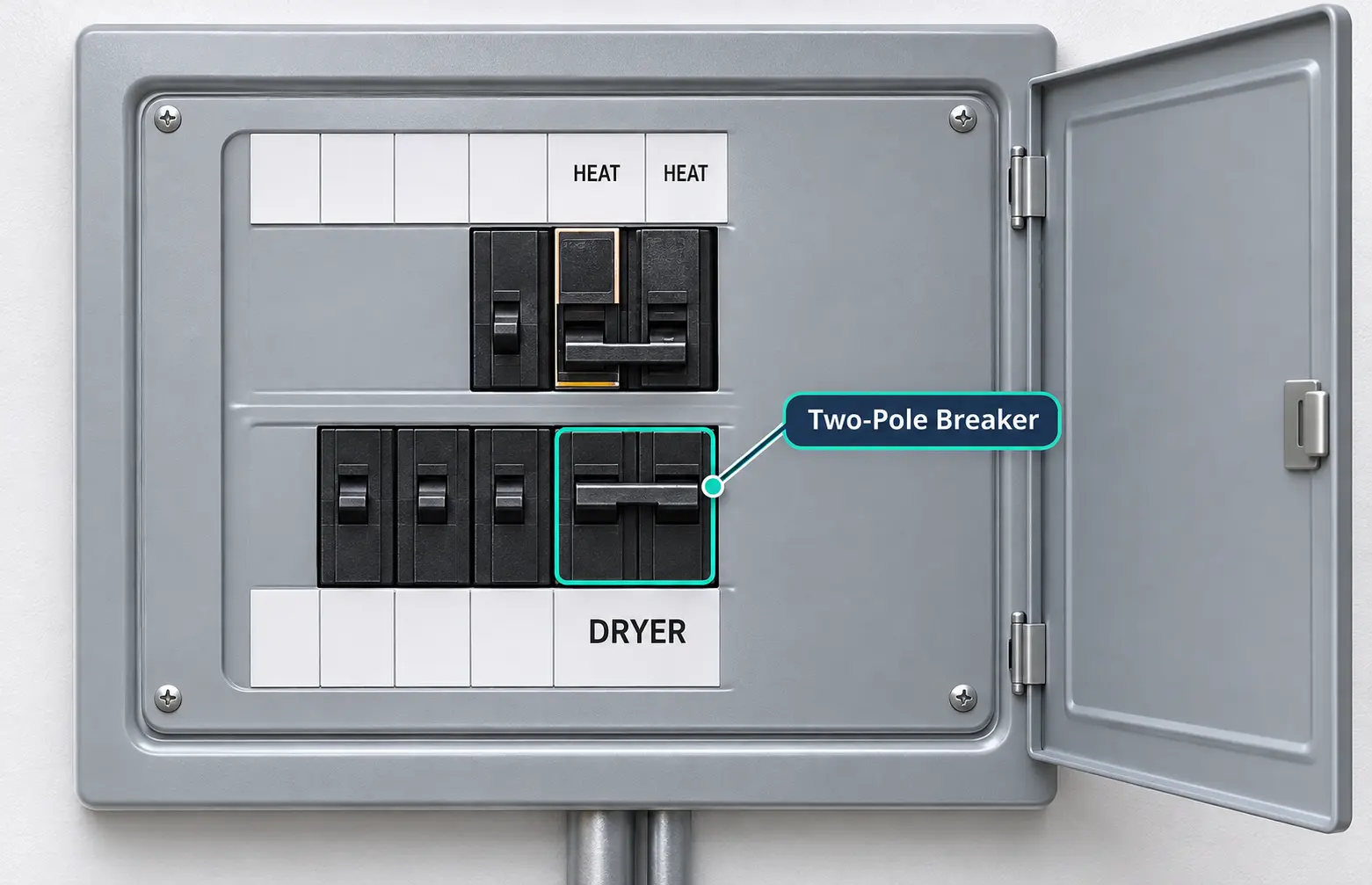
If you own a conventional electric dryer, a normal-looking display and a spinning drum do not prove that the heater has its required power. In many U.S. installations, the drum motor can operate with part of the supply available, while the heater needs the full 208/240-volt supply. A partially tripped two-pole breaker or a supply fault can therefore leave the drum spinning and the clothes cold.
From a safe, dry location, note whether the dedicated dryer breaker appears tripped. If the breaker and electrical panel are intact, dry, and accessible, follow the appliance and panel manufacturers' instructions for one normal reset of the appropriate breaker. Do not remove the panel cover. Do not touch exposed wiring, open the dryer's terminal compartment, probe the outlet, or test the electrical supply with a meter. If the circuit trips again, leave it off and contact a qualified electrician.
Gas dryers usually have a different household electrical requirement, commonly a standard 120-volt outlet for the controls and motor. The conventional electric-dryer partial-240V explanation should not be applied automatically to a gas dryer, a heat-pump dryer, or every model.
3. For a gas dryer, consider the external gas supply
A gas dryer's motor and electronic controls can continue working even when its burner produces no heat. If the dryer is newly installed, has recently been moved, or has stopped heating after utility work, a closed gas shutoff valve or interrupted service is one possible explanation. A depleted LP tank can also matter where propane is used.
Only check an easily visible, accessible external supply indication if your manufacturer's instructions permit it and there is no gas odor or alarm. Do not loosen fittings, disconnect the flex connector, open the burner compartment, light anything to test the supply, or attempt to adjust a valve you cannot positively identify. If the supply condition is uncertain, contact your gas provider or a qualified gas-appliance technician.
4. Clear the lint screen and check visible airflow restrictions
Heat that cannot move through the laundry and exhaust system can lead to long drying times, overheating, and protective shutdowns. While a blocked vent is not proof that a failed heater is the cause of zero heat, it is an important safety and performance check.
- Turn the dryer off and let it cool. Remove lint from the lint screen in the manner described in the manual; reinstall it before operation.
- Look for clothes, storage items, or rugs blocking the dryer's air inlets or outlets.
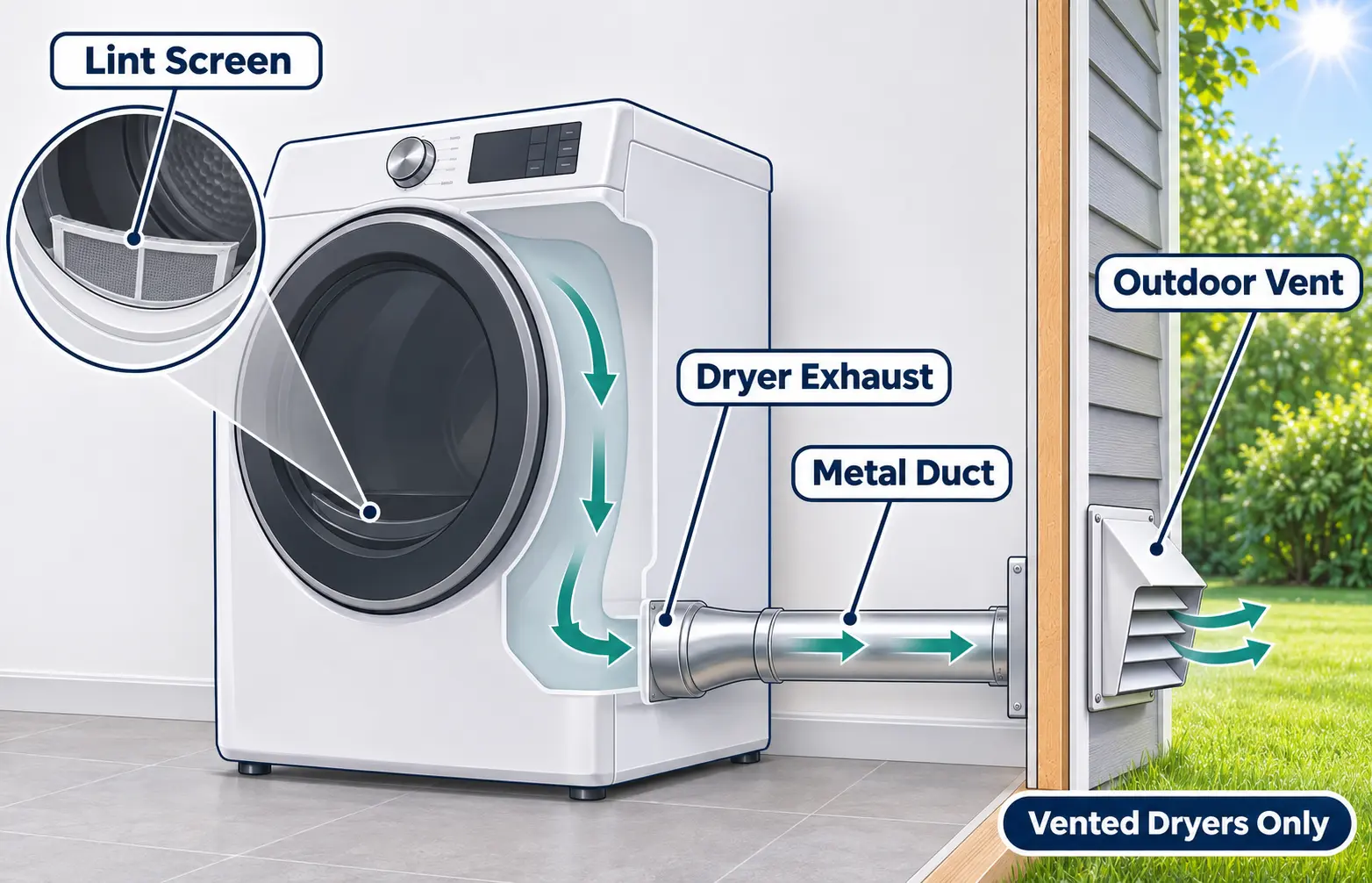
- On a vented dryer, inspect only the visible, safely accessible sections of the exhaust duct for obvious crushing, kinks, separation, or damage. Do not climb onto the roof or dismantle inaccessible ductwork.
- Check that the exterior vent hood is not visibly blocked by debris or nesting material when it can be reached safely from ground level. If cleaning requires tools, ladder work, or moving a heavy appliance, use a qualified service provider.
The U.S. Fire Administration recommends cleaning the lint filter before and after each use and keeping the vent path clear. Never run a vented dryer with the exhaust disconnected into the room as an improvised diagnostic test, particularly a gas dryer; improper venting creates fire and combustion-product hazards.
5. Note any code, warning light, or recent change
Before scheduling service, write down the exact model number, the selected cycle, any error code, and when the problem began. Did the unit stop heating immediately after installation? Does it make heat for a few minutes and then turn cold? Does the breaker trip? Has a vent warning appeared? These details can prevent guesswork and help a technician narrow the fault.
Do not assume a displayed code has the same meaning across brands. For example, certain Samsung heating-related codes can indicate overheating or an airflow issue, not simply a burned-out heater. Use the specific model's manual or the manufacturer's code lookup.
Why an electric dryer can tumble but not heat
A conventional electric dryer has separate functions for tumbling, moving air, and generating heat. Seeing the drum rotate confirms that the motor is doing at least some of its job, but it does not verify the heater circuit. That distinction is the central reason this symptom needs its own troubleshooting path.
| Possible issue | What you might notice | Safe next step |
|---|---|---|
| No-heat cycle selected | Dryer tumbles normally but never warms on Air Fluff or No Heat. | Choose a model-approved heated cycle. |
| Partial electrical supply | Controls and drum work, but heater remains cold; perhaps after a trip or installation change. | Check for an ordinary breaker trip only if safe; otherwise call an electrician. |
| Heater or heat-control failure | Cold air persists after correct settings and an apparently normal supply. | Arrange appliance service; symptoms alone cannot identify the failed part. |
| Overheat protection or airflow fault | Heat may stop intermittently, or the unit may show an airflow or temperature alert. | Clean accessible lint areas and arrange vent or appliance inspection. |
A tripped supply can be easy to overlook
GE Appliances and Frigidaire both describe electric dryers that run on partial household voltage while the heating system stays inactive. That does not mean every cold dryer has a breaker problem, and it is not an invitation to test a live 240-volt outlet. If one safe reset does not restore normal operation, further supply testing belongs to a qualified electrician.
What if the breaker looks normal?
A breaker handle may not always make a trip obvious. However, a dryer can also have damaged wiring, a defective heater, a failed temperature control, or another model-specific fault. An appliance technician may need to distinguish between a supply fault and an internal failure after the initial homeowner checks. If the dryer has never heated since it was installed or moved, put the electrical installation high on the list for professional inspection.
Gas dryer runs but does not heat: what is different?
With a gas dryer, the drum motor is powered electrically while heat comes from a gas burner. A working drum therefore does not establish that the burner is receiving gas or igniting correctly. A missing gas supply is one possibility; burner ignition, flame-sensing, valve-control, or protective-system faults are others.
Start by identifying that the appliance is actually a gas model and checking whether the correct heated cycle is selected. If a recent installation or utility interruption may be involved, consult the owner's instructions and your gas supplier about the external supply. Keep the surrounding air openings clear. If the dryer still tumbles without heat, book service rather than trying internal burner or valve work.
A gas dryer that produces heat briefly and then loses it is also different from one that never heats. That pattern may be useful to tell the technician, but it does not prove that the gas-valve coils, igniter, or any single part has failed.
Match the symptom to the right next step
Use the pattern below to avoid spending money on the wrong replacement part. The table is a way to organize symptoms, not a substitute for a professional diagnosis.
| What happens | Most useful distinction | What to do |
|---|---|---|
| Drum rotates; air stays cold for the entire heated test | True no-heat symptom | Confirm controls; check safe external electric or gas supply conditions; request service if unresolved. |
| Drum rotates; some warmth is present but clothes stay damp | Poor drying instead of total no heat | Review lint, vent, load and moisture-sensor guidance. |
| Dryer heats at first, then stops heating | Intermittent or protective behavior | Note timing and alerts; check accessible airflow; schedule service if it repeats. |
| Dryer runs on Air Fluff but not on a heated setting | Possible setting misunderstanding or true heater fault | Verify the selected test cycle against the manual. |
| Dryer will not start or the drum does not rotate | Different fault family | Use a no-start/no-tumble diagnostic path, not this guide. |
| Breaker trips repeatedly; plug scorched; gas odor or alarm | Potential immediate hazard | Stop; evacuate for gas/CO concerns; obtain emergency or qualified service as appropriate. |
For ventless heat-pump dryers, check the specific filter, heat-exchanger, condensate-tank, and error-code requirements in the manufacturer instructions. Do not assume the appliance has a standard electric heating element, gas burner, or outdoor exhaust flap.
What parts can cause no heat even though the drum spins?
If the simple checks do not solve the issue, a technician may examine the heating system and its safety controls. Different designs use different components, and a component name in an online forum is not a diagnosis for your dryer.
Electric heating element
A failed resistance heater can prevent heat while the motor still works. The element's design and service access are model-specific. Replacement should follow an accurate diagnosis, not a symptom-only guess.
Thermostats, thermistors and protective cutoffs
These monitor or limit heat. Some failures interrupt heating; on other models a thermal fuse can stop the dryer from running entirely. Never bypass a safety device to see whether heat returns.
Gas ignition and valve controls
An igniter, flame-sensing component, or valve-control fault may prevent burner heat. They require qualified assessment because they are part of a fuel-burning system.
Control board, relays or wiring
A failed control or connection can interrupt the heater command or supply. Electrical tests inside the cabinet are not homeowner checks and require the correct service information.
A common mistake is to replace the thermal fuse or heating element immediately because an online video mentions it. That can waste money and overlook a dangerous vent restriction, an incomplete supply, or a failed protective control. If a protective component is open, the underlying cause must also be investigated before the appliance returns to service.
When to stop troubleshooting and call a professional
Homeowner checks should end when the next step requires access to electrical terminals, interior wiring, a gas burner, fuel connections, or sealed heat-pump components. Arrange qualified help when:
- The dryer still produces no heat on a correct heated cycle after safe external checks.
- A dedicated breaker trips again after one ordinary reset, or the supply/cord installation is questionable.
- There is visible heat damage, sparking, smoke, or an electrical burning odor.
- A gas model has unknown or interrupted supply, or there is any suspected combustion problem.
- A warning or temperature/vent error keeps returning after basic cleaning.
- Vents run through inaccessible walls or roof areas, or a heavy machine would need to be moved to inspect them.
- A ventless/heat-pump model indicates an internal heating, refrigerant, or heat-exchanger fault beyond routine owner maintenance.
For a gas odor or carbon monoxide alarm, do not wait for a routine appliance appointment: follow the evacuation and emergency-response guidance above.
What to tell the technician
A concise problem description can speed up a visit:
- Dryer brand and full model number
- Electric, gas, or heat-pump/ventless type
- “Drum turns, but there is no warmth on a heated timed cycle” or the exact observed pattern
- Any alerts, error codes, breaker trips, burning odor, or installation changes
- Whether the lint screen and safely accessible vent areas were checked
Frequently asked questions
Why does my dryer spin but not get hot?
The motor and heater do different jobs. A no-heat cycle, partial electrical supply on certain conventional electric dryers, missing gas supply on a gas dryer, or a failed heat-control component can leave the drum rotating without warmth. The right first step is confirming the selected cycle and the actual heat symptom.
Can a dryer run on 120 volts but not heat?
Many conventional U.S. electric dryers can operate their motor and controls when only part of their normal 208/240-volt supply is available. The heater may remain off. This does not describe every dryer design, and homeowners should not test live receptacle voltage or open terminal covers; a qualified electrician can assess the supply.
Is a blown thermal fuse always the reason my dryer has no heat?
No. Thermal protective devices behave differently across models. Some failures affect heat; some stop the motor or prevent starting. A repair professional should identify the actual fault and investigate overheating or vent problems before replacing parts.
Why does my gas dryer run but stay cold?
The electrically powered drum can turn even when the gas burner is not producing heat. Possible causes include a closed or interrupted external gas supply and internal ignition or safety-control faults. Do not dismantle or test the burner yourself.
Can a clogged dryer vent make it seem like there is no heat?
Yes, restricted airflow can lead to poor drying, overheating, or a protective reduction or loss of heat. But a dryer that never produces any warmth may have a different issue. Clean the lint screen and check visible vent restrictions without running the dryer disconnected from its exhaust.
Should I keep running the dryer until it starts heating again?
No. Repeated unattended cycles do not diagnose a heating failure and can worsen an airflow or electrical problem. Stop and arrange service if the simple safe checks do not restore normal heat. Never continue operating a dryer that shows smoke, melting, unusual burning smells, or a gas/CO warning.
Does this troubleshooting apply to a ventless heat-pump dryer?
Only the broad steps, such as checking cycles and reading model-specific error codes, carry over. Heat-pump dryers have different heating and moisture-removal systems and commonly operate at lower temperatures. Follow the manufacturer's heat-exchanger, filter, condensate, and service guidance instead of conventional vented-dryer assumptions.
The bottom line
If your dryer runs but does not heat, verify that the cycle actually calls for heat and confirm the difference between a completely cold drum and slow drying with some warmth. For conventional electric dryers, a missing part of the supply can explain why the drum turns but the heater does not. For gas dryers, the motor can run without gas-burner heat. Accessible lint and vent maintenance remains important, but internal electrical, gas, and safety-device diagnosis is professional work.
If you are dealing with several symptoms rather than the specific runs-but-no-heat condition, continue with our broader dryer heating guide.
Manufacturer and safety references
Guidance varies by model. Use the owner's manual for your specific dryer; these references provide general context.
- GE Appliances: Electric Dryer — Runs But Does Not Heat
- GE Appliances: Gas Dryer — Runs But Does Not Heat
- Whirlpool: Dryer Is Not Heating
- Frigidaire: Dryer Runs but Does Not Seem to Heat
- Samsung: Clothes Are Not Dry After Using Samsung Dryer
- LG: Dryer Not Heating, Not Drying, or Taking Too Long
- ENERGY STAR: Heat Pump Dryers
- U.S. Fire Administration: Clothes Dryer Fire Safety