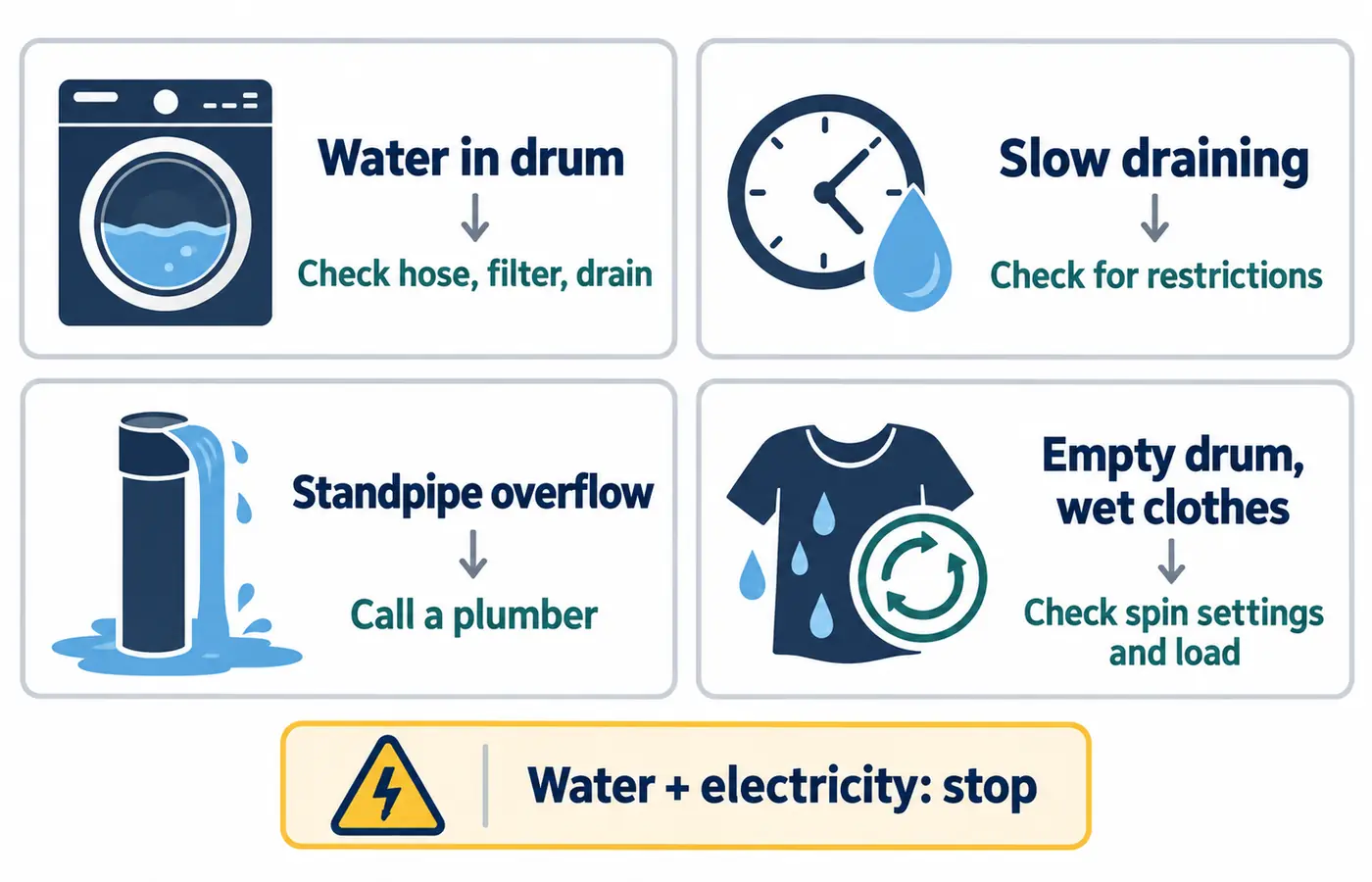
If your washer isn't draining, the most useful first clue is where the water is. Water standing in the drum after a cycle points toward a drainage problem. An empty drum with soaking-wet clothes may instead point toward a spin or load-balance problem. Common causes of poor drainage include a kinked drain hose, a clogged pump filter on models that have one, incorrect drain-hose installation, a blocked household drain, or a pump that needs professional attention.
Quick answer: What should you check first?
If the area is dry and electrically safe, stop the washer, note any error code, and inspect the visible drain hose for kinks or crushing. Check whether water is backing up at the household standpipe or utility sink. If your owner's manual identifies a user-accessible pump filter and emergency drain, follow that model's controlled-draining procedure after power is safely disconnected and hot water has cooled.
If the tub is still full, a pump only hums, a drain code keeps returning, or you cannot safely access the water, stop troubleshooting and arrange appliance service. Do not force a locked front-load door open.
Safety First: A Washer Full of Water Can Be Hazardous
A drainage problem can leave several gallons of water in the machine. Before moving hoses, opening any filter, or starting another cycle, check for water on the floor, near a wall outlet, or around the power cord. If electrical components or the plug are wet or have been submerged, do not touch them. Keep clear and have the power isolated and equipment evaluated by qualified help. Electrical equipment exposed to flooding should not simply be dried and restarted.
Water left after a hot or sanitize cycle may be hot enough to burn. Allow it to cool before using any manual-drain procedure. Samsung specifically warns about this risk in its US no-drain guidance. Follow your own washer's instructions rather than assuming a single cooling time works for every machine.
Start With the Symptom, Not a Replacement Part
A washer that cannot pump water out is not necessarily suffering from the same problem as one that spins poorly. Use the observations below to narrow the next safe check.
| What you notice | What it may suggest | Next safe step |
|---|---|---|
| Water is visibly standing in the drum after the cycle | Slow or failed drainage | Check the displayed code, exterior hose, standpipe, and model-approved filter access. |
| Water drains, but only slowly | A restriction in the drain path | Look for a crushed hose, accessible filter debris, or plumbing backup. |
| The washer hums but water stays in the tub | A drain restriction or pump-related fault | Do not assume a humming pump is healthy; arrange service if safe basic checks fail. |
| Water spills or rises at the standpipe or sink | A household drain may be restricted | Stop using the washer and contact a plumber if the drain cannot handle the discharge. |
| The drum is empty, but clothes are soaked | Low spin speed, load balance, or a spin-cycle issue | Check cycle settings and see our washer not spinning guide. |
| You hear sloshing but see no water in the basket | Possibly normal balance-ring fluid on some top-load models | Check your owner's manual before treating the sound as trapped wash water. |
Five Checks to Make Before Assuming the Pump Has Failed
- Pause or stop the cycle and read the display. Write down any error code before it disappears. Some washers normally pause between stages; GE notes that pauses of a few minutes can be normal on certain models. A prolonged stop with visible standing water is different.
- Look at the exterior drain hose. Where you can see it without moving a heavy machine or working in a wet area, check for a sharp bend, flattening, pinching, or obvious damage. The hose should follow the installation guide for that model.
- Check the household drain opening. If water has spilled from the standpipe or utility sink, do not start a second pump-out cycle. A washer can be working while the house drain is unable to accept the water.
- Check the door or lid and the selected cycle. Make sure nothing is trapped in the door seal or latch area and that the cycle actually includes draining. A lid or door problem can interrupt some washer models; do not defeat the interlock.
- Use only a documented homeowner-accessible drain procedure. On some front-load washers this means an emergency drain tube and pump filter behind a small service door. Other models do not provide these features. See the safe draining section below.
If a drain or spin test is specified by your owner's manual, perform it only after the machine is fully reassembled, the drain connection is secure, the floor is dry, and there is no risk of overflow. Never keep restarting a washer that is leaking or spilling water.
Common Reasons a Washing Machine Won't Drain
1. The Drain Hose Is Kinked, Crushed, or Incorrectly Installed
The hose carries used water from the washer to a standpipe or laundry sink. A kink behind the machine can restrict that flow. So can an obstruction in the hose or an installation that places the hose outside the height and insertion limits specified by the manufacturer.
Inspect accessible sections with the washer off and the surrounding area safe. A kink that can be straightened without pulling fittings apart may be a simple fix. If the hose is damaged, inaccessible, or trapped behind a heavy stacked unit, seek qualified assistance rather than dragging the appliance or disconnecting a full line without a way to contain the water.
The connection also should not be sealed airtight where the manual requires an air gap. Excessive insertion or an improperly arranged connection can cause siphoning or water-flow problems; a blocked household drain is a separate issue. Manufacturer references: Samsung and Whirlpool.
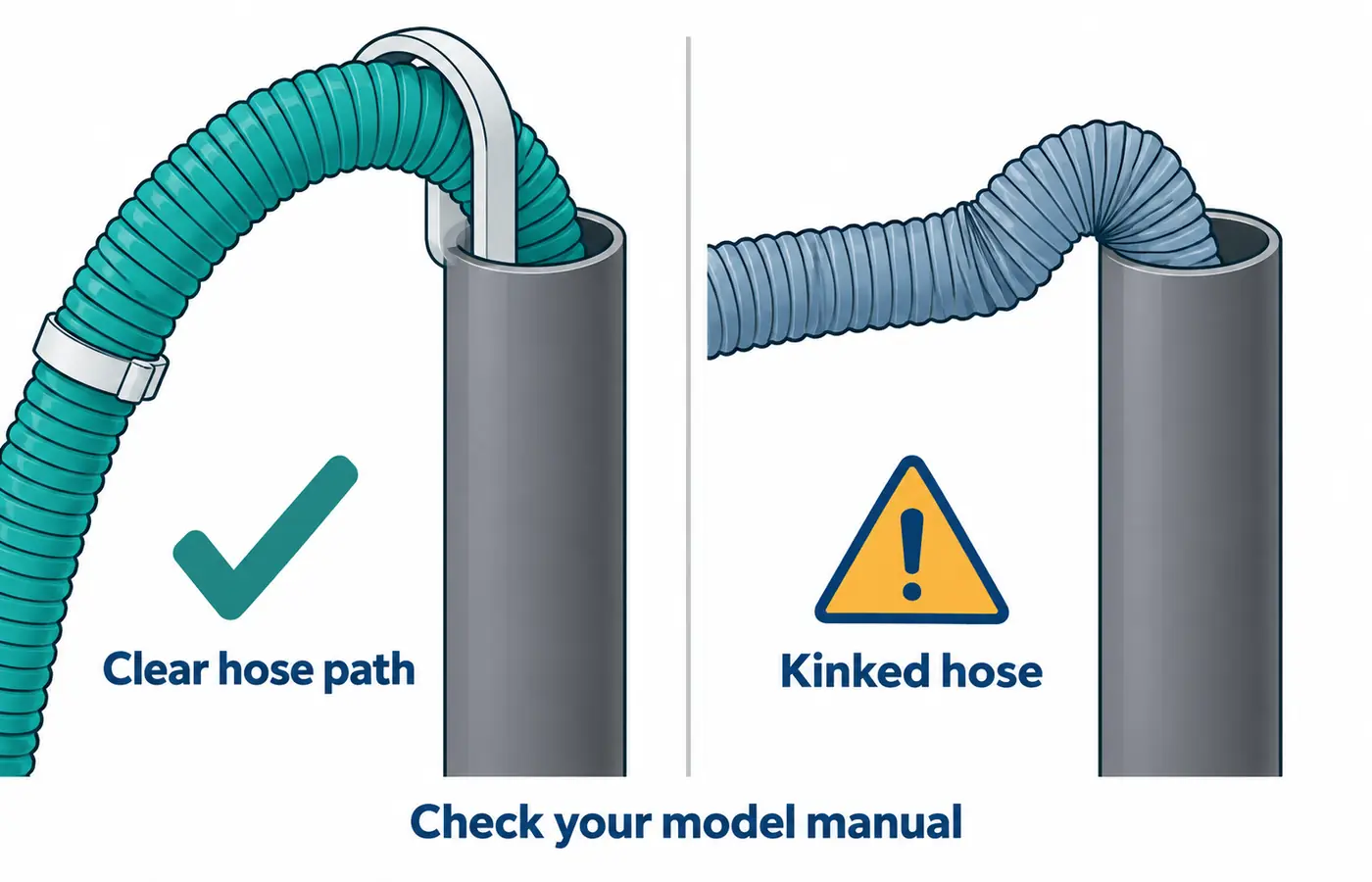
2. The Pump Filter Is Clogged, if Your Model Has a User-Accessible One
Coins, lint, hairpins, and other items can collect in a drain-pump filter and slow water removal. Many front-load machines have a service access door, but not every washer has a customer-removable filter. LG says its accessible drain-pump filter is found on specified front-load and combo units, not its top-load washers; Samsung likewise limits the removable-filter step in its US guide to front loaders.
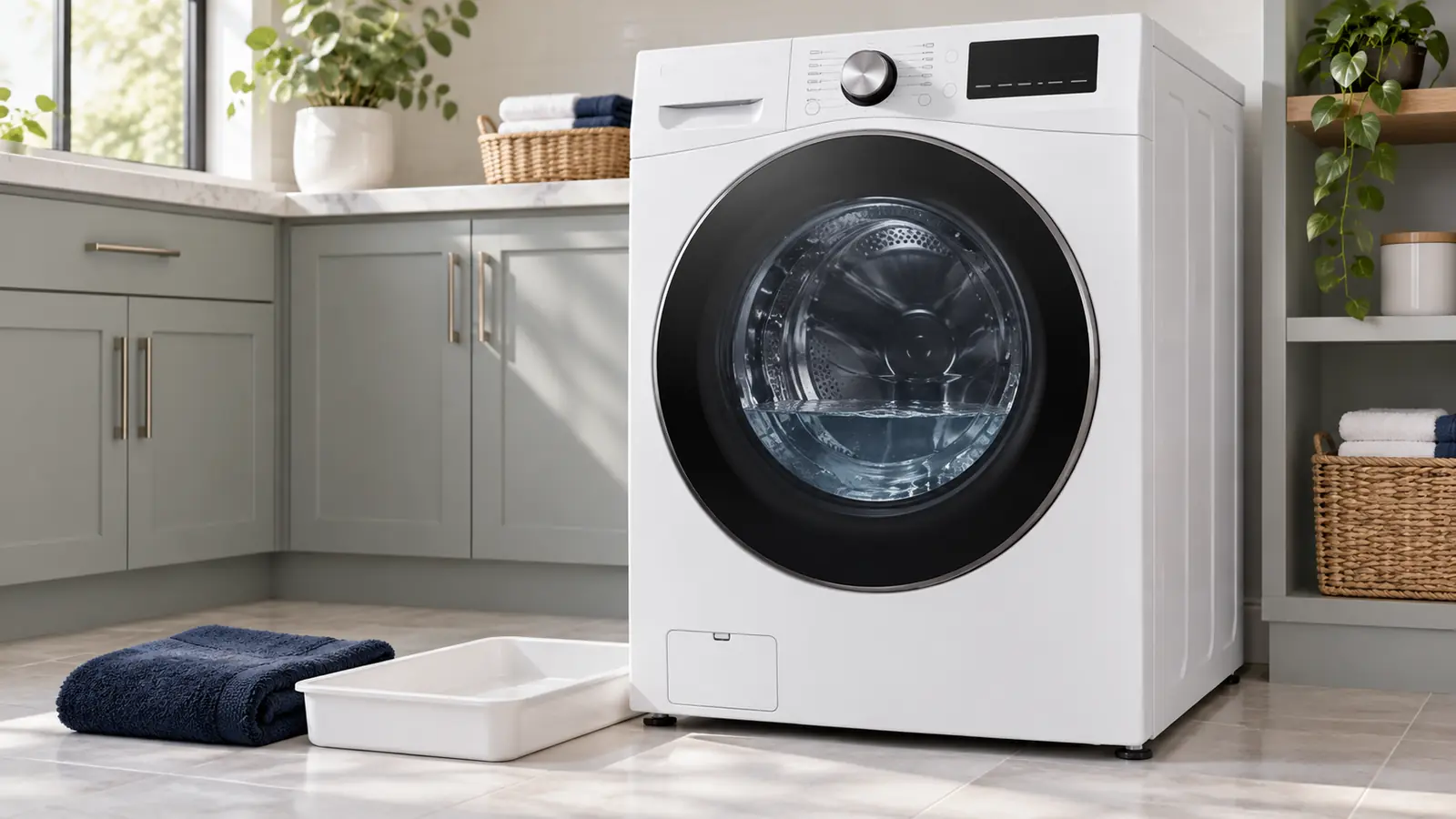
Before touching a filter, locate the exact model's procedure. If the unit has an emergency drain tube, it may allow you to release water gradually into a shallow container. Some units have a filter but no separate emergency tube; others have no practical homeowner access at all. Opening a filter abruptly while the tub is full can cause a large spill.
Where the manual permits filter cleaning, prepare towels and a shallow pan, turn the machine off, disconnect power only if the plug is safely accessible and dry, wait for hot water to cool, release water using the provided method, remove debris from the accessible filter, and reinstall every cap and filter securely. Do not reach into the cabinet, pull the pump assembly, or probe electrical components.
See LG's drain-pump filter instructions or Maytag's manual-draining overview for examples of model-dependent access.
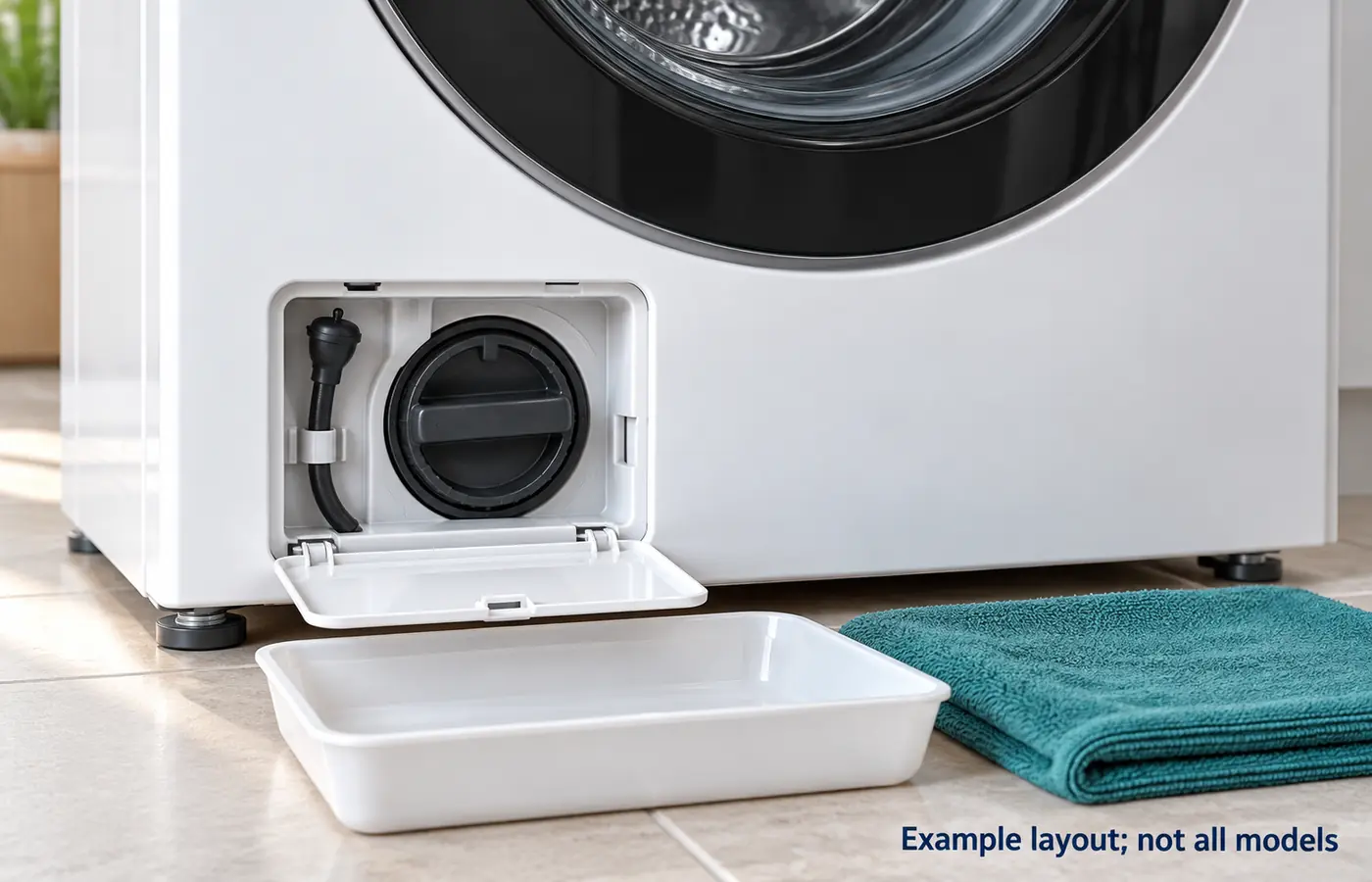
3. The Standpipe or Household Drain Is Blocked
A washer may pump water successfully but still leave a mess if the household drain backs up. Warning signs include water rising from the standpipe, overflow at the laundry sink, gurgling, or drainage problems elsewhere in the utility area.
GE Appliances identifies the standpipe or household plumbing as a possible source of slow draining and recommends plumbing help if the drain cannot accept water. If you see an overflow, stop using the machine. Do not run repeated pump tests or direct the drain hose onto the floor. A plumber is generally the better first call when the home's drainage connection is blocked; an appliance technician is more appropriate when the washer cannot push water out of its own drain system.
4. Excess Detergent or Suds Interfere With the Cycle
Excessive foam can interfere with draining or spinning on some high-efficiency machines. Use detergent intended for your washer, follow the dosing instructions for load size and soil level, and account for concentrated formulas. LG notes that excess suds can contribute to an OE drainage error in certain front-load models.
If the filter is clear and the machine's manufacturer recommends a rinse or tub-clean cycle to clear suds, follow that documented procedure after the drainage issue and any leaks have been addressed. Do not keep adding products or run a new cycle while water is overflowing.
5. The Door, Lid, or Cycle Cannot Advance Normally
Some machines interrupt certain drain or spin stages when the door or lid is not correctly closed or a safety interlock reports a fault. Check for clothing caught in the seal, a door that is not fully shut, or a related display message. The exact relationship between lid position and draining varies by machine design and age, so the model manual matters.
Never tape down a lid switch, bridge a lock, force a door, or run the washer with an interlock defeated. If the door remains locked and standing water is visible, follow the manufacturer's recovery instructions or contact service.
6. The Drain Pump or Another Internal Component Needs Service
A failed or obstructed pump, damaged internal hose, or an electronic fault can also prevent drainage. These possibilities become more relevant when the exterior drain hose is correctly routed, any homeowner-accessible filter is clear, and the problem continues.
A humming sound by itself cannot confirm whether the pump is functioning. LG uses pump noise as one clue in a model-specific diagnostic sequence; GE advises service when a washer is full of water and only hums. Internal pump inspection, cabinet removal, wiring tests, and part replacement belong to a qualified appliance technician.
How to Get Standing Water Out of a Washer Safely
The right method depends on the type and model of washer. There is no single safe emergency-drain procedure for all washing machines. If water has reached electrical components, do not attempt the steps below; obtain qualified help instead.
Front-load washer with a documented emergency drain tube
- Confirm the procedure in the owner's manual, stop the cycle, and allow hot water to cool.
- Turn the machine off and unplug it if the plug, outlet, and floor are dry and safely accessible.
- Place towels and a shallow pan below the designated service access.
- Use the small emergency drain tube exactly as documented, emptying the pan in controlled portions. Never remove the main filter first when water could rush out.
- Refit the tube cap and, where instructed, clean and securely reinstall the user-accessible filter. Check the area for leaks before using the washer again.
Top-load washer or model without a documented drain-access procedure
Do not assume there is a filter or tube behind a panel. Keep the lid closed if needed for safety, stop the cycle, and check the exact manufacturer's instructions for an available drain function. If safe, a model-supported Drain & Spin option may help, but do not repeat it when the standpipe is overflowing or the pump is struggling.
If the tub remains full or the manual offers no accessible emergency-drain method, arrange appliance service. Maytag notes that manually draining a top loader may require a professional.
Front-Load vs. Top-Load: What Changes?
| Question | Front-load washer | Top-load washer |
|---|---|---|
| Is there a removable pump filter? | On some models, often behind a lower-front service cover. | Often no homeowner-accessible drain filter; check the model manual. |
| Can I release water through a small drain tube? | Some models provide one; others do not. | Usually not a standard homeowner feature; do not assume access. |
| Should I open a locked door or lid? | Never force a locked front door open with standing water behind it. | Do not bypass a lid interlock or reach into moving components. |
| Where do I check first? | Visible hose, code, standpipe, and documented service access. | Visible hose, standpipe, code, cycle/lid status, and manual. |
Common Washer Drain Error Codes
Error codes can save time, but meanings differ by brand and model. Look up the exact code using the model number on your washer rather than assuming that the same letters mean the same problem everywhere.
| Brand / covered family | Example code | Typical meaning in cited guidance |
|---|---|---|
| LG washers | OE |
Water outlet or drainage error; hose and accessible filter are common checks. |
| Samsung US washers | nd, 5E, SE, 5C, SC |
No drain or slow drainage. |
| Whirlpool / Maytag, applicable models | F9 E1 |
Long drain time. |
| Electrolux front-load, applicable models | E21 |
Water is taking too long to pump out. |
For comparison, OE is associated with a drainage error in LG guidance, while similar-looking OE/0E
codes in Samsung's US code table can indicate overflow. Verify the brand before interpreting
the display. Manufacturer references: LG, Samsung, Whirlpool, and Electrolux.
When to Call an Appliance Technician vs. a Plumber
Call an appliance technician
- The washer stays full after safe, model-approved checks.
- A pump hums without moving water, or a drain code returns.
- The filter is inaccessible or the door remains locked.
- You suspect an internal pump, wiring, sensor, or door-lock fault.
Call a plumber
- Water backs up or spills from the standpipe or laundry sink.
- Several nearby household drains are slow or gurgling.
- There is a likely obstruction beyond the washer's drain hose.
- The laundry plumbing connection needs to be corrected.
If flooding has affected outlets or electrical equipment, contact a qualified electrician or appropriate emergency help before either appliance or plumbing work proceeds. The Electrical Safety Foundation International cautions against re-energizing water-damaged electrical equipment without proper evaluation.
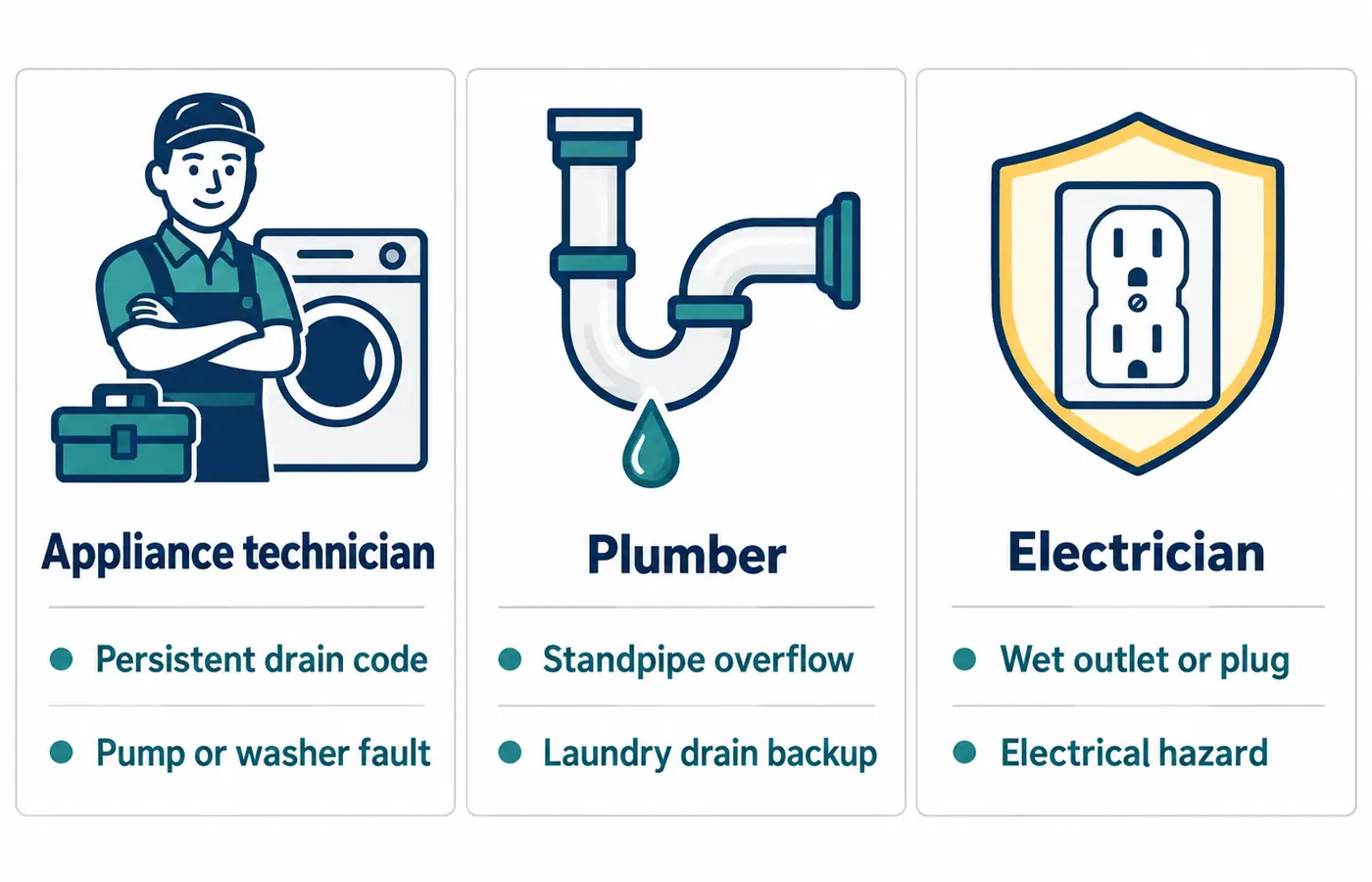
How to Reduce the Chance of Another Drain Problem
- Empty pockets. Coins, clips, and other small items may collect in accessible filters or affect the drain path.
- Use the correct detergent and amount. Follow your washer's HE and load-size recommendations to minimize excess suds.
- Maintain the filter only as instructed. If your model includes a customer-accessible pump filter, use its specified cleaning procedure and interval. LG recommends regular cleaning for its covered front-load models.
- Keep the drain hose correctly supported. Recheck routing after moving the washer or having the laundry area remodeled.
- Notice plumbing warning signs. Water rising at the standpipe or a slow laundry sink should be addressed before another wash cycle.
- Never rely on an extension cord. The U.S. Fire Administration advises plugging major appliances, including washers, directly into a wall outlet.
Frequently Asked Questions
How do I get water out of a washing machine that won't drain?
Look up the manufacturer's emergency-drain procedure for your exact model. Some front-load washers provide a small tube behind a lower service door; other machines have no customer-accessible drain point. If the washer is full, water is hot, or there is an electrical hazard, do not improvise by removing panels, tipping the appliance, or forcing the door. Arrange professional help when no safe manufacturer-approved method is available.
Why does my washer hum but not drain?
Humming can occur when the drain system is attempting to operate but water cannot move, or when a pump-related problem is present. It is not a reliable stand-alone diagnosis. GE recommends service for a washer that remains full of water and only hums. Check only the safe, accessible hose or filter items allowed by your manual before escalating.
Can a washer refuse to spin because it cannot drain?
Yes, some washers will not begin or complete a high-speed spin while too much water remains. If you can actually see standing water, address the drainage issue first. If the basket is already empty but clothes remain wet, the more relevant problem may be spin speed, balance, or the spin mechanism. See Washer Not Spinning: Troubleshooting Guide.
Does every washer have a drain pump filter I can clean?
No. Some front-load models provide a user-removable filter; many top-load machines do not provide the same access. A hidden internal filter or pump is not permission to remove the cabinet. Use the owner's manual and model number to confirm exactly what is intended for homeowners.
Why is water coming back up the washer standpipe?
The household drain may be partially blocked or unable to accept the washer's discharge. Stop the cycle if overflow occurs, keep the area safe, and consider a plumber. Also check the washer's installation manual for the correct hose position; incorrect insertion or an airtight seal can cause different drainage problems, including siphoning or backflow.
Is it safe to run Drain & Spin again?
Only if the machine's manual supports that option and there is no leak, wet electrical equipment, standpipe overflow, or other safety concern. A single model-approved check after correcting an obvious issue may be reasonable. Repeating cycles against a blocked drain can create more water damage and is not a substitute for repair.
Manufacturer and Safety References
This guide summarizes common homeowner-safe checks. Drain layouts, access panels, error codes, and acceptable procedures vary by model. For exact instructions, use the manual associated with your washer's model number.
- Whirlpool Product Help — Washer Not Draining or Spinning?
- Samsung US — Washing Machine Will Not Drain
- LG US — How to Clean the Drain Pump Filter
- GE Appliances — Front Load Washer Will Not Drain or Drains Slowly
- GE Appliances — Top Load Washer Will Not Drain
- Maytag — How to Drain a Washing Machine
- Electrolux — E21 Long Pump-Out Time
- ESFI — Water-Damaged Electrical Equipment