A washer that won't spin can leave clothes dripping wet, stop midway through a cycle, or appear to wash normally without ever reaching the final high-speed spin. The cause may be as simple as an uneven load or the wrong cycle setting. In other cases, the washer cannot drain, its door or lid isn't securing properly, or a component needs professional attention.
Start with the symptom. A machine that drains completely but won't spin calls for different checks than one with water still standing in the drum. The steps below cover both top-load and front-load washers, with important differences noted where the model matters.
Stop immediately if there is an electrical or water hazard.
Do not continue using a washer that produces smoke, sparks, a burning odor, an electric shock sensation, or repeated breaker trips. Do not touch an outlet or plug while standing in water. Stop using the appliance and obtain qualified help. Never reach into a moving drum or force open a locked door.
Washer Not Spinning? Check These Five Things First
If your washing machine won't spin, work through these low-risk checks before assuming it needs a new motor. Use the controls described in your owner's manual and let any moving parts stop completely before opening the washer.
1. Wait for the normal cycle transition
Some washers pause before pumping out water or accelerating into spin. Check whether the display still shows an active cycle. A short pause alone doesn't prove a failure.
2. Redistribute the laundry
After the drum stops and the lid or door releases, separate tangled garments and spread their weight more evenly. Remove items if the drum is tightly packed.
3. Review the spin setting
Look for Low Spin, No Spin, Rinse Hold or a gentle-fabric program. Select a spin speed appropriate for the fabric care label and the washer's instructions.
4. Check the lid or door
Check for clothing caught in the opening and close the lid or door normally. Never defeat, tape down or bypass a lock or safety switch.
5. Look for standing water
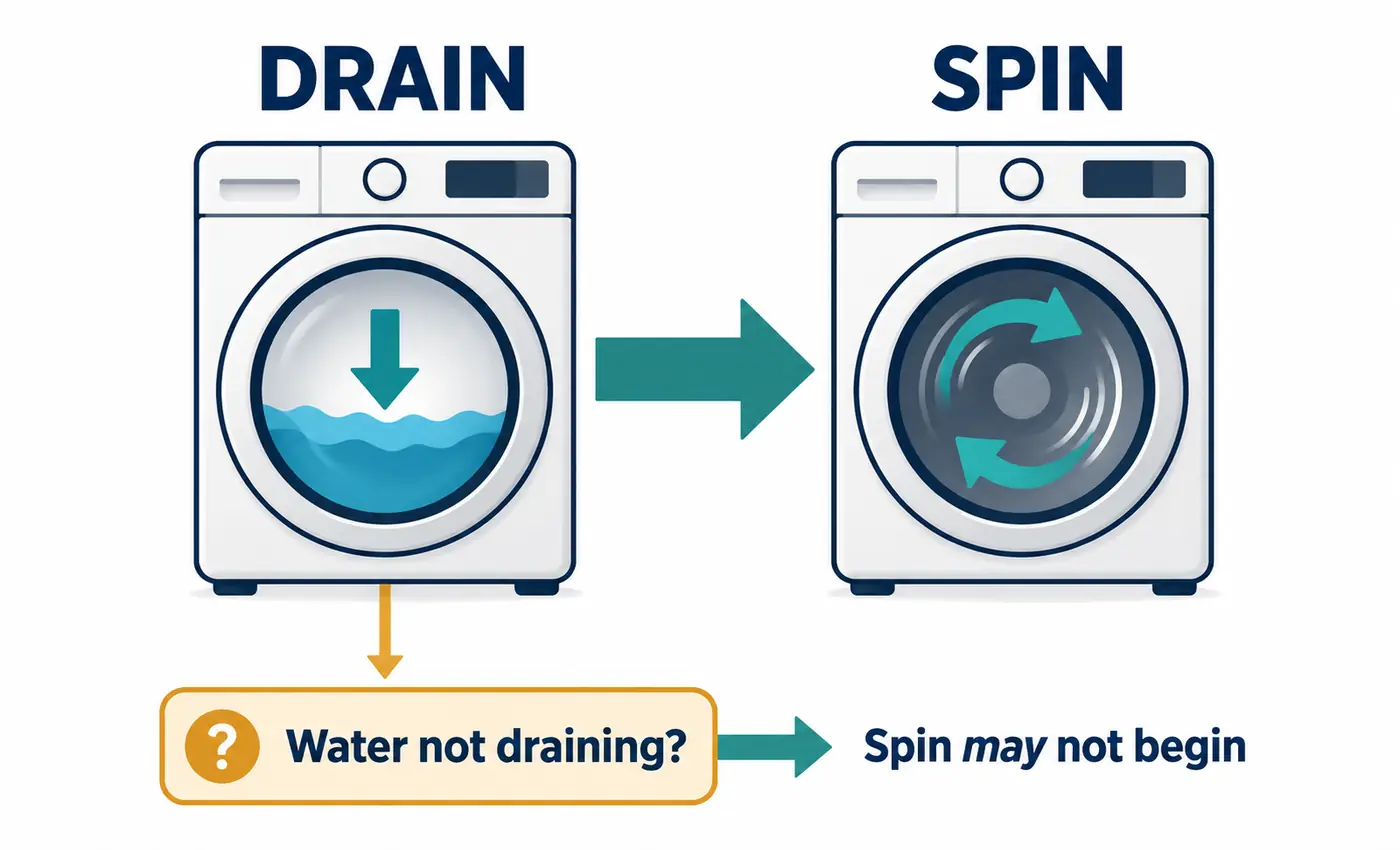
If water remains in the drum, the washer may be unable to complete its drain stage and begin spinning. Inspect only accessible, visible drain-hose sections first.
If you change a setting or rebalance a load, test the appropriate Spin, Drain & Spin, or Rinse & Spin program only if your specific washer provides it and its manual permits it. Stop if a leak, severe banging or an electrical warning occurs.
Diagnose the Symptom Before You Try a Fix
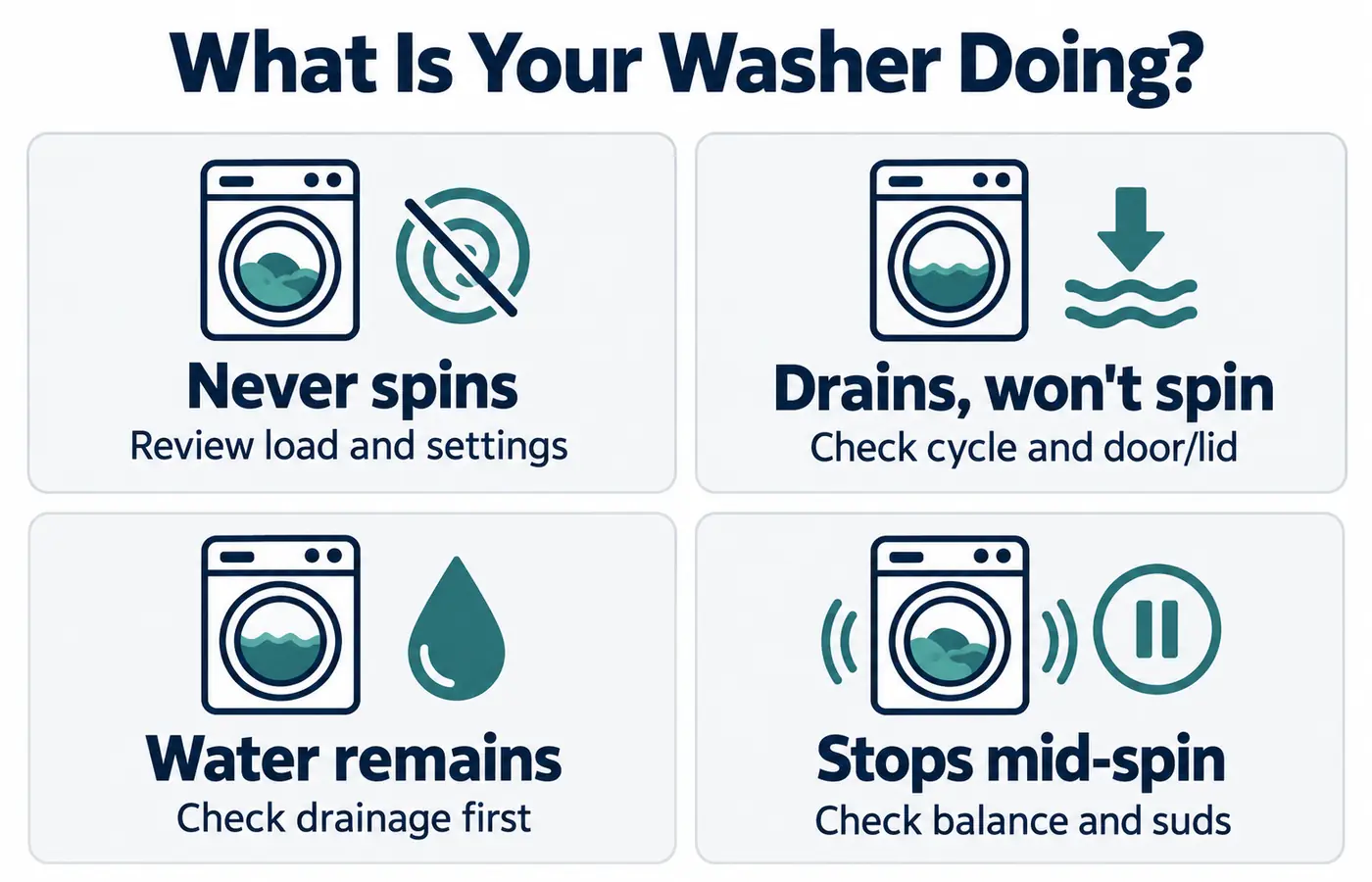
The same phrase—“washer not spinning”—can describe several different behaviors. Matching what you observe to a likely problem area helps avoid unnecessary repairs.
| What the washer does | Start by checking | What it may mean |
|---|---|---|
| Doesn't spin at all | Cycle state, lid/door closure, settings, drainage | The machine may not be receiving permission to start the spin stage; a persistent problem can require service. |
| Starts spinning, then stops or shakes | Uneven or bulky load, washer stability | Balance protection may be limiting or interrupting spin. |
| Drains completely but won't spin | Spin settings, lid/door lock, imbalance | A drain blockage is less likely if water actually empties; a drive or control fault remains possible. |
| Won't drain or spin; water remains | Visible drain hose, model-approved maintenance filter | A drainage problem may be stopping the washer before spin. |
| Washes but won't rinse or spin | Normal pause, Rinse Hold, water supply/drainage, cycle error | The issue may occur before the final spin stage, not during spinning itself. |
| Spins, but clothes are soaking wet | Low spin speed, load balance, suds, incomplete drainage | The washer may spin, but not fast or long enough to extract the expected water. |
Common Causes of a Washing Machine That Won't Spin
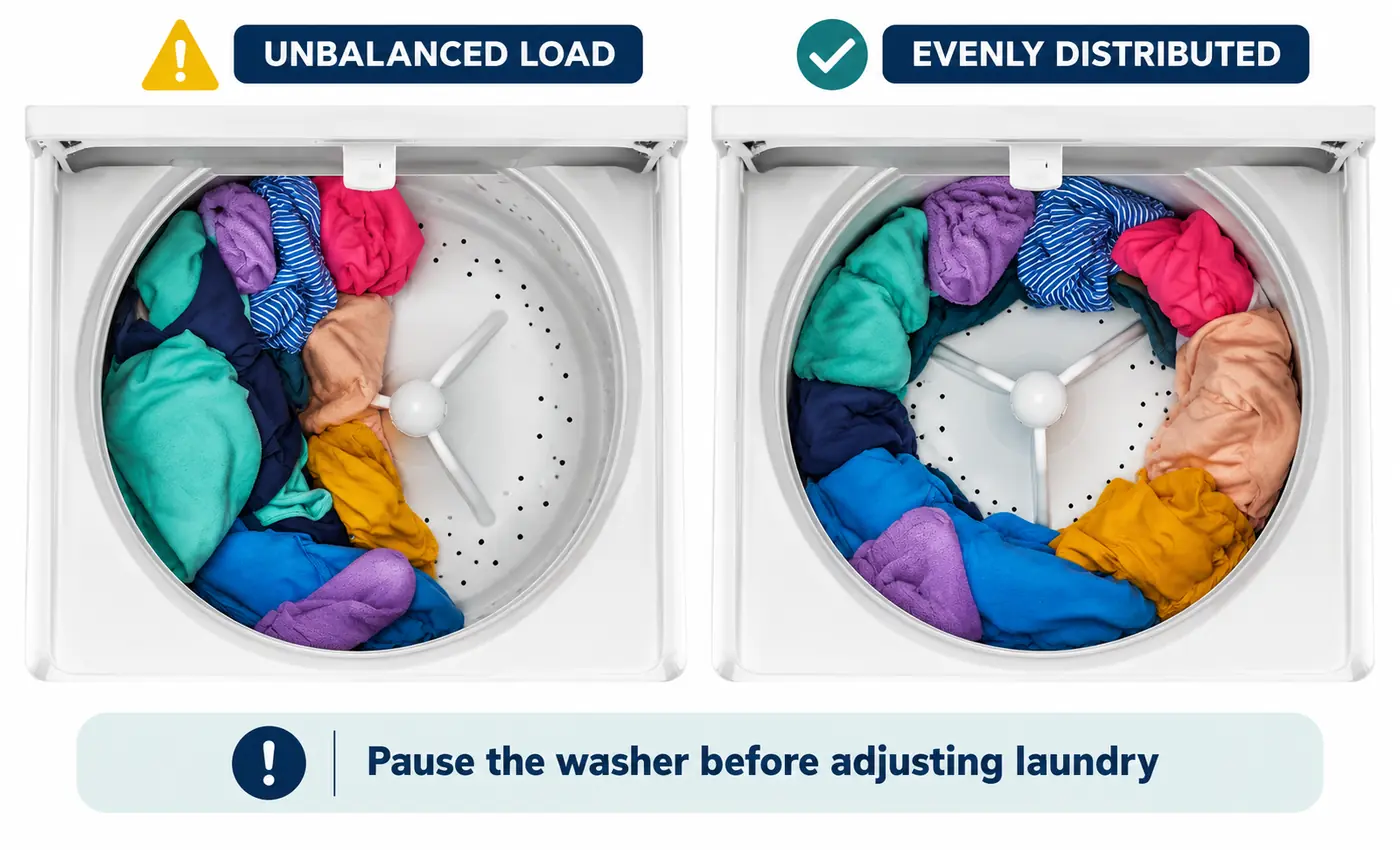
1. An unbalanced, oversized or very small load
Wet towels, bedding, jeans and single bulky items can gather on one side of the basket. The washer may reduce spin speed, refill to redistribute the load or stop the cycle to limit vibration. Overfilling can create the same problem, but so can washing just one heavy item.
Safe fix: Wait until the basket stops and the lock releases. Loosen tangled items, spread the load evenly, and remove some clothing if it is packed tightly. For a very small load, adding one or two similar washable items may help if your manual recommends it. Follow the garment care instructions for bulky items; do not assume every comforter is machine washable.
2. Low Spin, No Spin or a gentle wash cycle
A washer may be operating as programmed while leaving clothes wetter than expected. Delicate and hand-wash settings often use gentler extraction. Some machines also offer No Spin, Rinse Hold or similar options that delay or skip the normal high-speed final spin.
Safe fix: Review the selected cycle and any spin-speed or rinse-hold option. Choose a suitable speed for the fabric rather than automatically selecting the highest setting. If the load is already washed and the machine has a supported Spin or Drain & Spin cycle, use it according to the manual.
3. The door or lid isn't securely closed
Many washers require confirmation that the lid or door is closed and, for certain operations, locked. Clothing trapped in a front-load door gasket, a lid that hasn't latched, or an incomplete cycle-start command can prevent normal operation. Some front-load models also require the detergent drawer to be fully closed.
Safe fix: After the machine stops, remove any item caught at the opening, then close the door or lid normally. Look for a door/lid warning on the display and follow the owner’s instructions. A damaged latch, switch or lock assembly needs proper diagnosis; never bridge or bypass an interlock.
4. The washer has not finished draining
On washers that drain before spinning, standing water can prevent the final spin from starting. A visibly kinked hose, drainage restriction or user-serviceable filter clogged with lint or small objects may be involved. A failed pump or other internal fault is also possible, but it cannot be diagnosed from wet clothes alone.
Safe fix: Check the visible exterior drain hose for sharp bends or crushing without pulling the washer away from the wall or disconnecting plumbing. If the exact model has a user-accessible pump filter, consult its maintenance procedure before opening anything. Some front-load models have a residual-water hose and filter behind a lower service flap; many top-load models do not.
Important before opening a drain filter
Turn off and safely isolate the washer from electrical power, allow hot water to cool, and prepare a shallow pan and towels. Follow your model's instructions for controlled drainage and filter removal, then secure every cap before reuse. If there is a large amount of standing water, an inaccessible filter, or water near electricity, stop and get help.
5. Too much detergent or excessive suds
Excessive foam can interfere with water removal and the washer's cycle logic. This is more likely if you use too much detergent or a non-HE product in a washer that requires high-efficiency (HE) detergent. Suds-related behavior can resemble slow drainage or poor spin performance.
Safe fix: Follow the detergent label and washer's dosing guidance. If the machine displays a suds-related message, follow the manufacturer's recovery instructions. Avoid improvised chemical treatments and do not keep restarting cycles while water is leaking.
6. The machine is not level or has shifted
A washer that rocks on the floor or was recently moved may have difficulty maintaining balance during high-speed spin. Excessive movement can cause the washer to reduce speed or stop. On newly installed machines, model-specific installation steps—such as removing shipping restraints on applicable front-load washers—also matter.
Safe fix: With the washer stopped, inspect whether it sits stable and appears level. Follow your model's instructions for leveling and installation. Do not move a heavy, stacked or tightly connected appliance alone, and do not reach behind it where power or water connections are difficult to access safely.
7. A power interruption or an unfinished cycle
An outage or interruption may leave the washer between stages. Some washers also pause normally before draining and accelerating into spin. A countdown that hasn't reached the end isn't necessarily a fault.
Safe fix: Check the display and wait through a normal transition if the washer is otherwise operating safely. If power was lost, follow the exact model's restart procedure. If the unit is repeatedly tripping a breaker, do not reset the breaker again to force operation.
What If the Washer Drains but Won't Spin?
If you can confirm the water has drained away but the drum never accelerates, focus first on the lid or door lock, selected spin speed, an interrupted program and balance warnings. Repeatedly cleaning the drain filter is unlikely to solve a problem when drainage is already normal.
A drive belt, clutch, coupling, motor, speed sensor or electronic control could be involved, depending on washer design. However, hearing a hum or seeing the drum stand still does not identify a failed part. Those possibilities require a qualified technician to inspect the correct model.
What If the Washer Won't Drain or Spin?
Water still visible in the drum changes the priority. On many designs, the washer must remove water before it proceeds to spin. Check the exterior hose only where you can safely see it, note any drain-related message, and follow the user-maintenance instructions for that model. Do not detach hoses full of water or keep forcing a spin cycle when the tub cannot empty.
If the drain path is inaccessible, the water level remains high, or the same problem returns after safe maintenance, arrange service. The drain system deserves its own diagnosis; a spin symptom alone does not prove a faulty motor.
Why Does It Start Spinning and Then Stop?
A washer that begins spinning but slows down or stops often needs a balance check. Heavy towels may bunch up, a small load may sit off-center, or the machine may not be level. Some washers add water and try again, which can look like the cycle is moving backward.
Stop and seek service if violent shaking continues with a properly arranged load, the washer walks across the floor, or you hear repeated grinding or metal-on-metal noise. Do not hold a running washer in place.
What If Clothes Are Still Soaking Wet?
Wet laundry doesn't always mean the drum never spun. Low-spin fabric settings, a heavy unbalanced load, excessive suds and incomplete water removal can all reduce extraction. Check whether the selected cycle was intended to spin gently and whether any standing water remains. Only run an additional spin program if the manual supports it and no safety warning is present.
What If It Washes but Won't Rinse or Spin?
When a washing machine stops between washing, rinsing and spinning, the fault may occur before the final spin. A normal program pause, Rinse Hold, lack of incoming water during rinse, an incomplete drain, or a detected load imbalance can interrupt progress. Determine which stage is actually failing and record any displayed code.
If the machine won't rinse, check that the water supply is available and that the selected cycle does not intentionally hold the load in water. If it won't empty the water after rinsing, handle that as a drainage issue. If it rinses and drains but never spins, return to the door/lock, balance and program checks above. Persistent sequence failures can require control-system diagnosis rather than another spin-only attempt.
Top-Load vs. Front-Load Washer: What Changes?
Top-load washer
- Check the lid and any lid-lock warning.
- Spread heavy clothing evenly inside the basket after it stops.
- Look for rocking, off-balance alerts or a shifted appliance.
- Do not assume there is a front-access drain pump filter.
Front-load washer
- Look for fabric caught at the door opening or gasket.
- Confirm the door closes normally; on some models, the dispenser drawer also matters.
- Check load distribution and spin-speed settings.
- Clean a user-accessible drain filter only if your manual specifies one.
Features differ even within one brand. For example, LG documents a maintenance drain pump filter on its cited front-load and combo products, not its top-load washers. Always identify your model before following a video that shows hidden panels, hoses or service procedures.
Washer Error Codes and Resets Depend on the Model
Write down exactly what appears on the display. A letter or number can mean different things across manufacturers, product lines and production years. Here are examples, not a universal code dictionary:
| Example | What the manufacturer describes | Appropriate next step |
|---|---|---|
| LG top-load uE / UE / Ub | Load balance problem on affected models | Review load distribution, washer stability and the model's recommended cycle. |
| LG front-load OE | Water is not draining properly | Check the visible drain hose and model-approved filter procedure. |
| Samsung drain or balance alert | Meaning depends on the exact model and displayed code | Use Samsung's official code lookup or the owner's manual instead of guessing. |
There is no universal washer reset. Online instructions to unplug every washer for a fixed number of minutes or lift the lid a set number of times can apply only to particular designs—or be irrelevant. Use a documented power, reset or calibration procedure for your specific model. Never attempt a reset to work around repeated electrical trips, leaks or a damaged lock.
When to Stop Troubleshooting and Call for Repair
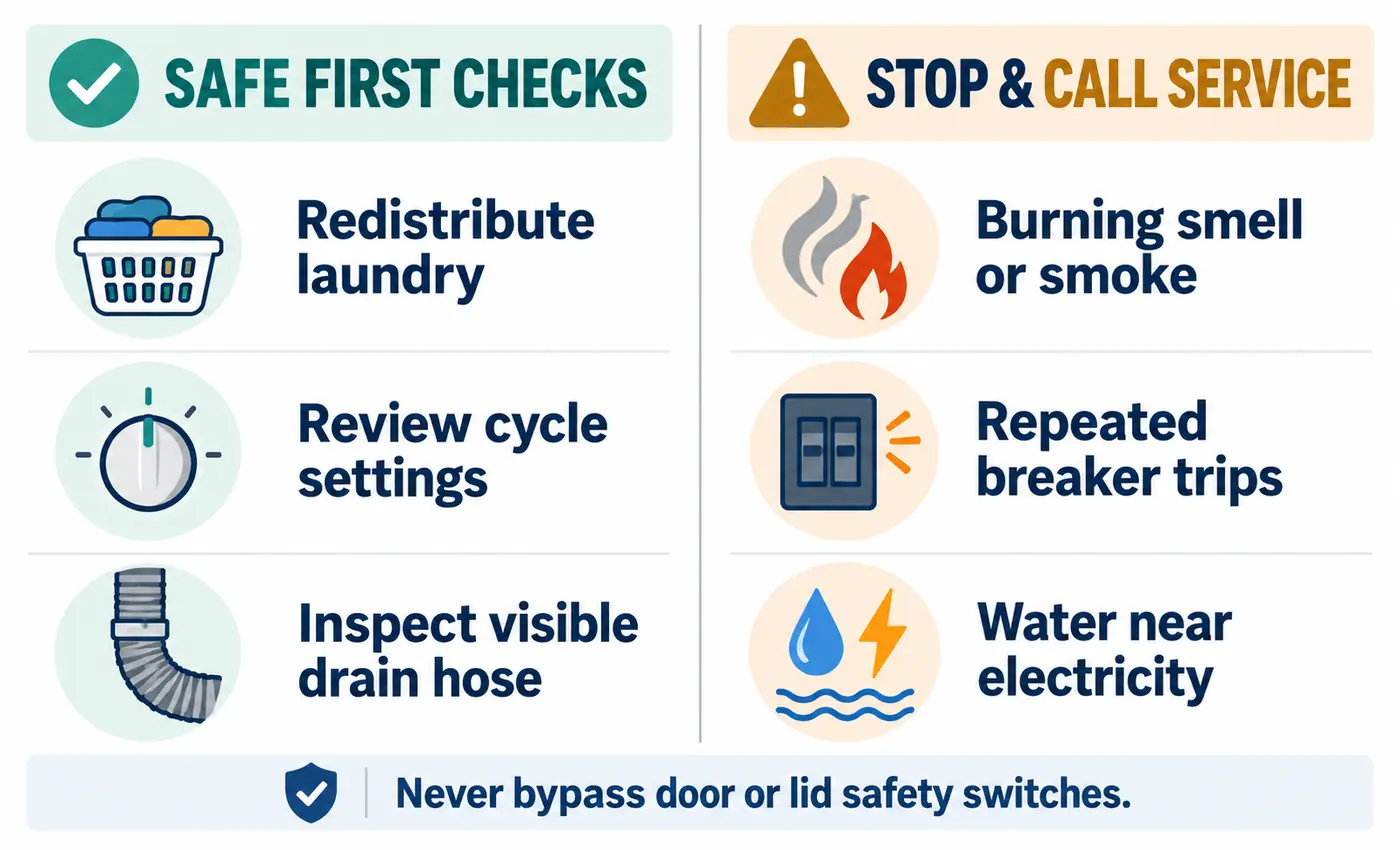
A few owner-level checks can rule out common non-failure causes. They should not turn a safe inspection into electrical, mechanical or flood-damage work.
- Confirm a normal cycle or pause has finished.
- Redistribute a load after the drum stops.
- Review the cycle, spin speed and detergent amount.
- Close the door or lid normally.
- Observe visible hose kinks and check machine stability.
- Perform explicitly documented user maintenance on an accessible filter.
- Smoke, burning smell, sparks, shocks or repeated breaker trips.
- Water near electrical connections or uncontrolled leaking.
- Severe banging, grinding or movement across the floor.
- A door that will not unlock through the documented procedure.
- Persistent no-spin after safe checks.
- Suspected wiring, motor, belt, coupling, board or lock replacement.
For a service call, note the brand, model number, the exact stage where the machine stops, whether the tub drains, any error code, and whether the failure occurs with a normal balanced load. This information helps the technician narrow down the problem without assuming a particular part is defective.
Frequently Asked Questions
Why is my washer not spinning but draining normally?
If the washer empties fully, check the spin setting, door/lid lock, load balance and whether the cycle actually reached its spin stage. A persistent failure can involve the drive or controls, but it needs model-specific testing before anyone replaces parts.
Can an unbalanced load stop a washing machine from spinning?
Yes. Some washers reduce or interrupt spin when the load is unevenly distributed. Wait for the drum to stop and unlock, then rearrange the laundry. Extremely small and single bulky loads can also create an imbalance.
Why are my clothes soaked even though the washer spun?
The spin may have been intentionally slow, interrupted by imbalance, limited by suds, or affected by incomplete drainage. Check the cycle and spin-speed options along with whether water remains in the washer.
Can I use Drain & Spin to fix wet clothes?
It can help if your washer provides that cycle, the selected fabrics permit it, and the original problem was a low-spin setting or redistributed load. It will not reliably fix a blocked drain, broken lock or failed component. Do not keep retrying if the machine is leaking or displaying a fault.
How do I reset a washer that won't spin?
Consult the manual for your exact brand and model. Reset and calibration methods vary, and some machines have no homeowner reset for this symptom. Never use a reset to override a safety warning or repeatedly tripped breaker.
Is it safe to keep trying the spin cycle?
One appropriate retry after correcting a load or setting may be reasonable if the washer is otherwise operating safely. Stop if you notice violent vibration, grinding, overheating, electrical warnings, leaks or recurring error codes.
The Bottom Line
When your washer isn't spinning, the best first move is to separate a true no-spin problem from poor spin performance or incomplete drainage. Start with a balanced load, the proper cycle, a securely closed lid or door and any visible drain problem. Use model-specific instructions for filters, errors and resets. If the washer still cannot spin—or shows unsafe electrical, water or mechanical symptoms—stop and arrange a qualified repair.
Manufacturer Guidance and Safety References
Troubleshooting varies by brand and model. Consult your product's own manual for procedures and limitations.
- Whirlpool Product Help: Not Spinning — Top Load Washer
- Maytag: Washing Machine Not Spinning — Possible Causes and Fixes
- GE Appliances: Top Load Washer — Does Not Spin
- GE Appliances: Front Load Washer — Does Not Spin
- Samsung: Washing Machine Does Not Spin at All
- Samsung: Washing Machine Spins Poorly
- LG: Top-Load Washer UE/Ub Error
- LG: How to Clean the Drain Pump Filter
- Electrical Safety Foundation International: Appliance Safety Tips