A freezer can feel cold and still be too warm to keep food frozen. If your freezer is not freezing, start by checking the actual temperature, protecting thawing food, and looking for a door, setting, or airflow problem. Those checks are safer—and often more useful—than guessing which internal part has failed.
Quick answer: why is my freezer not freezing?
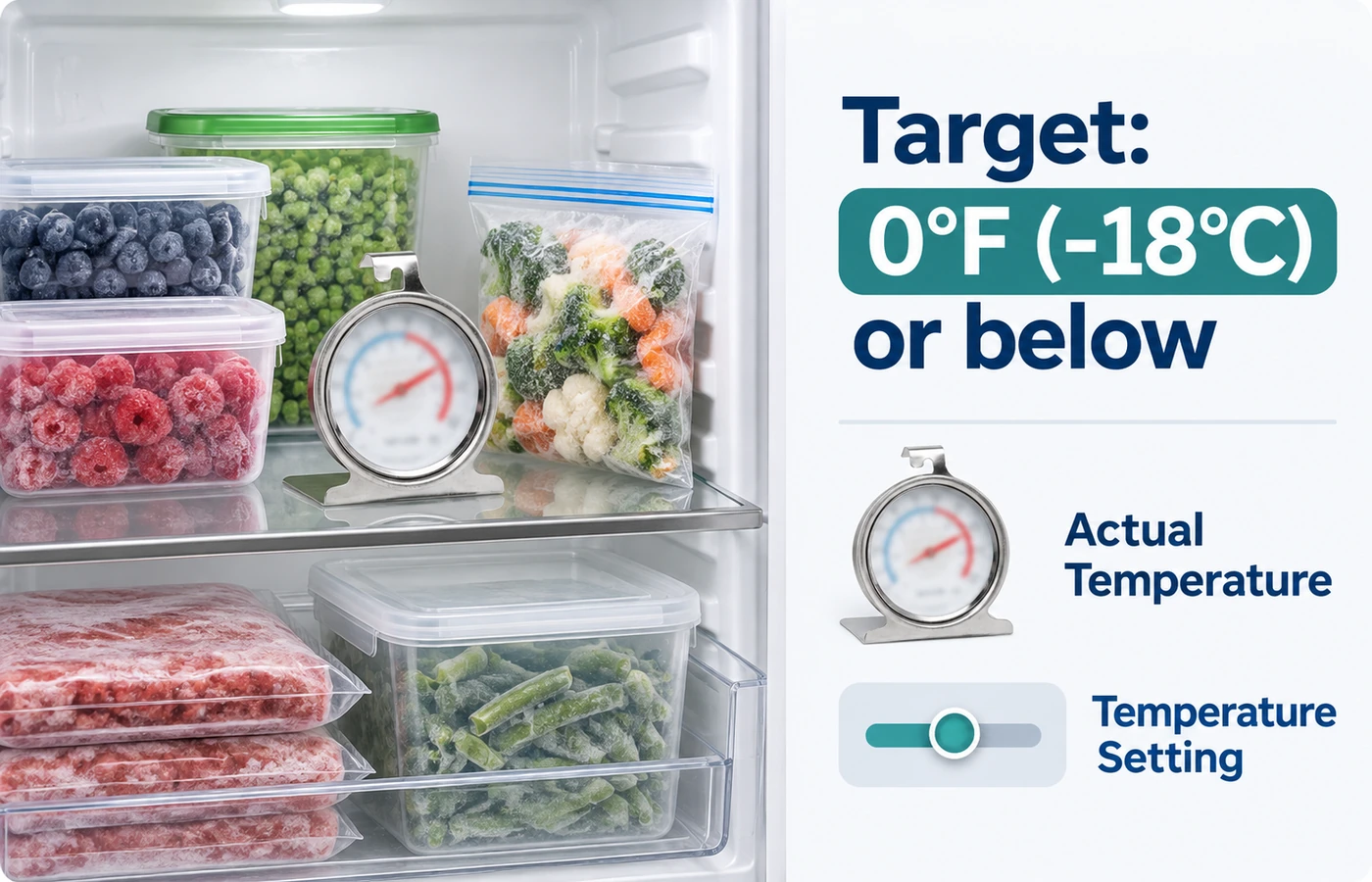
Common explanations include an incorrect setting, a door that does not seal, food blocking air vents, a recent power interruption or large food load, heavy frost, or a cooling-system fault. The target for frozen-food storage is 0°F (-18°C) or below.
Do this first: Check the food, measure the temperature with a freezer thermometer, verify the controls, close the door fully, and clear visible vents. If those checks do not help, or electrical trouble is present, arrange service.
What to check before troubleshooting a freezer
Before moving food or changing settings, check whether the freezer has been losing temperature. Soft ice cream, partially thawed packages, dripping condensation, or a high-temperature alarm all deserve attention. A freezer that feels chilly to your hand might still be far above the temperature needed for long-term frozen storage.
1. Measure, don't guess
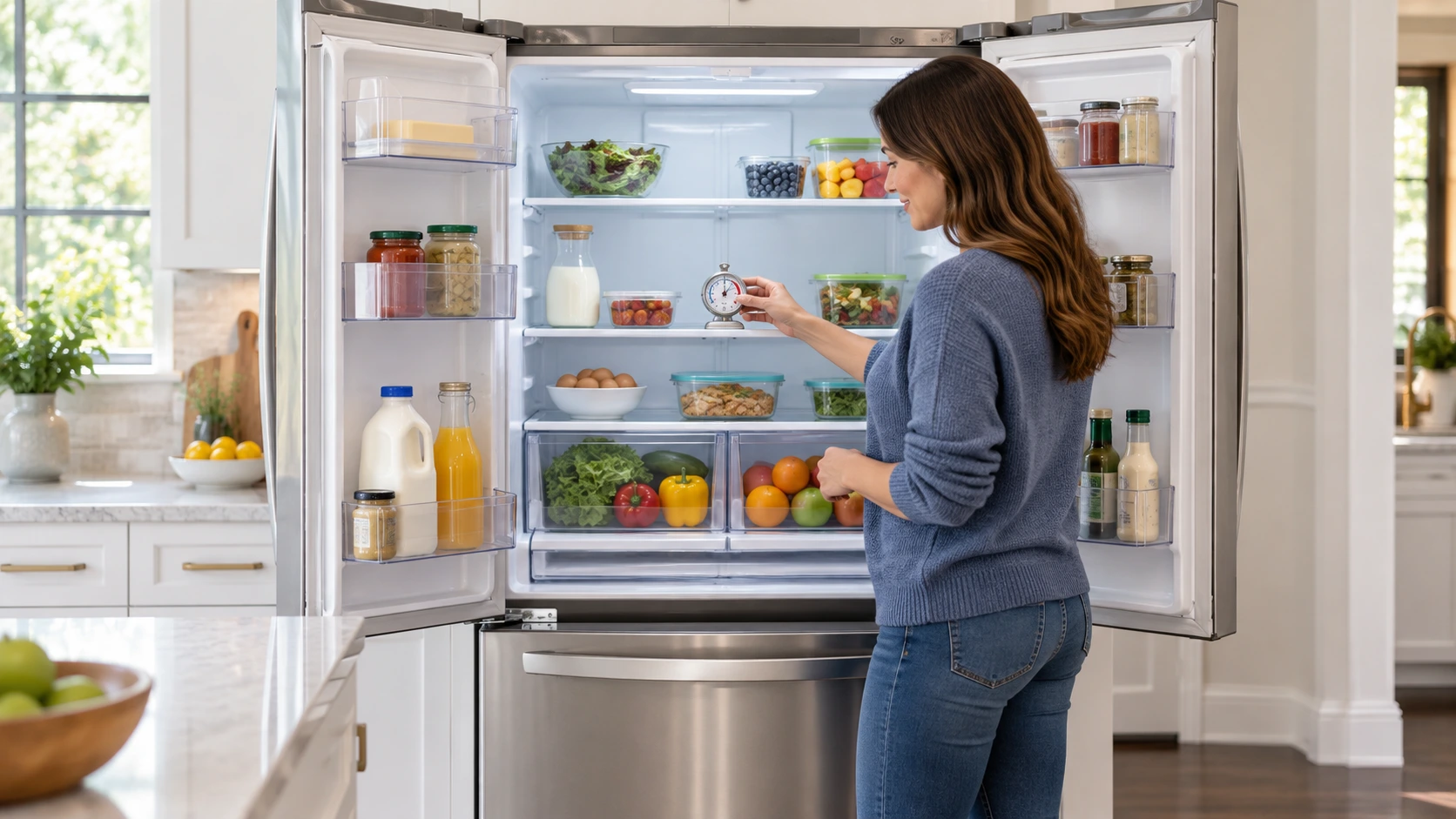
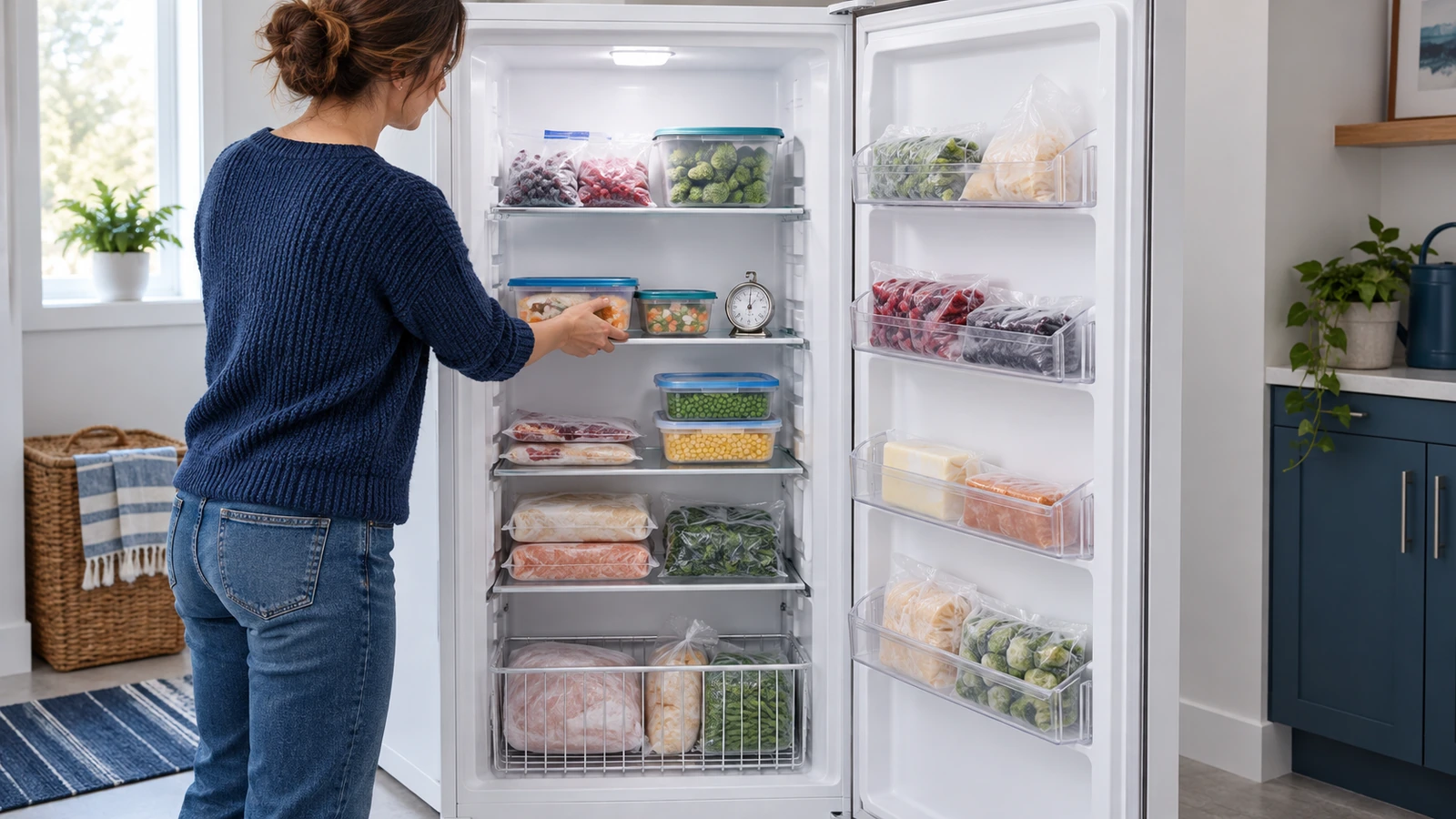
Place a freezer-safe appliance thermometer where its manufacturer instructs. Compare the reading with the 0°F (-18°C) storage target. A control panel's selected temperature is not necessarily the actual temperature inside the compartment.
2. Protect your food
If food is thawing, move items that are still safe to a working freezer or other suitable cold storage if possible. Assess each item using its temperature, ice crystals, exposure time, and the FoodSafety.gov food-specific chart.
Don't assume a short test proves the freezer is fixed. Room temperature, how often the door is opened, recently added warm food, and the specific model all affect recovery. Manufacturers commonly describe a stabilization period after installation, an outage, or a setting change, but recovery time is not a food-safety allowance. Do not keep questionable perishables warming up while you wait.
Stop immediately for electrical warning signs
A burning smell, damaged cord, hot or discolored receptacle, repeated breaker trips, tingling/shock, or water contacting an outlet calls for professional attention. Do not touch wet electrical equipment, remove electrical covers, or repeatedly reset a tripping breaker. Keep people away from the hazard and contact a qualified electrician or appliance service professional.
Freezer not freezing: identify the symptom first
“Not freezing” can describe several different problems. Matching the symptom to the next safe check helps avoid unnecessary disassembly.
| What you notice | Possible explanation | Best first step |
|---|---|---|
| No lights or display, no apparent cooling | Power interruption, unplugged unit, tripped protection, or internal fault | Check for an outage and an accessible, dry connection; stop for damaged wiring or repeat trips. |
| Cold air, but food is soft or thawing | Temperature too high, poor seal, blocked airflow, heat/load, or weak cooling | Measure actual temperature; check door, settings, and vents. |
| Seems to run constantly but does not freeze | Warm air infiltration, high load, ventilation problem, or internal cooling fault | Inspect door closure and surrounding clearance; check temperature trend. |
| Heavy frost or ice near the back wall | Door moisture, restricted airflow, or a defrost-related problem | Check door/gasket; follow the manual for defrosting, and seek service if frost returns. |
| Newly installed or recently restarted | Normal cool-down, unsuitable location, wrong settings, or installation issue | Confirm installation instructions, monitor temperature, and keep food safe elsewhere. |
| Display shows an unfamiliar code or Cooling Off mode | Model-specific diagnostic message or noncooling mode | Use the exact model's manual or manufacturer's support page. |
Seven safe checks when your freezer is not freezing
Work through the checks in order. They apply broadly to household freezers and freezer compartments, but the control layout, maintenance access, and defrost procedure depend on the appliance. Your model's use-and-care manual takes priority.
1. Confirm power, settings, and special operating modes
Look for an obvious outage, a loose but safely accessible plug, an accidental “Off” setting, or an unexpected control-panel mode. If the plug is dry and the area is safe, confirm the appliance is connected as its manual specifies. Major appliances should not be operated through extension cords or overloaded multi-outlet adapters.
Set the freezer according to the manufacturer's instructions, using 0°F (-18°C) or below as the general food-storage goal. Make one adjustment at a time so you can observe whether the measured temperature improves. Different manufacturers use different scales, and a colder-looking number or a “Max” label may not mean the same thing on every model.
On some Samsung refrigerator-freezers, Cooling Off (Demo) Mode disables cooling even while lights and controls continue to operate. The display may show “OF OF” or “O FF.” Other brands also have model-specific showroom or vacation functions. Check the manual rather than following a random button sequence, which could change another setting.
If a breaker trips again after it is reset, stop instead of cycling it repeatedly. If you have already confirmed a safe power supply and appropriate settings but the compartment is not cooling, move on to the remaining external checks.
2. Make sure the freezer door closes all the way
A bag of frozen vegetables, an overfilled drawer, or a misaligned basket can hold the door slightly open. Warm, humid air then enters and can cause both a temperature rise and frost. Open the door briefly and check for packages touching the door, drawers that do not sit flat, or shelves that have shifted.
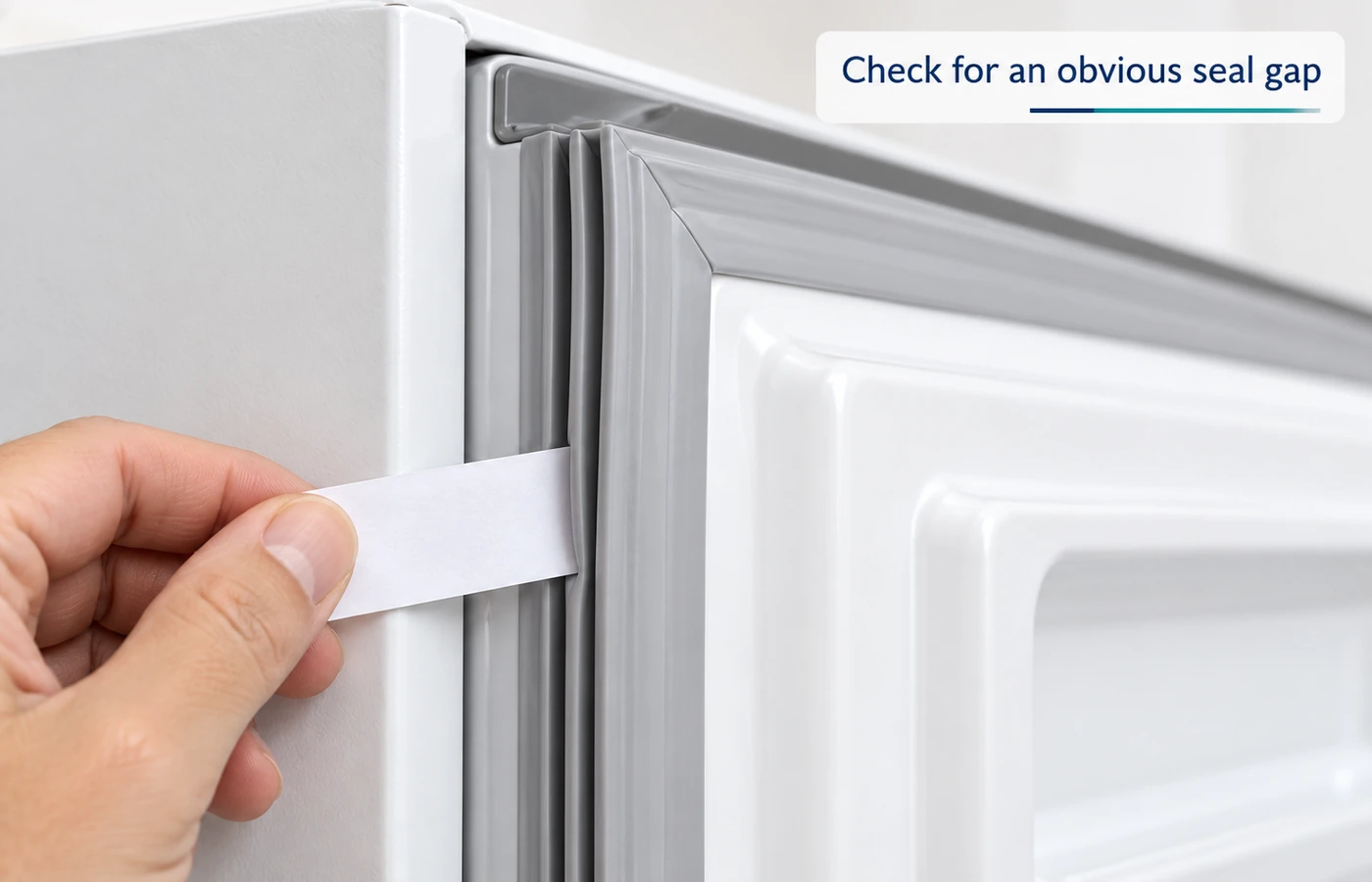
Inspect the gasket—the flexible seal around the door—for food residue, folds, tears, or sections that do not contact the cabinet. Wipe it with mild soapy water if allowed by the manual and dry the surface. You can close the door on a dollar bill or strip of paper and gently pull; resistance can help flag an obvious weak area. This is only a screening check, not a definitive test of the seal.
If the gasket is torn, the door appears misaligned, or the leak persists after clearing obstructions, follow the manufacturer's repair guidance or request service. Avoid forcefully bending the door or heating the gasket with a hair dryer.
3. Open up space around air vents and food packages
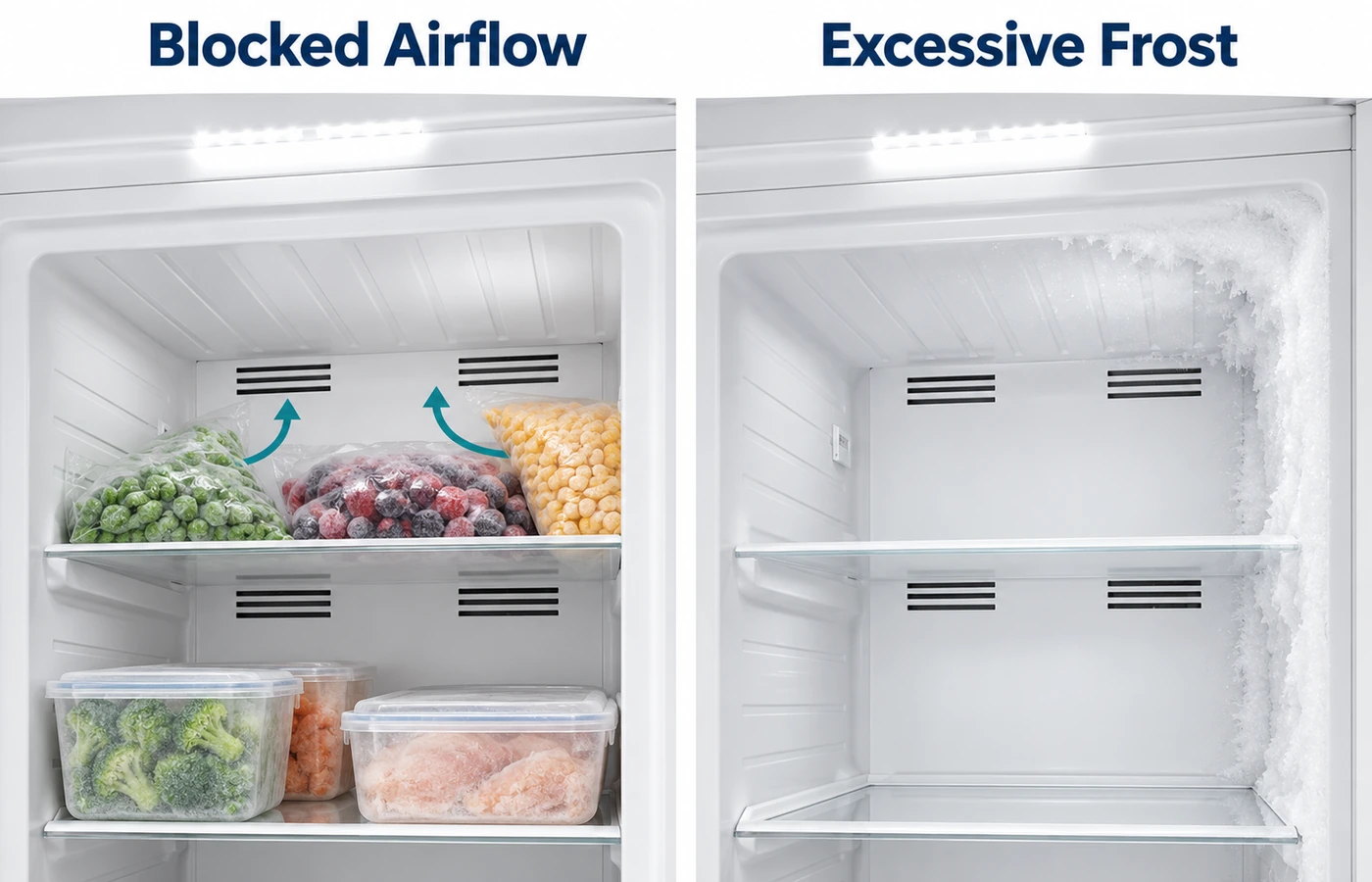
On many refrigerator-freezer combinations and frost-free freezers, internal fans circulate cold air. Packages pushed tightly against the vents can interfere with circulation, leaving some areas warmer than others. Rearrange containers so visible supply and return openings are not blocked. Do not remove internal covers to search for a hidden vent or fan.
Overloading is not the only issue: a freezer that has just received a large quantity of unfrozen food can temporarily warm as the new load cools. Follow your manual's guidance on freezing capacity and loading. Avoid packing food so tightly that the door cannot seal. If only one area is soft while others are frozen solid, note that uneven pattern for a technician.
4. Check the installation area and accessible exterior dust
Freezers need the clearances and ambient temperatures specified in their installation instructions. A unit close to a heat source, in direct sunlight, or with inadequate ventilation may struggle to reject heat. A garage or unheated outbuilding is not automatically suitable: the allowed room-temperature range varies by model, even among products described as “garage ready.”
If the manual calls for cleaning an accessible exterior condenser area, disconnect power as instructed and use an appropriate vacuum attachment or soft brush on surfaces you can reach without removing protective panels. Some standalone chest and upright freezers have condenser tubing built into the cabinet walls, so there may be no exposed coil to clean. Never remove the rear cover merely to find the coils.
5. Look for frost buildup without chipping at the ice
A small amount of frost can be associated with normal use, depending on the freezer type. Thick frost around the door, back wall, or airflow openings can point to a door gap, frequent openings, or a defrost problem. Photograph the frost pattern if you plan to request repair; it may help describe what is happening.
For a manual-defrost freezer, relocate food to safe storage, follow the exact shutdown and drainage procedure in the owner's manual, and let frost melt using the manufacturer-approved method. Protect flooring and keep meltwater away from electrical connections. A frost-free freezer that repeatedly develops heavy ice may need professional diagnosis instead of frequent defrosting.
6. Consider what happened before the problem started
Think about a recent power failure, a prolonged door opening, a move, an installation change, or a large grocery load. These events can explain a temporary temperature rise. On some models a changed setting or restart requires roughly a day or more to stabilize; the actual time differs by model and conditions. Check the manufacturer's instructions rather than assuming every freezer needs the same number of hours.
Use the thermometer to monitor progress while protecting food in a working freezer when necessary. If the temperature continues to rise, stays well above the food-storage target after an appropriate model-specific recovery period, or a high-temperature alarm returns, contact service.
7. Check the display for error codes and request model-specific support
Error messages can help identify the next step, but codes are not universal. Record the brand, model number, displayed code, approximate thermometer reading, and whether the fan or compressor sound has changed. Look up the code on the manufacturer's website. Do not remove an evaporator cover, probe electrical terminals, or test a compressor start device based on a generic internet checklist.
When contacting support, explain whether the freezer is completely warm, cold but not freezing, or freezing unevenly. Those details are more useful than simply saying that it is broken.
What if the freezer is running but not freezing?
A humming sound or a running fan tells you that something is operating, not that the freezer is achieving its target temperature. Persistent running can reflect the freezer's attempt to recover from an open door, warm room, heavy load, or obstructed airflow. It can also accompany a fault that needs repair. Avoid deciding that the compressor or refrigerant is defective from the sound alone.
Evaporator fan or airflow issue
Uneven cooling, unusual fan noise, or ice buildup may be consistent with a fan or airflow problem. The fan's location and behavior vary by model, and a door switch may stop it when the door is open. Let a technician evaluate suspected internal fan faults.
Defrost system problem
Repeated thick frost in an automatic-defrost model can be associated with a defrost heater, sensor, control, or related problem. Frost can also result from a door that leaks moist air, so it does not prove a specific electrical part has failed.
Temperature sensor or control fault
Incorrect readings or erratic operation can involve controls or sensors. The safe homeowner step is to compare the display with an independent thermometer and record codes, not to measure live voltage inside the appliance.
Compressor or sealed refrigeration system
A compressor, start-related component, or refrigerant-circuit fault may be possible after basic causes are excluded. Only an appropriately qualified professional should diagnose internal electrical and sealed-system issues.
Refrigerant service is not a homeowner troubleshooting step. In the United States, EPA Section 608 rules cover technicians who perform work that may release refrigerant, including attaching gauges to refrigerant circuits. Do not attempt to open lines, add refrigerant, or bypass electrical protections.
Is food still safe if the freezer stopped freezing?
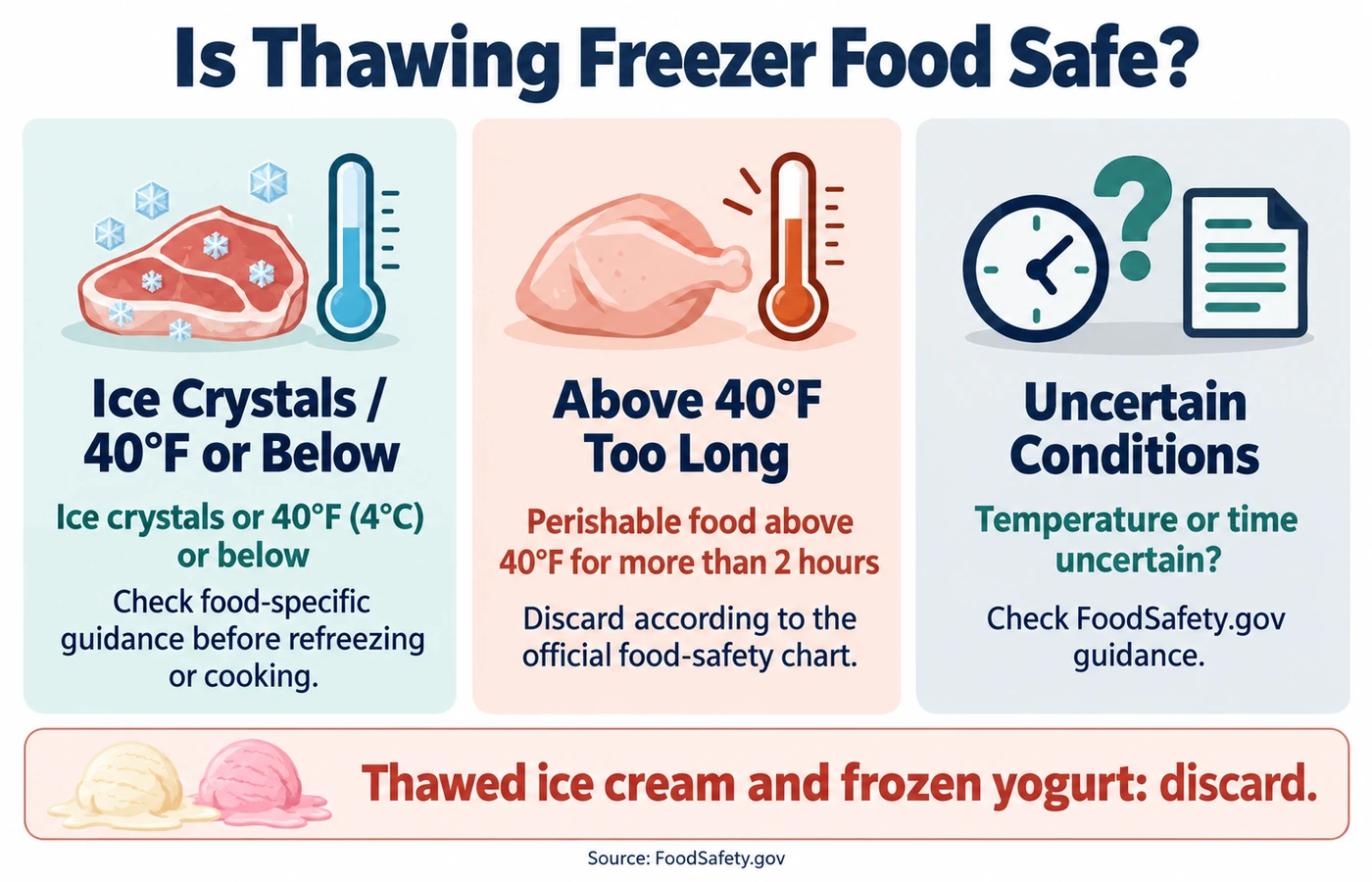
Food safety comes before fixing the appliance. The freezer's air temperature, a package's internal temperature, the presence of ice crystals, the type of food, and how long it has warmed all matter. Food that looks or smells normal may still be unsafe; never taste it as a test.
| What you can establish | Safer decision |
|---|---|
| Food still has ice crystals or is at 40°F (4°C) or below | Many foods can be cooked or refrozen, although texture may change. Check the food-specific exceptions in the official chart. |
| Meat, poultry, seafood, prepared meals, or other listed perishables have been above 40°F for more than 2 hours | Discard according to FoodSafety.gov's category-specific guidance. |
| Ice cream or frozen yogurt has thawed | The FoodSafety.gov chart calls for discarding it rather than refreezing. |
| You do not know how warm high-risk perishable food became or for how long | Do not rely on smell or appearance; take a conservative approach and consult the official chart. |
FoodSafety.gov's familiar 48-hour estimate for a full freezer (about 24 hours if half full) applies to a power outage with the door kept closed. It does not guarantee safety in a malfunctioning freezer that keeps cycling, warming gradually, or being opened. If the unit is failing, use actual food conditions and the official food chart instead.
Move suitable food to functioning cold storage promptly. If you need to defrost the appliance, plan where food will go before turning it off. Cleaning and repair may make a freezer cold again, but they cannot reverse unsafe temperature exposure that has already occurred.
When should you call a freezer repair professional?
Arrange qualified appliance service if the freezer does not recover after the safe checks and the recovery interval specified for your model, if a recurring alarm or error code persists, if heavy frost rapidly returns, or if you suspect a hidden fan, defrost, control, or sealed-system problem. An appliance professional can assess whether repair makes sense for the age, condition, and warranty of the unit.
- Call an electrician or seek urgent help for electrical hazards: burning smell, damaged wiring, an unsafe outlet, shock, or persistent breaker trips.
- Call appliance service: rising temperature despite correct settings, confirmed door closure, clear vents, and an appropriate recovery period.
- Check warranty and product support first: have the model number, age, symptoms, thermometer readings, and any display codes ready.
- Protect food during the decision: arrange alternative cold storage and follow food-safety guidance; do not wait for a service appointment while perishables warm.
How to help prevent freezer cooling problems
- Keep a freezer thermometer in a suitable location and occasionally check that storage is at 0°F (-18°C) or below.
- Make sure packages and baskets do not hold the door open or obstruct visible vents.
- Clean the door gasket gently, and inspect it for cracks or gaps.
- Follow model-specific ventilation, placement, loading, and condenser-cleaning instructions.
- Defrost manual-defrost appliances as directed; investigate unusually rapid frost buildup.
- Record the model number and keep the use-and-care manual accessible.
Frequently asked questions
Why is my freezer cold but not freezing?
The temperature may be below room temperature but still above the 0°F (-18°C) food-storage target. Incorrect settings, warm-air leaks, obstructed vents, recent food loading, or a cooling fault may be involved. Measure the actual temperature before choosing a fix.
Why is my freezer running but not freezing food?
A freezer may run longer while trying to recover from a door problem, added food, or a hot location. Running continuously does not identify a defective compressor. Verify the door, airflow, surroundings, and actual temperature; request service if it cannot achieve the required temperature.
How do I reset a freezer that is not freezing?
There is no universal reset for all freezers. Check the owner's manual for any model-approved power-cycle or control procedure. If an electrical breaker repeatedly trips, stop; do not keep resetting it. A reset will not repair a damaged gasket or failed component.
How long does it take a freezer to get cold after being turned on?
Some manufacturers advise allowing around 24 hours after an installation, outage, or setting adjustment, while particular models and food loads may need longer. Check your model's manual and thermometer. Protect potentially thawing food independently of the appliance's recovery time.
Can I use a hair dryer to defrost a freezer?
No. Whirlpool specifically warns against hair dryers, heaters, knives, and other sharp tools for speeding defrost. Follow the manual-defrost procedure for your model, keep water away from electrical parts, and never chip ice near hidden tubing.
What if my refrigerator works but the freezer doesn't freeze?
Different temperature readings between compartments do not prove which internal part is faulty. First confirm the freezer's actual temperature, controls, door seal, and airflow. If the refrigerator compartment also becomes too warm, see our refrigerator-not-cooling guide for the broader symptom.
Related troubleshooting
If fresh food is also warming, start with Refrigerator Not Cooling: Troubleshooting Guide.
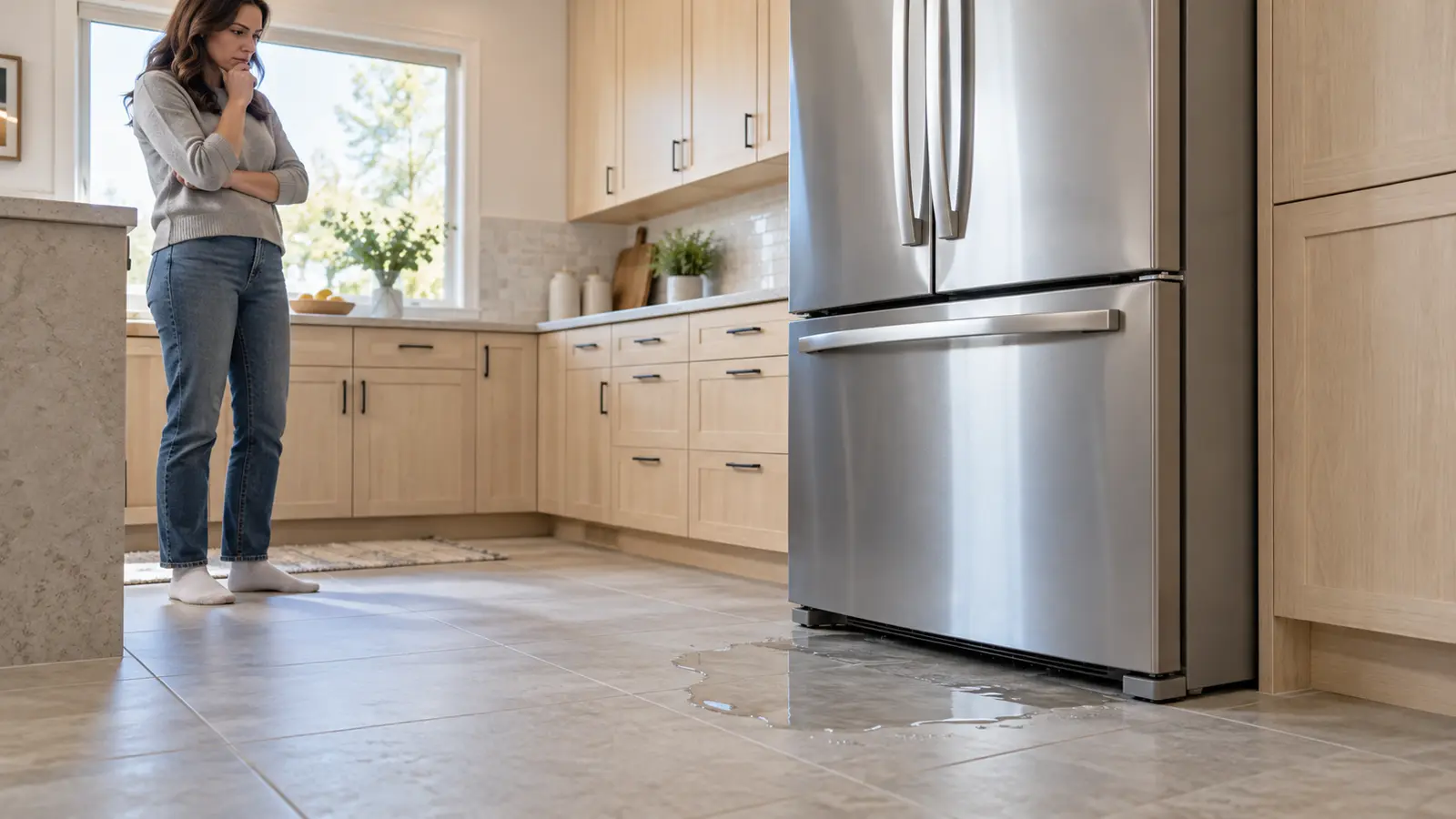
If you find unexpected puddles or meltwater around the appliance, see Refrigerator Leaking Water? Causes and Safe Fixes.
Sources and further reading
The guidance above draws on U.S. government food-safety information and manufacturer support. Always consult the manual for your exact appliance model before changing controls, cleaning, or defrosting.
- FoodSafety.gov — Food Safety During Power Outage
- FDA — Food and Water Safety During Power Outages and Floods
- Whirlpool — What to Do If Your Freezer Is Not Freezing
- Electrolux — Freezer Not Freezing or Not Cooling
- LG — If Your LG Freezer Is Not Cold Enough
- Samsung — Cooling Issues with Samsung Refrigerator or Freezer
- Whirlpool Product Help — How to Defrost the Freezer
- EPA — Section 608 Technician Certification Requirements
- Electrical Safety Foundation International — Home Safety