An air conditioner freezing up is not a sign that it is cooling too well. Ice on an indoor evaporator coil or refrigerant line usually means the system cannot absorb heat normally. Restricted airflow, a refrigerant problem, or a component fault may be responsible. If you see ice or strongly suspect a freeze-up, switch cooling to OFF at the thermostat. Let the ice melt without forcing it, and do not keep running the cooling cycle to see whether the problem goes away.
Quick answer: What should you do first?
- Set the thermostat's system mode to OFF to stop the cooling cycle.
- Keep hands away from electrical equipment and closed HVAC cabinets. If water is near wiring or controls, stay clear and get professional help.
- Allow the ice to thaw naturally. Use fan-only circulation only if your equipment supports it, the blower sounds normal, and there is no water or electrical hazard.
- Check a user-accessible filter and visibly blocked supply or return vents from a safe, dry location.
- Arrange HVAC service for recurring ice, unexplained poor airflow, suspected refrigerant trouble, or any unsafe condition.
This guide focuses on a typical U.S. ducted central air conditioner, or a heat pump operating in COOL mode. Window units and ductless systems can also freeze, but their access points and operating instructions differ. Follow the manual for your exact equipment rather than assuming every system has the same controls.
AC Freezing Up? What to Do Right Now
The priority is to stop adding ice while protecting the equipment and your home. Don't try to diagnose a capacitor, open the evaporator-coil compartment, or connect gauges before taking this first step. The thermostat is the appropriate homeowner control when it can be used safely.
Do
- Stop the cooling call at the thermostat.
- Note where frost is visible without touching it.
- Check for a blocked accessible filter or return grille.
- Watch for water in a dry, safe location as ice melts.
- Contact a qualified HVAC technician if the cause is unclear.
Do not
- Keep cooling with a frozen coil.
- Chip, scrape, or strike the ice.
- Use a hair dryer, heat gun, or hot water.
- Open electrical or sealed refrigerant components.
- Bypass a safety switch or repeatedly reset breakers.
A frozen AC may still have a working indoor fan. Moving air is not proof that the refrigerant circuit is cooling correctly. Likewise, an outdoor fan that is spinning does not rule out a frozen indoor coil. If you are hearing electrical buzzing, smelling burning insulation, or seeing water close to electrical parts, do not attempt further checks.
What Does It Mean When an AC Freezes Up?
In a central cooling system, warm indoor air passes across an evaporator coil inside the air handler or near the furnace. Refrigerant circulating through that coil absorbs heat. Moisture from the air normally condenses on the cold coil, then drains away as liquid water through the condensate system.
If the coil becomes cold enough for that moisture to freeze, frost can develop on its surface. As ice thickens, it can restrict the passage of air even further. Less airflow reduces the heat reaching the coil, which may allow more ice to form. This is why a system can start with slightly reduced cooling, then progress to weak airflow or warm air from the registers.
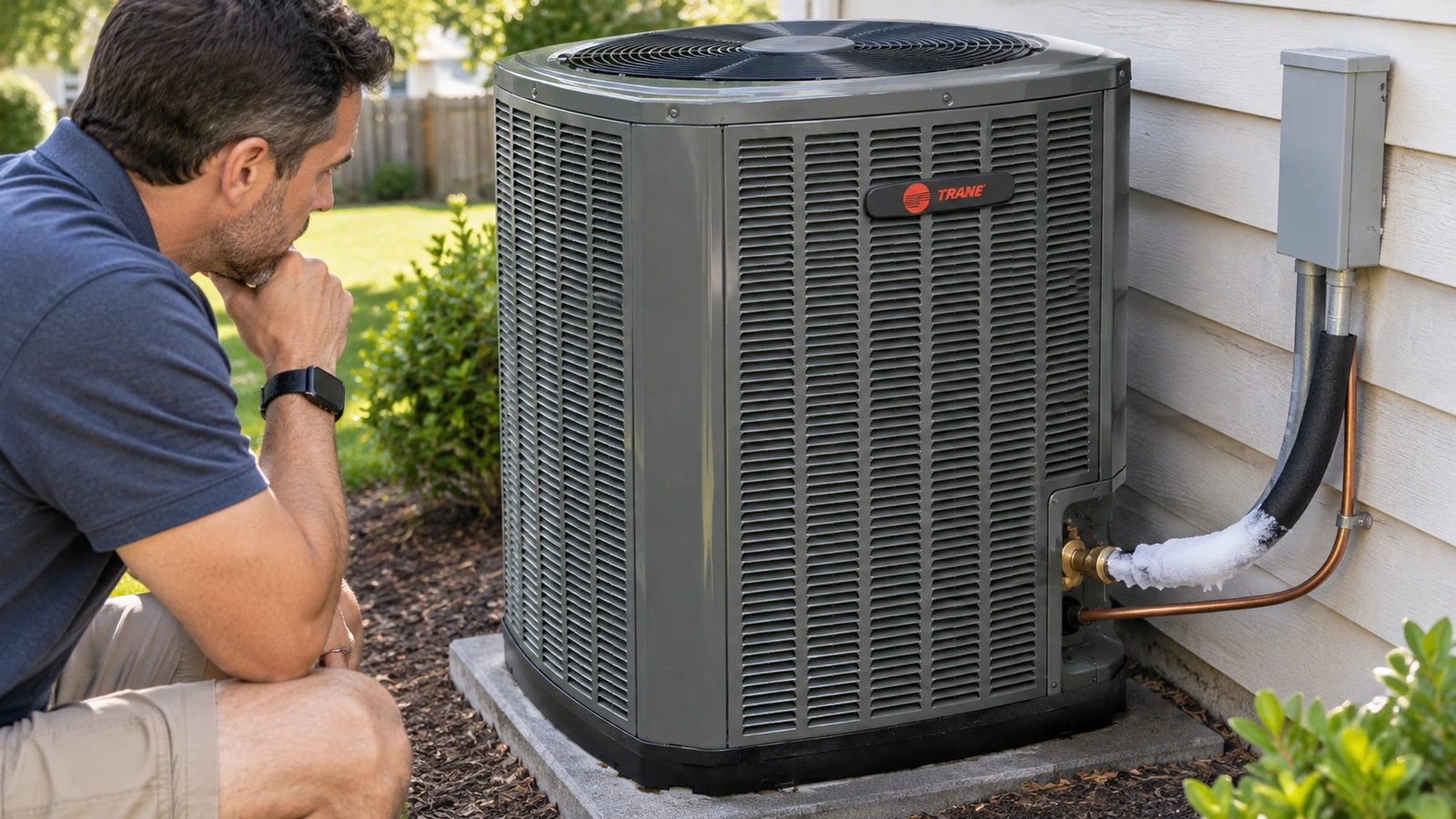
Ice can also appear on accessible refrigerant tubing near the indoor or outdoor equipment. That visible frost is a clue, not proof of which part failed. It does not automatically mean the outdoor condenser coil itself is frozen, and it cannot establish a refrigerant leak by sight alone.
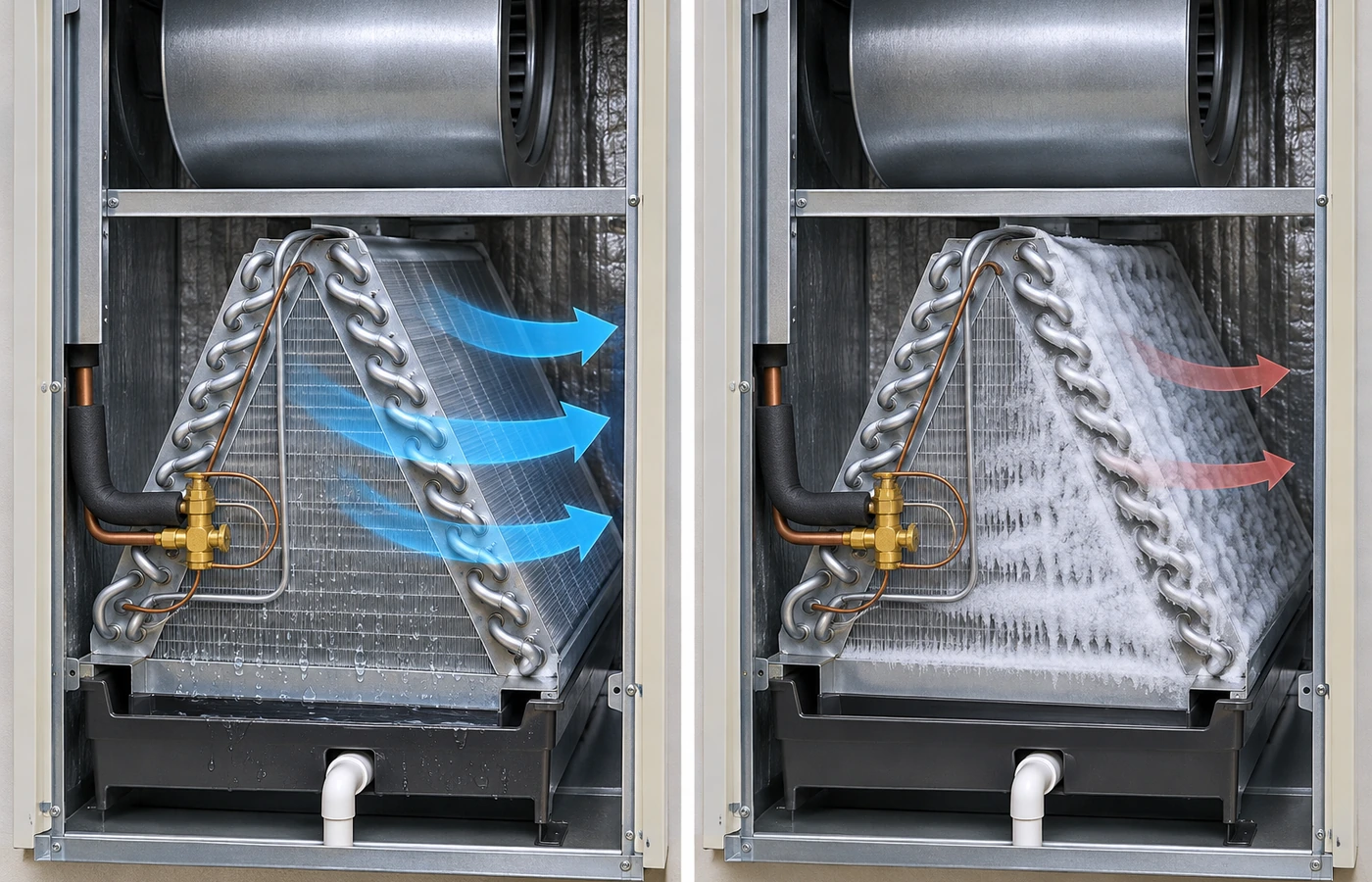
Manufacturers including Trane describe restricted airflow and low refrigerant as possible reasons an evaporator coil becomes frozen. A technician needs to determine which condition, if any, applies to a specific system.
Signs Your AC Unit Is Freezing Up
Not everyone can see the indoor evaporator coil, and homeowners should not open equipment panels to look for it. Start with symptoms you can observe without taking anything apart.
| What you notice | What it may mean | Safe response |
|---|---|---|
| Frost on an exposed refrigerant line | The cooling system may be icing, although the underlying cause is unknown | Turn cooling off; photograph from a safe distance |
| Weak airflow at several supply registers | An iced coil, dirty filter, or blower issue may be limiting airflow | Check only accessible filters and unobstructed grilles |
| AC runs but rooms feel warmer | The system may be losing cooling capacity; freezing is one possibility | Look for other noninvasive clues; do not assume ice is present |
| Unusual water after a period of poor cooling | Ice may be melting, or a separate condensate problem may exist | Keep away from wet electrical areas; seek service for overflow |
| Freeze-ups return after a thaw | The cause has probably not been corrected | Leave cooling off and schedule diagnosis |
Weak airflow, warm vents, and water are not unique to freezing. A system with an outdoor-unit startup problem, duct issue, or clogged drain can show some of the same symptoms. The most useful evidence is the combination of the cooling symptoms, where any ice appears, and what happens after cooling is stopped.
Why Is My AC Freezing Up? Common Causes
Whether you search for “why is my AC freezing up,” “why is my AC unit freezing up,” or “why do AC units freeze up,” the core question is the same: why is the indoor coil getting cold enough to accumulate ice? The main groups of possible causes are airflow restrictions and problems affecting refrigeration or control. There is no reliable way to rank a specific home's cause from a search phrase alone.
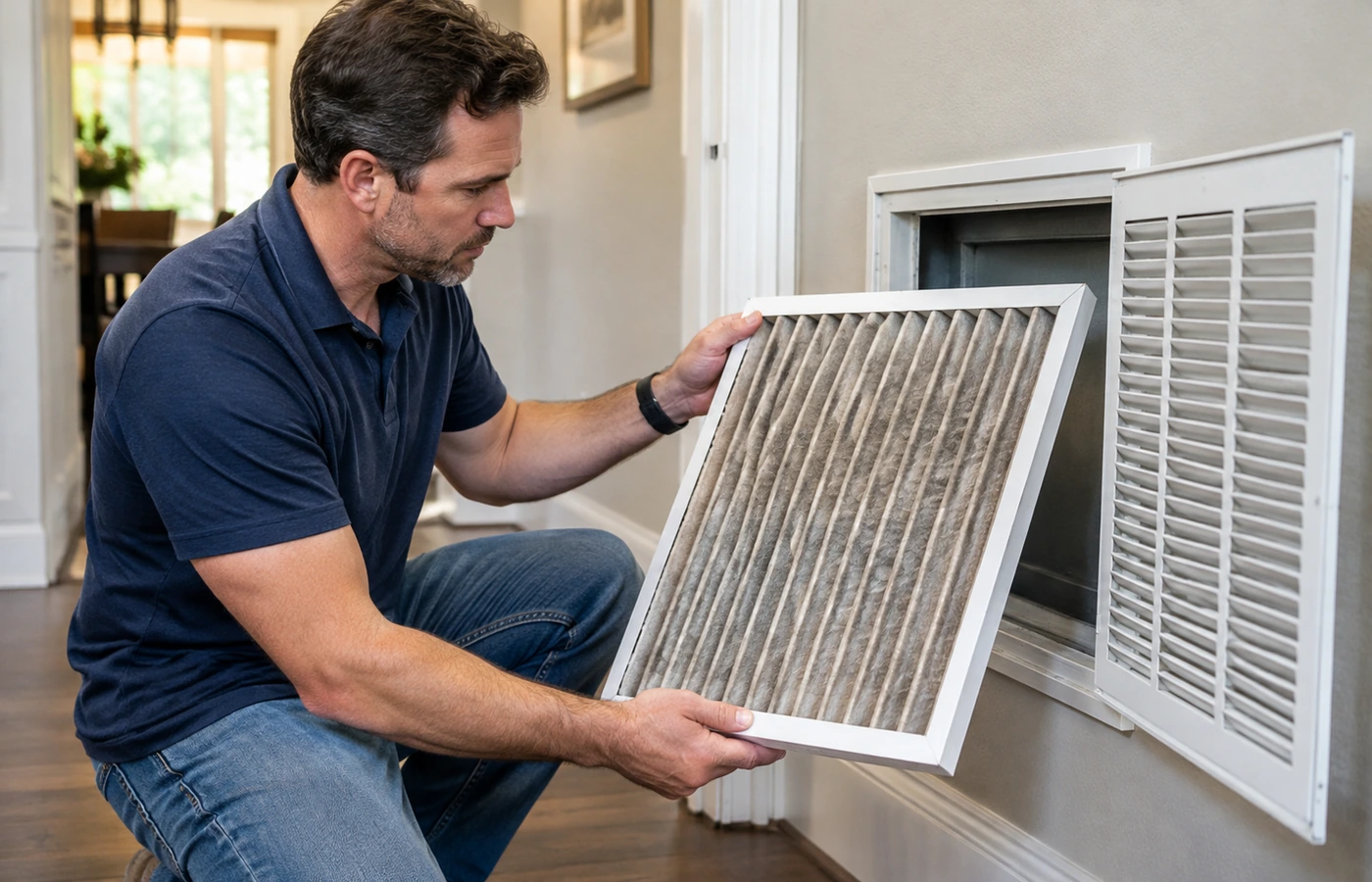
1. Dirty or overly restrictive air filter
An air filter loaded with dust can reduce the amount of room air passing through the evaporator coil. With too little warm air to absorb heat, the coil may become abnormally cold. A filter that is the wrong size, installed incorrectly, or too restrictive for the system can also contribute to low airflow.
If your filter is in a normal homeowner-accessible return grille or slot and the area is dry and safe, inspect it using the manufacturer's instructions. Replace a dirty disposable filter with the specified size and an appropriate type. Do not leave a required filter out during normal operation, improvise a filter size, or remove an equipment service panel to reach one.
2. Blocked return grilles or restricted supply airflow
Large furniture against a return grille, a rug covering a floor return, or multiple closed supply registers can interfere with the intended airflow path. The system needs air returning to the equipment as well as an unobstructed path back into occupied rooms.
Look at visible, room-level grilles and registers. Move a lightweight obstruction when doing so is safe, and follow the system's intended vent configuration. Avoid changing duct dampers hidden in an attic or crawlspace. A duct design or static-pressure problem requires professional measurement rather than trial-and-error adjustments.
3. Dirty evaporator coil
Dust that passes the filter can collect on damp evaporator-coil surfaces. That buildup can impair heat transfer and airflow. Unlike changing a filter, cleaning an indoor coil often involves internal access, fragile fins, wiring, or specialized cleaning methods. It belongs in a qualified HVAC maintenance visit, not a homeowner ice-removal project.
Do not assume a dirty coil merely because a filter was dirty. The coil should be inspected after it has safely thawed and the system is in a condition suitable for service.
4. Indoor blower or airflow-control problem
A blower that does not start, operates erratically, or moves less air than intended can leave the evaporator coil short of heat. The underlying problem might involve the blower wheel, motor, control equipment, or airflow settings. Depending on the system, a technician may also investigate duct restrictions and static pressure.
Signs worth recording include an unusually weak stream of air from multiple vents, humming without expected airflow, or an abrupt change in normal fan sound. Do not reach into a fan compartment, test a capacitor, open a cabinet, or try to start a stuck motor by hand.
5. Refrigerant leak or incorrect refrigerant charge
A refrigerant problem can change pressures and temperatures in the evaporator coil and contribute to icing. Low charge is one possibility, but ice is not a refrigerant gauge. Restricted airflow can create similar symptoms, and a technician may need to measure several conditions before identifying the cause.
Refrigerant circulates in a sealed system; it is not normally consumed like fuel. If a leak is found, a durable repair addresses the leak and verifies proper system operation rather than simply adding refrigerant repeatedly. Under U.S. EPA Section 608 requirements, work involving refrigerant-circuit service and gauge connections requires properly qualified personnel. Do not connect a DIY recharge kit or pressure gauge.
6. Thermostat, controls, or operating conditions
A thermostat or control fault can keep equipment operating when it should cycle off or otherwise interfere with normal cooling. Unusual cooling operation in cool outdoor weather may also matter for some equipment, but there is no single outdoor-temperature cutoff that applies to every central AC or heat pump. Model-specific limits and controls vary.
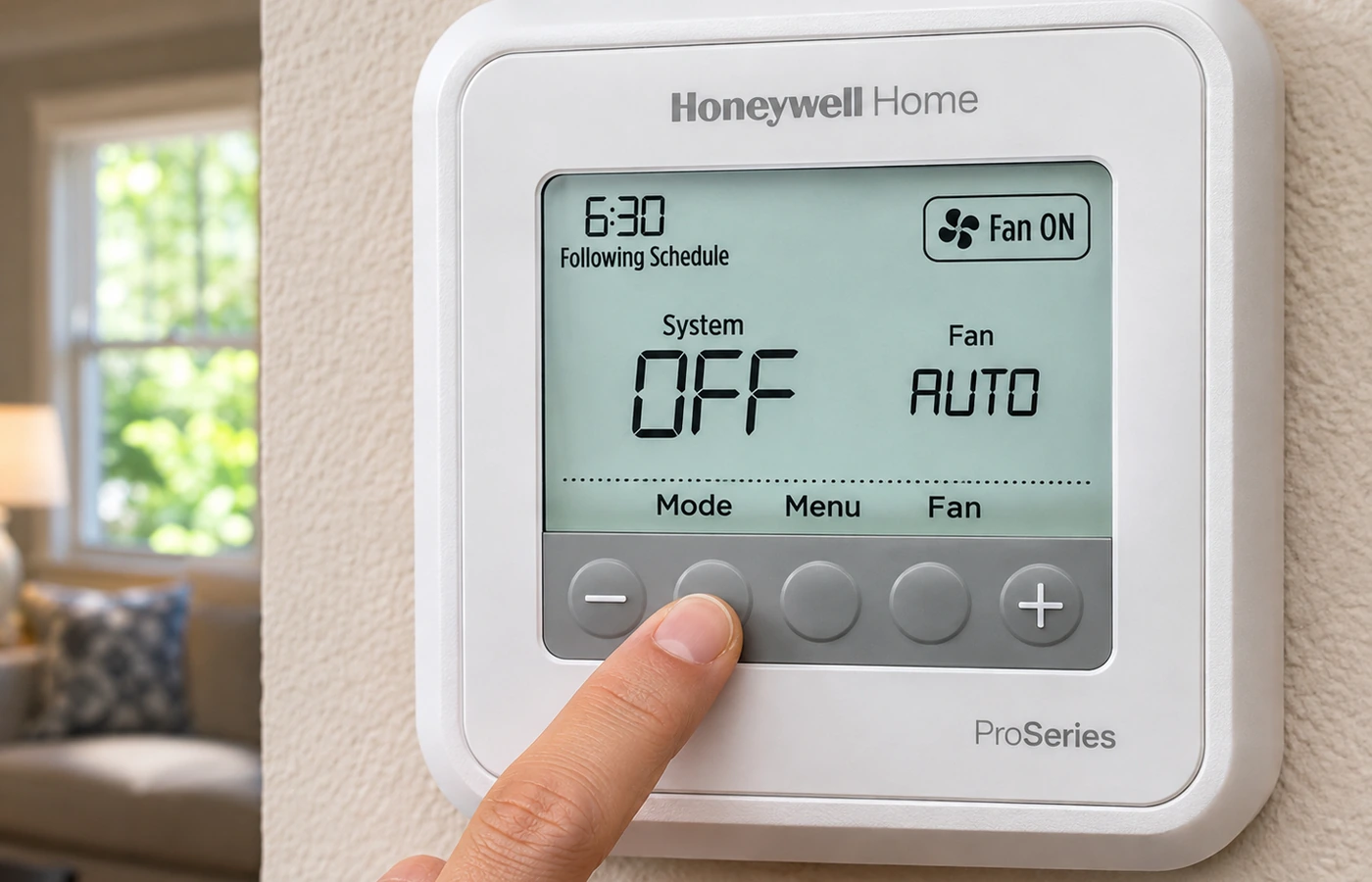
Homeowners can note the displayed system mode, set temperature, fan setting, and any visible error message. Do not bypass a control or disconnect thermostat wiring as a troubleshooting shortcut. If the problem happens mainly at night, that timing is a clue for the technician, not a diagnosis on its own.
How to Thaw a Frozen AC Safely
Thawing removes the ice but does not necessarily correct the reason it formed. The safest general approach is to stop cooling, let the ice melt naturally, observe for water, and decide whether the system needs professional evaluation before it can operate again.
- Stop the cooling cycle. Use the thermostat's system-mode control to select OFF. On a heat pump in cooling mode, do not switch to HEAT or attempt to force an outdoor defrost cycle to melt an indoor coil.
- Consider fan-only operation only when appropriate. Some thermostats allow the indoor fan to run with cooling OFF. If your manual confirms this and the blower works normally, circulation may help the coil thaw. Do not use it if you see overflowing water, suspect electrical damage, hear abnormal blower noises, or are unsure how your system behaves.
- Give the ice time to melt naturally. The time can vary widely with ice thickness, airflow, and equipment design. Do not rely on a universal one-hour, three-hour, or overnight rule; hidden ice may remain after exposed piping looks clear.
- Watch for melting water. A thaw can produce more water than usual. From a safe, dry location, look for unexpected pooling or stained ceiling areas near an attic-mounted air handler. Do not handle wet wiring, outlets, switches, or equipment.
- Check only safe airflow basics. A user-accessible filter, blocked furniture, and room-level vents can be assessed while cooling remains off. Do not pour chemicals into a drain or open the evaporator cabinet to inspect ice.
- Decide on service before restarting. If ice was heavy, the cause is unknown, water or electrical hazards are present, airflow is abnormal, or the problem has happened before, leave cooling off and contact a technician. Only consider returning to normal operation when the coil has fully thawed, everything is dry and safe, the cause was a clearly corrected user-accessible airflow obstruction, and the manufacturer's instructions permit it. Stop cooling immediately if icing or poor airflow returns.
Never force the thaw
Avoid hair dryers, heat guns, hot water, sharp tools, and striking the ice. These can damage coils, tubing, insulation, or nearby electrical components. Carrier's frozen-coil guidance advises against direct heat and emphasizes correcting the underlying cause.
Why Does My AC Keep Freezing Up After It Thaws?
A complete thaw restores the coil's physical airflow passages, but the fault that caused the ice may still be there. A dirty filter can be replaced, yet a clogged coil, failing blower, restrictive duct system, or refrigerant issue may remain. Turning cooling back on repeatedly can recreate the same freeze-up and expose the equipment to additional stress.
Repeated freezing is especially important when the filter is clean and return grilles are open. Those observations make some simple airflow causes less obvious, but they do not prove a leak or an expensive component failure. A technician may check:
- Actual airflow and static pressure, rather than judging airflow by sound alone.
- The condition of the evaporator coil, blower, filters, and duct connections.
- Refrigerant pressures, temperatures, and charge using appropriate procedures.
- Thermostat calls, operating controls, and any safety-device faults.
- Condensate drainage and water damage after thawing.
If you are wondering why an AC freezes up only at night, note the outdoor conditions, thermostat settings, and how long it ran beforehand. The pattern can help narrow the diagnosis, but a nighttime freeze does not by itself establish a thermostat failure or a refrigerant shortage.
Frozen Indoor AC Coil vs. Frost on an Outdoor Heat Pump
These two situations can look similar from a distance but involve different operating modes. An indoor evaporator coil that freezes while a central system is trying to cool the house is abnormal. A heat pump extracting heat from outside air during the heating season may temporarily collect frost on its outdoor coil and use an automatic defrost cycle.
| Situation | What to understand | What to do |
|---|---|---|
| Indoor evaporator coil or suction line iced during COOL mode | Abnormal cooling operation; airflow or refrigeration problems are possible | Turn cooling OFF and follow the safe freeze-up guidance |
| Thin, temporary outdoor-coil frost during heat-pump HEAT mode | Can occur during ordinary heating operation with automatic defrost | Consult the model manual; observe whether defrost clears the frost normally |
| Heavy persistent outdoor ice, repeated failed defrost, or loss of heating | May signal a heat-pump heating or defrost problem | Request qualified heat-pump service; do not force controls or remove ice mechanically |
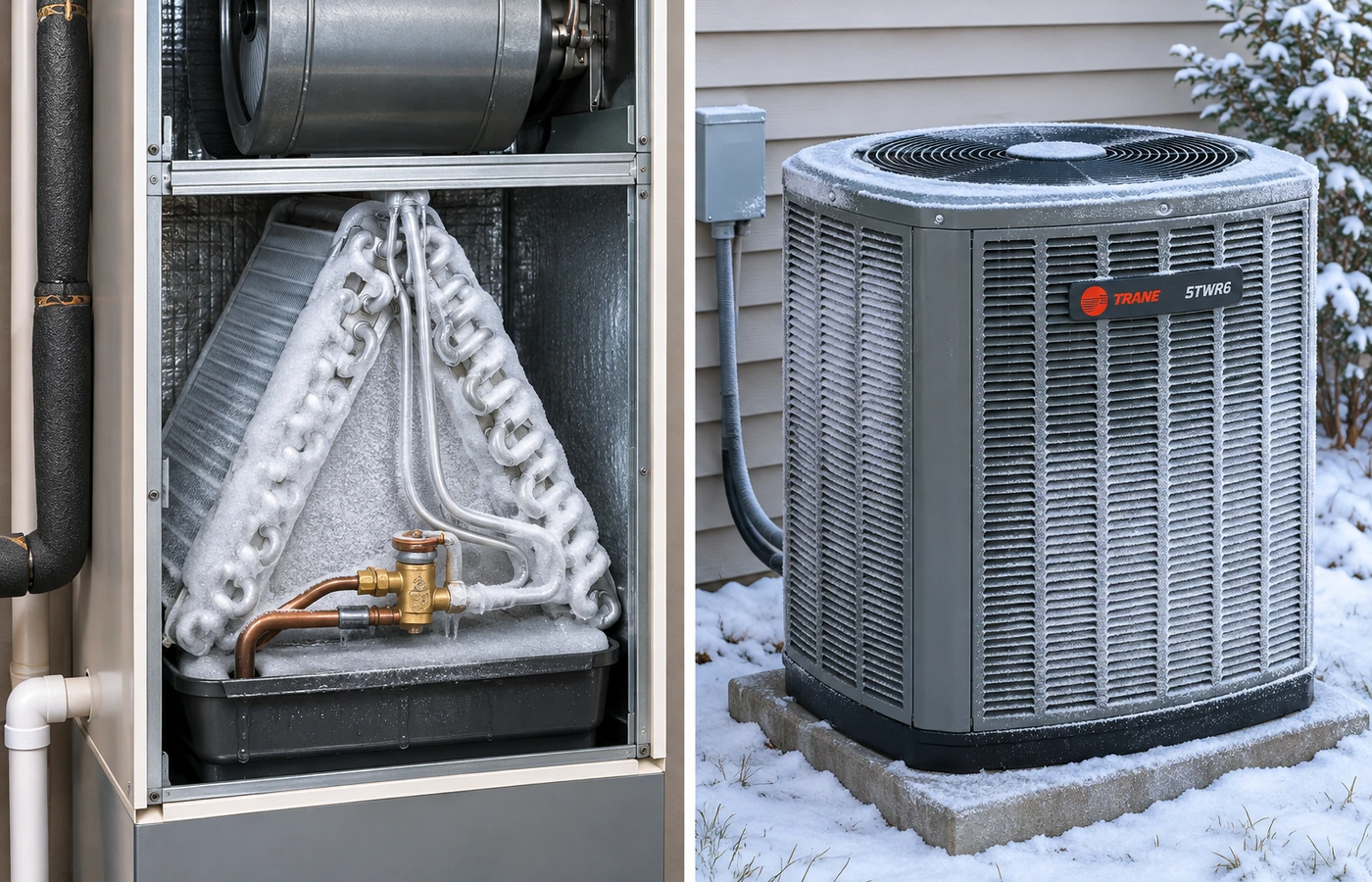
Trane's explanation of heat-pump defrost distinguishes temporary outdoor frosting in heating mode from indoor cooling-coil freeze-ups. Never assume the outdoor unit can be put into a manual defrost mode by a homeowner; the controls and safe procedures differ by model.
How to Prevent AC Freeze-Ups
Prevention is mostly about maintaining the airflow the system was designed to receive and catching developing faults before they turn into ice. These steps also help keep routine cooling problems from being mistaken for a frozen coil.
Check filters regularly, but use the correct replacement
Inspect a user-accessible filter on a schedule appropriate to your household and equipment. Pets, dust, construction work, and heavy cooling use may call for more frequent checks. Replace it according to its instructions and your HVAC manufacturer's requirements. A more expensive or denser filter is not automatically better if the blower cannot maintain proper airflow through it.
Maintain open airflow paths
Keep return grilles free from furniture, storage boxes, and rugs. Check that room-level registers have not accidentally been blocked. Do not close numerous supply registers as a do-it-yourself zoning method unless your system was designed for it. If certain rooms consistently have low airflow, request a proper assessment instead of guessing at duct adjustments.
Schedule professional cooling maintenance
Periodic service gives a technician the chance to inspect the coils, blower, controls, airflow, condensate drain, and refrigerant operation before ice develops. ENERGY STAR's maintenance checklist includes these professional tasks and recommends regular homeowner filter checks. A maintenance visit is not a promise that every failure can be prevented, but it helps identify avoidable restrictions and developing problems.
Treat repeated frost as a service issue
If cooling returns after the ice melts but the coil freezes again, do not fall into a cycle of thawing and restarting. The visible frost is a symptom; the underlying airflow, refrigeration, or control condition needs to be found. Similarly, a frozen line should not be interpreted as a reason to buy and add refrigerant.
When to Call an HVAC Technician
Contact a qualified HVAC professional if the ice is extensive, the coil freezes again, cooling remains weak after an accessible filter issue is corrected, you suspect a refrigerant problem, or the cause is not clear. Professional help is also appropriate when the indoor blower operates abnormally or the equipment makes unfamiliar mechanical sounds.
Stop and escalate promptly if you notice:
- Burning smells, smoke, sparking, or repeated breaker trips.
- Water touching or approaching wiring, switches, outlets, or equipment controls.
- Unusual loud grinding, electrical buzzing, or a blower that is not operating normally.
- Persistent frost or water overflow in a difficult-to-access indoor unit or attic.
- Freeze-ups that recur despite visible airflow obstructions being cleared.
Do not enter a wet electrical area to investigate, and do not attempt to reset or bypass a protective device. The Electrical Safety Foundation International recommends qualified evaluation of water-damaged electrical equipment before it is returned to service.
What to tell the technician
A short record is more helpful than guessing which part is broken. Note whether the system was cooling or heating, when the symptoms started, the thermostat's system and fan settings, any visible ice location, whether airflow was weak, and whether water appeared during thawing. Include photos taken from a safe distance and the equipment model number if it is already visible without opening a cabinet.
Ask what evidence supports the diagnosis. For example, if a refrigerant issue is suspected, a useful explanation will involve appropriate measurements and a plan to address the source of the problem, not an assumption based solely on visible frost.
AC Freezing Up FAQs
Why would an AC freeze up in summer?
Summer heat does not prevent the indoor coil from becoming too cold. Restricted airflow, a refrigerant problem, or a malfunctioning component can allow condensation to freeze on the evaporator coil even while the weather outside is hot.
Can an AC run while it is frozen?
The fan or compressor may continue operating, but that does not make it safe to keep cooling. Running a frozen system can restrict airflow, impair heat transfer, and risk expensive damage. Set cooling to OFF when a freeze-up is suspected.
Will a frozen AC thaw on its own?
Ice can melt after the cooling cycle is stopped, but the original cause may remain. A thaw is not the same as a repair. If ice returns, leave cooling off and seek qualified diagnosis.
How long does a frozen AC take to thaw?
There is no universal time. Light frost may clear faster than thick ice, and hidden ice can remain after the visible line looks normal. Allow natural thawing and avoid restarting on the basis of an arbitrary timer.
Why is my AC freezing up at night?
A nighttime pattern can reflect operating conditions or a problem that becomes noticeable after longer run periods. Low airflow, control behavior, and refrigeration issues are possibilities, but timing alone cannot identify the cause. Record the pattern for your HVAC technician.
Does a frozen refrigerant line always mean low refrigerant?
No. A frozen suction line can accompany several conditions, including airflow restriction and refrigerant problems. Ice location cannot establish the charge level, and refrigerant diagnostics should be left to qualified personnel.
Should I set the thermostat fan to ON to melt ice?
Fan-only circulation may help if your thermostat and HVAC system support it, the blower works normally, and the area is dry and electrically safe. Keep the cooling system OFF. If there is water overflow, unusual fan behavior, or any uncertainty about the equipment, skip that step and ask for service.
Can I restart cooling after replacing a dirty filter?
Not while ice remains. Once fully thawed, a system with a clearly corrected, user-accessible filter blockage may be returned to service only if conditions are safe and the manufacturer's instructions allow it. Heavy or repeated icing, abnormal airflow, or an uncertain cause calls for a professional evaluation instead.
Is an outdoor heat pump covered in frost the same problem?
No. Some outdoor frost during heat-pump heating can be normal and removed by an automatic defrost cycle. Indoor evaporator-coil icing during cooling is a different problem. Heavy outdoor ice that does not clear or heating that fails should be evaluated by a heat-pump technician.
Bottom line: If your AC unit is freezing up, stop cooling first. An accessible filter or blocked grille may reveal a simple airflow problem, but ice on a coil or refrigerant line is not enough to diagnose the system. Let it thaw without forced heat, keep clear of water and electrical hazards, and get qualified help when icing is recurrent or unexplained.