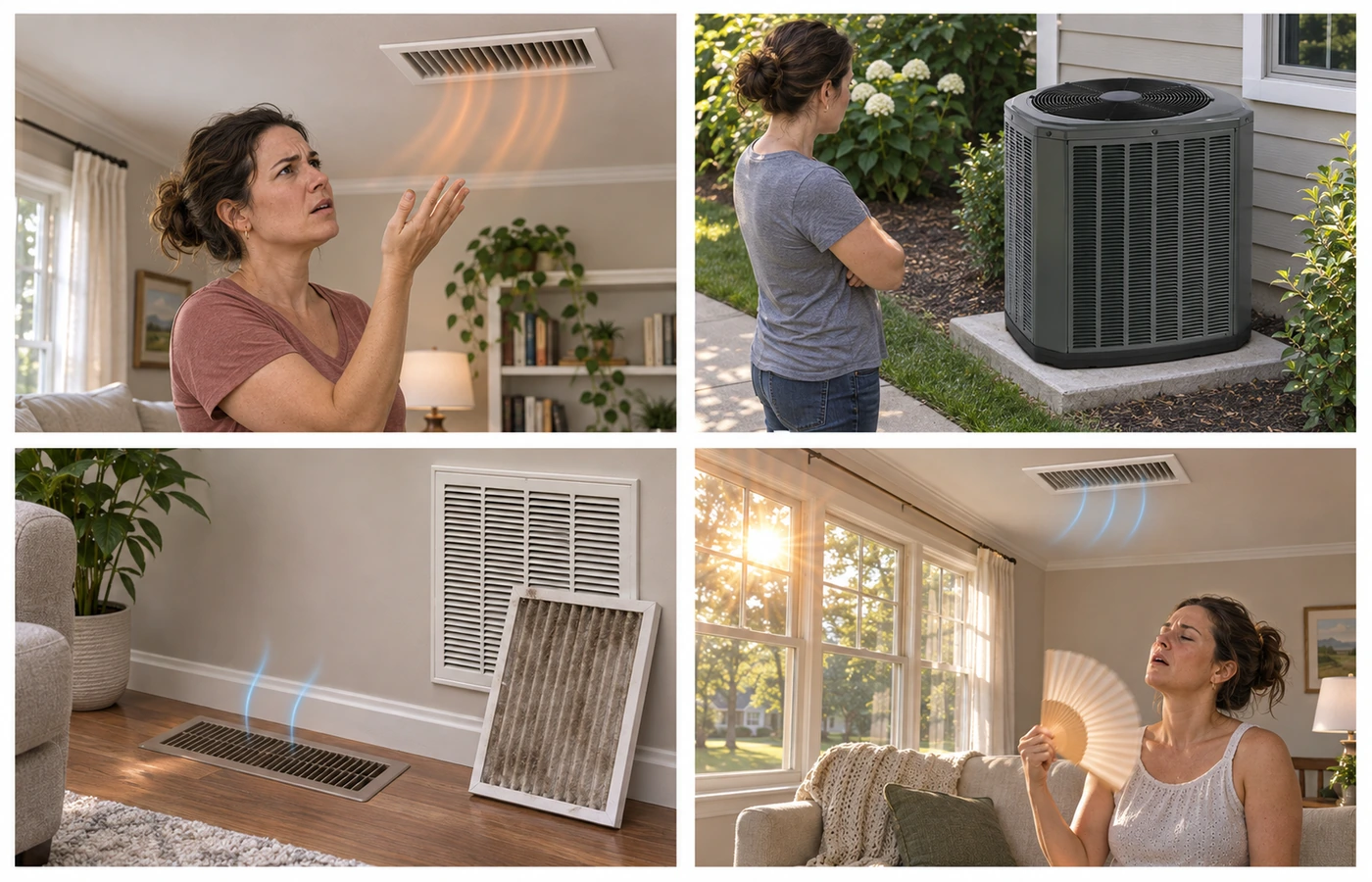
Your AC is running but not cooling, yet the air still moves through the vents. That does not necessarily mean the air conditioner is completing a cooling cycle. The indoor blower can circulate room-temperature air while outdoor equipment is off, delayed, or malfunctioning. In other cases, both units appear active but the system cannot remove enough heat. The safest way to narrow the problem is to identify what is actually running before assuming a specific part has failed.
Quick answer: Why is my AC running but not cooling?
Common explanations include a thermostat fan set to ON instead of AUTO, restricted airflow, an outdoor unit that is not operating as expected, a frozen indoor coil, dirty outdoor coils, or a refrigerant or electrical fault. An indoor fan making noise does not confirm that the compressor is cooling.
Start safely: Verify the thermostat is calling for cooling, check a homeowner-accessible filter and open vents, and observe the outdoor unit from a safe distance. If you notice ice, a burning smell, water near electrical equipment, a tripped breaker, or repeated failed starts, turn cooling off when safe and arrange qualified service.
What does “AC running” actually mean?
In a typical U.S. central split system, the indoor blower moves air through the ductwork while the cooling equipment removes heat from that air and releases it outdoors. Those functions are connected, but they are not identical. A person can hear a fan, feel air at a register, or see an outdoor fan spinning without knowing whether the refrigeration system is providing normal cooling.
Indoor blower running is not the same as active cooling
Many conventional thermostats have separate System and Fan controls. A fan setting of ON can circulate air even between cooling calls. If the thermostat is set to OFF or is not requesting cooling, that moving air may simply be at room temperature. On many conventional systems, selecting COOL with the fan on AUTO is a useful starting point. However, variable-speed, communicating, and humidity-control systems may intentionally run the indoor blower in other ways. Follow your model's instructions rather than treating one fan setting as a universal rule.
An outdoor fan spinning does not prove the compressor is cooling
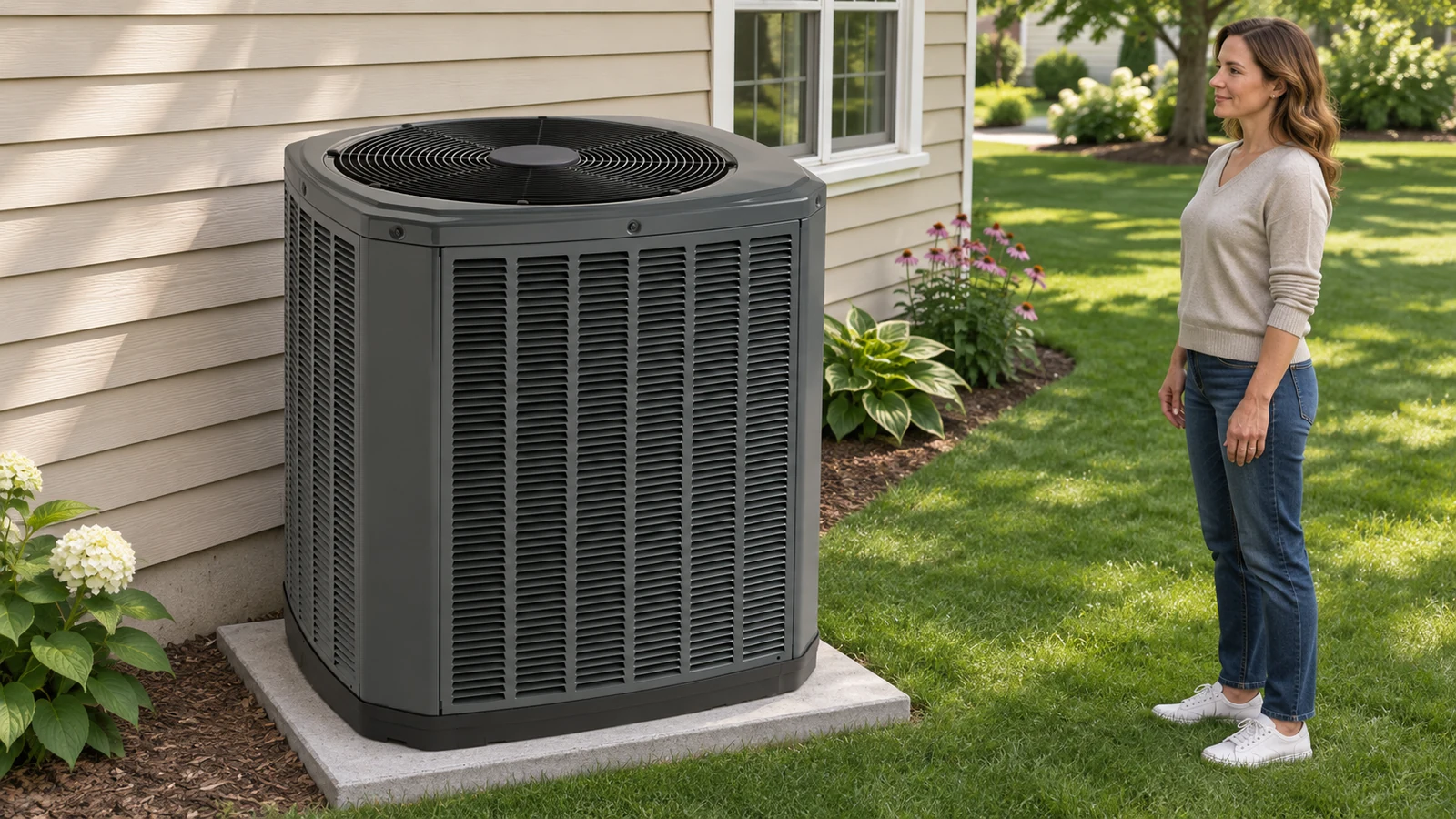
The outdoor unit normally releases heat removed from the house. Observing an outdoor fan or hearing a motor tells you that something is operating, not that refrigerant is circulating correctly or that the equipment is delivering its rated capacity. Compressor operation, electrical controls, protective delays, and refrigerant conditions cannot be confirmed by looking through the fan grille. Do not lean over the unit, reach toward moving parts, or open an access panel to investigate.
A normal delay can look like a failure
Some thermostats and cooling systems intentionally delay compressor startup after a setting change or interrupted power. Smart controls and variable-speed equipment can also behave differently from older single-stage units. Check your owner's manual for model-specific status messages or waiting periods. Avoid repeatedly switching modes or cycling power to force a start. If the system never begins cooling after its normal sequence, record the symptoms and request service.
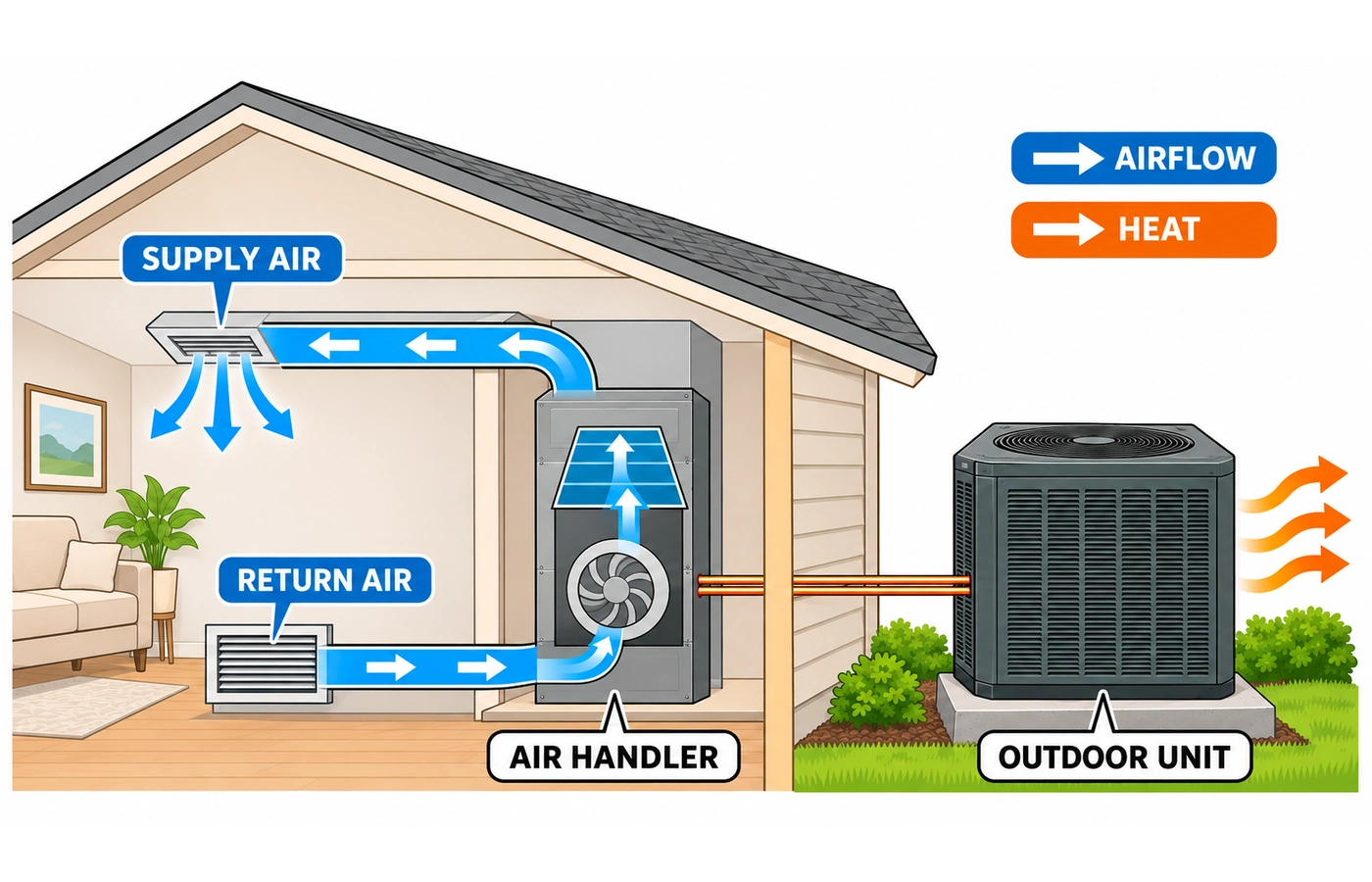
This guide focuses on conventional U.S. ducted central air conditioners and heat pumps in cooling mode. A ductless mini-split, window unit, or advanced communicating system may have different controls and operating sequences.
Identify the exact symptom before troubleshooting
Start with what you can safely see, hear, and feel. The following comparisons help decide whether the problem is a fan-only condition, an outdoor-unit issue, weak airflow, or a home comfort issue. None of these observations identifies a failed component by itself.
| What you notice | What it may suggest | Safe next step |
|---|---|---|
| Air comes from vents, but the outdoor unit appears off. | Fan-only operation, normal startup delay, lost outdoor power, or a control or safety issue. | Check the thermostat mode and any displayed delay; observe only. Arrange service if the outdoor unit stays inactive. |
| Indoor and outdoor fans appear active, but vent air stays warm. | Cooling may be impaired by an airflow, coil, refrigerant, compressor, or control problem. | Check the accessible filter and outside clearance; have a technician assess equipment performance. |
| Airflow gets weaker and cooling fades. | Restricted airflow or possible evaporator-coil icing. | Check for visible restrictions and ice without opening cabinets; turn cooling off and call for service if icing is suspected. |
| Air feels cool at vents, but rooms never become comfortable. | Duct loss, heat gain, inadequate distribution, or limited capacity under the home's load. | Note which rooms and times are affected; request a broader home and airflow assessment. |
| Cooling starts, stops, or makes unusual repeated sounds. | Protective shutdown, control trouble, or a mechanical/electrical fault. | Do not repeatedly restart or test electrical parts; call a qualified technician. |
If the indoor blower runs but the outdoor condenser does not
That is primarily an outdoor-unit-not-starting situation, not proof of a bad capacitor or compressor. There may be a normal control delay or a problem with power, control wiring, a protective switch, or an outdoor component. Because the equipment can contain dangerous stored electrical energy, keep the diagnosis visual and leave internal testing to a professional.
If both fans appear to run but no cold air is produced
The apparent activity narrows the description, but not the diagnosis. A fan may operate while the compressor fails to provide effective cooling, or the system may be moving too little air across a compromised coil. Restricted heat rejection outdoors and sealed-refrigerant-system faults can produce similar symptoms. A technician may need to measure system operation rather than infer a failure from sound alone.
If the vents feel cold but the house stays warm
That points to a different question: whether cooled air is reaching the occupied spaces and whether the home is gaining heat faster than the system can remove it. Hot upstairs rooms, afternoon solar exposure, leaking ducts, and insufficient return airflow belong in a whole-house cooling assessment. The presence of some cool supply air does not guarantee that the home will reach the thermostat setpoint.
Five safe checks when the AC runs but does not cool
These checks are limited to normal controls and homeowner-accessible observations. You do not need to remove an electrical cover, use a meter, touch refrigerant tubing, pull a disconnect, or test moving parts.
1. Verify a real cooling call at the thermostat
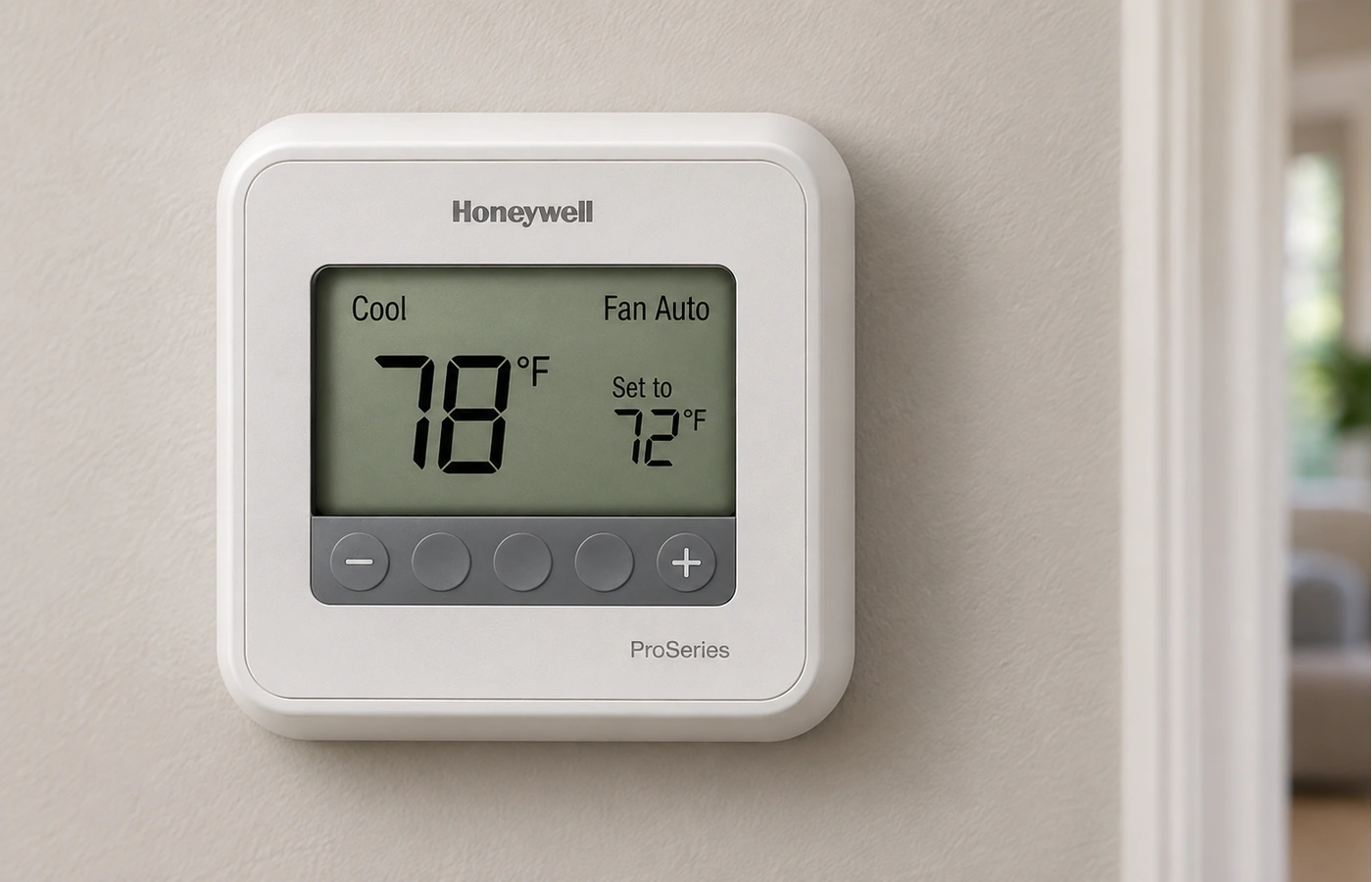
Confirm that the system is set to COOL and the target temperature is below the displayed room temperature. On a conventional ducted system, check whether Fan ON is circulating air independently of a cooling call; AUTO is normally the clearer setting for a basic cooling check. Review schedules, holds, and alerts. If a thermostat uses user-replaceable batteries, follow its manual. Do not remove a wired thermostat from its base, bridge terminals, or change installer settings.
A display reading such as Cool On usually indicates a request or operating status, but it does not prove that the outdoor refrigerant circuit is working. Observe whether the system follows its normal startup sequence without rapidly changing settings.
2. Check the user-serviceable air filter
A clogged filter can restrict air across the indoor cooling coil. With the system off according to the manufacturer's instructions, inspect a filter only when it is meant to be replaced or cleaned by the homeowner and is safely accessible. Use the recommended size and type. Reinstall it in the correct airflow direction, and never run a system that requires a filter with that filter removed.
A clean-looking filter does not rule out a blocked indoor coil, blower trouble, or inadequate duct airflow. If the filter location requires opening a sealed equipment cabinet or reaching into electrical components, leave it alone and ask a technician.
3. Look for blocked supply and return openings
Check that furniture, rugs, curtains, and stored objects are not obstructing visible supply registers or return grilles. Notice whether airflow is weak at every register or only in one room. Move simple obstructions, but avoid dismantling ducts or closing many registers to redirect air. An overall drop in airflow can contribute to poor cooling; one hot room may instead be an air-distribution problem.
4. Observe the outdoor equipment without touching it
From a safe ground-level position, look for dense shrubs, leaves, grass clippings, or stored objects crowding the outdoor unit. Remove only loose debris around the unit when you can do so safely, maintaining the clearance specified by the manufacturer. Do not reach through grilles, spray electrical parts, remove panels, or wash the coil without approved model-specific instructions and a safe shutdown procedure.
Note whether the outdoor unit appears quiet, the fan rotates, or it makes repeated unusual clicking or humming. Those details are useful for service, but they do not establish that the compressor works or that a capacitor has failed.
5. Check for warning signs and document the pattern
Look only at safely visible areas for frost on an accessible insulated refrigerant line, water around indoor equipment, or an abnormal status message. If icing is suspected, turn cooling off and arrange service. Avoid scraping ice, forcing the fan to run, or using heat to thaw a coil. Record whether the problem appeared suddenly, only occurs during the hottest part of the day, or began after a power outage or service visit.
Do not use breaker resets as a troubleshooting routine.
A tripped breaker, hot or wet panel, electrical odor, or repeated failed start may indicate a hazardous fault. Do not repeatedly reset or cycle a breaker, pull a disconnect, or test exposed terminals. Get qualified help.
Why an AC can appear to run without producing cold air
Once the simple observations are complete, the next step is understanding what may interrupt heat removal. Several problems can look identical from a vent. The following are possibilities for an HVAC technician to investigate, not diagnoses that can be confirmed by watching a fan.
Fan-only operation or a cooling call that never reaches the equipment
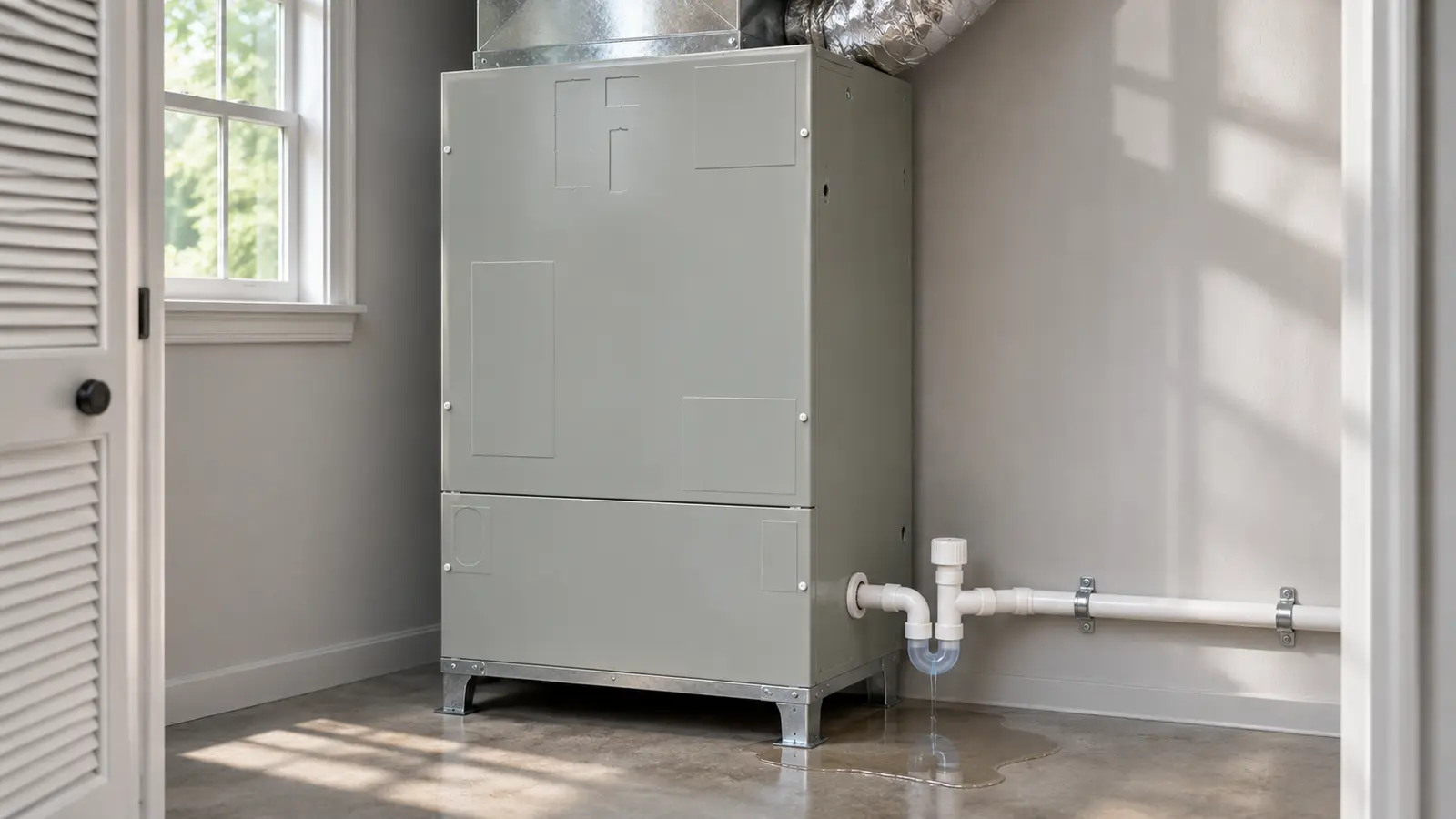
On some systems, the indoor blower can operate continuously while the cooling circuit remains off. Thermostat mode, a scheduled setting, a normal anti-short-cycle delay, or a control or safety problem may explain the mismatch. A condensate overflow switch, where installed, can interrupt part or all of the cooling operation. A homeowner can report a message on the control or visible water near the air handler but should not bypass a safety device or modify thermostat wiring.
Insufficient airflow and evaporator-coil icing
The indoor evaporator coil absorbs heat from air moving through the system. A severely restricted filter, obstructed airflow path, blower problem, or coil buildup can reduce heat transfer. In some circumstances, the coil may freeze, further restricting airflow and cooling. Refrigerant-related faults can also contribute to freezing, so ice is not proof of a dirty filter alone.
Symptoms can include progressively weaker airflow, cooling that fades after initially working, or visible frost in a safely observable location. Stop cooling when ice is suspected; do not run the system repeatedly just to test whether it freezes again. The cause should be identified before ordinary operation resumes.
Outdoor heat rejection is impaired
The condenser must reject the heat collected indoors. Restricted outdoor airflow caused by heavy debris, a compromised outdoor coil, or fan trouble can reduce cooling performance. Removing yard objects from around the unit may help preserve the needed clearance, but diagnosing a failed fan motor, blocked internal coil, or other component requires professional access and safety precautions.
Refrigerant charge, leakage, or a compressor fault
The refrigerant circuit moves heat from the indoor coil to the outdoor unit. Incorrect refrigerant charge, a leak, or a compressor-related failure can compromise that process. A system can appear to run while delivering little cooling. Temperature at one vent, unusual noises, and outdoor fan movement are insufficient to distinguish these causes. Certified technicians use appropriate system-specific measurements and service procedures.
Residential refrigerant systems are pressurized; handling refrigerant and opening a circuit are not homeowner DIY tasks. Do not attach gauges, use a recharge can, puncture tubing, or try to identify a leak by releasing refrigerant. U.S. EPA Section 608 establishes certification requirements for many activities that could release refrigerant from stationary air-conditioning equipment.
Electrical controls, protective shutdowns, and intermittent operation
A contactor, capacitor, control board, sensor, motor, or electrical connection may be involved in an AC that hums, clicks, stops, or repeatedly fails to cool. Components can retain dangerous charge even after power is switched off. Some modern equipment intentionally changes speed or pauses under certain conditions, so unusual operation should be compared with the model's normal behavior before declaring a fault. A technician should investigate recurring interruptions and verify any suspected failure rather than replacing a part based on a symptom alone.
What these symptoms cannot tell you
A spinning outdoor fan does not prove a healthy compressor. A quiet condenser does not always prove a bad capacitor. A frozen line does not automatically mean low refrigerant. And a thermostat set well below room temperature does not confirm that cooling is actually taking place. These clues make a service report more useful; they are not substitute tests.
What if the AC runs constantly but the temperature never drops?
First decide whether the air coming from supply vents feels noticeably cooler than the surrounding room air. Do not use an arbitrary fixed temperature difference or a guaranteed number of degrees per hour as a homeowner pass/fail test. Equipment type, humidity, airflow, sensor location, and operating conditions affect the result.
Vent air is not cool: concentrate the service description on the cooling equipment and what the indoor and outdoor units seem to be doing. Vent air is cool but rooms remain warm: the cooling circuit may be working while the home loses conditioned air, receives too little airflow, or gains heat faster than expected. Attic heat, duct leaks, solar exposure, or inadequate capacity call for a separate home-performance assessment.
Long runtimes during very hot weather can occur even in a functioning system. A sudden loss of performance compared with previous summers, failure to reach a setpoint under ordinary conditions, or persistent warm supply air deserves professional attention. Do not assume that buying a larger AC will solve an unmeasured airflow, duct, insulation, or equipment problem.
When should you turn off cooling and call a professional?
When a cooling system is clearly failing to cool after basic setting and filter checks, continuing to operate it is not a reliable way to diagnose it. Turn cooling off and seek qualified HVAC help, especially if the system has been running unusually long without improvement or starts making new abnormal sounds.
Stop and escalate promptly if you notice:
- Burning odors, smoke, sparks, or signs of overheating around equipment or wiring.
- A tripped breaker, repeated electrical shutdowns, a hot panel, or wet electrical equipment.
- Ice or frost on visible cooling-system components, especially with falling airflow.
- Water pooling close to the indoor air handler's electrical components or leaking through a ceiling.
- Repeated clicking, loud humming, grinding, or failed starts at the outdoor unit.
- Suspected refrigerant damage or any problem that would require an open cabinet or live testing.
For smoke or fire, move to safety and contact emergency services. Avoid touching electrical components in wet conditions. During extreme heat, prioritize a safe, cooler place for people at greater risk of heat illness rather than staying in an overheated home while waiting for repairs.
Work involving electrical measurements, capacitors, contactors, motors, refrigerant pressure, sealed-system repairs, or safety-switch bypass is for appropriately qualified professionals. Never attempt to spin-start an outdoor fan with a stick or tool.
What to tell an HVAC technician when your AC runs but is not cooling
A precise description can help the technician plan a safe diagnosis. It also avoids prematurely labeling the issue as a bad compressor or a refrigerant leak.
Thermostat and timing
- System mode, fan mode, room temperature, and setpoint
- Any delay message, code, schedule, or alert
- When the problem started and whether it comes and goes
What appears to run
- Indoor airflow normal, weak, or absent
- Outdoor unit visibly active, silent, or intermittently starting
- Whether vent air feels warm, neutral, or cool
Visible warning signs
- Ice, water, odors, or unusual sounds
- Any breaker or equipment warning
- Recent storms, outages, or maintenance visits
Checks completed safely
- Thermostat settings reviewed
- Homeowner-accessible filter inspected
- Vents and outdoor clearance observed
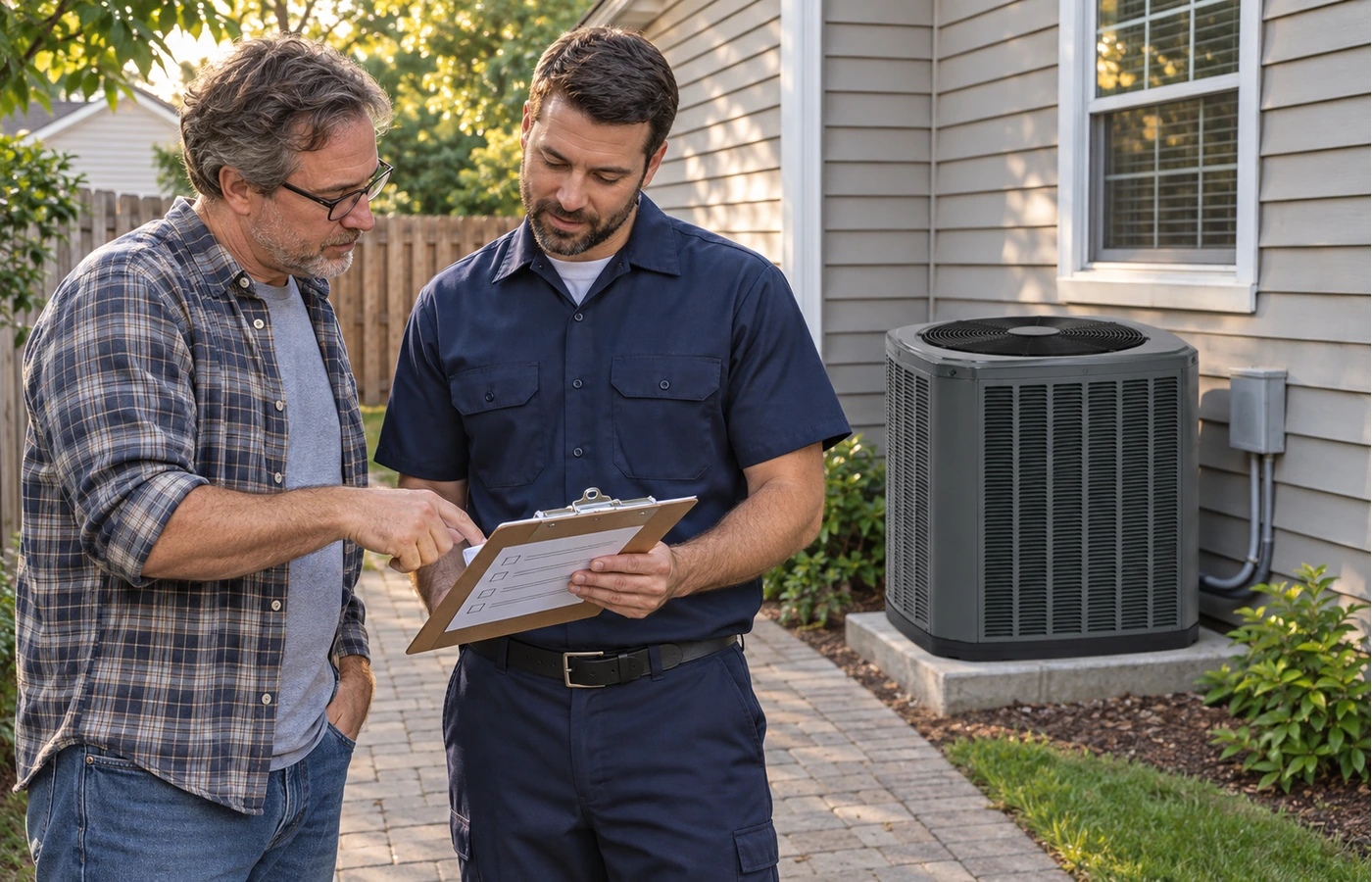
Ask what findings confirmed the root cause, whether the repair addresses the underlying problem, and what operating checks will verify that cooling has been restored. If refrigerant is added or a major part is proposed, ask for an explanation of the measurements and the reason for that recommendation. If the system makes cold air but the house remains hot, discuss duct performance and heat gain as separate considerations.
Prevent the same problem from returning
Follow the manufacturer's schedule for accessible filter checks, avoid blocking indoor returns and outdoor airflow, and arrange professional pre-season maintenance. ENERGY STAR recommends qualified contractor checkups that address controls, airflow, coils, condensate, electrical connections, and refrigerant-related system performance. These professional tasks should not be treated as a homeowner repair checklist.
Frequently asked questions
Can my AC fan run without the compressor cooling?
Yes. On many central systems, the indoor blower can circulate air between cooling cycles, particularly when the thermostat fan is set to ON. Some system controls also have protective delays. Air movement alone cannot establish compressor operation or effective cooling.
Why is the outdoor fan spinning but the vents are not cold?
An outdoor fan may run while cooling performance is reduced by a control, compressor, refrigerant, coil, or airflow problem. The visible fan is only one part of the system. Check thermostat settings and the accessible filter, then arrange diagnosis if the air stays warm. Do not test the compressor or capacitor yourself.
Should I keep running an AC that is not cooling?
If a simple thermostat setting explains the issue, correct it according to the manual and allow normal operation to resume. If the equipment remains unable to cool, or there is icing, an abnormal sound, water near wiring, or an electrical warning, turn cooling off when safe and seek professional service. Do not leave a malfunctioning system running indefinitely as a test.
Why does my AC start cold and then blow warmer air?
Changes in thermostat calls or normal control sequences can alter what you feel, but fading cooling with reduced airflow may also indicate icing or an equipment fault. Note when the change occurs and whether ice or unusual sounds appear. Avoid repeated restarts; obtain diagnosis if the pattern persists.
Does warm air from the vents mean the AC needs refrigerant?
No. Warm vent air can result from fan-only operation, incorrect settings, airflow restrictions, an inactive outdoor unit, or several other faults. Refrigerant charge cannot be determined by touch or by a vent-temperature guess. Only qualified technicians should investigate and service the sealed refrigerant circuit.
Why is my AC not blowing cool air in the house?
First distinguish whether the vents move air without cooling or whether some cool air is produced but the house stays hot. The first points more directly to a cooling-operation or airflow problem; the second may involve ducts, heat gain, or equipment capacity. Both require evidence rather than guessing at a single faulty part.
How long should I wait after changing the thermostat?
Use the compressor-protection delay stated in your specific thermostat or HVAC manual. There is no single waiting time that applies to every system. Do not repeatedly toggle cooling or reset circuit breakers to force equipment to start.
Sources and further reading
This article uses manufacturer information and U.S. public guidance for general homeowner education. The equipment owner's manual and an on-site professional diagnosis take precedence over generalized troubleshooting.