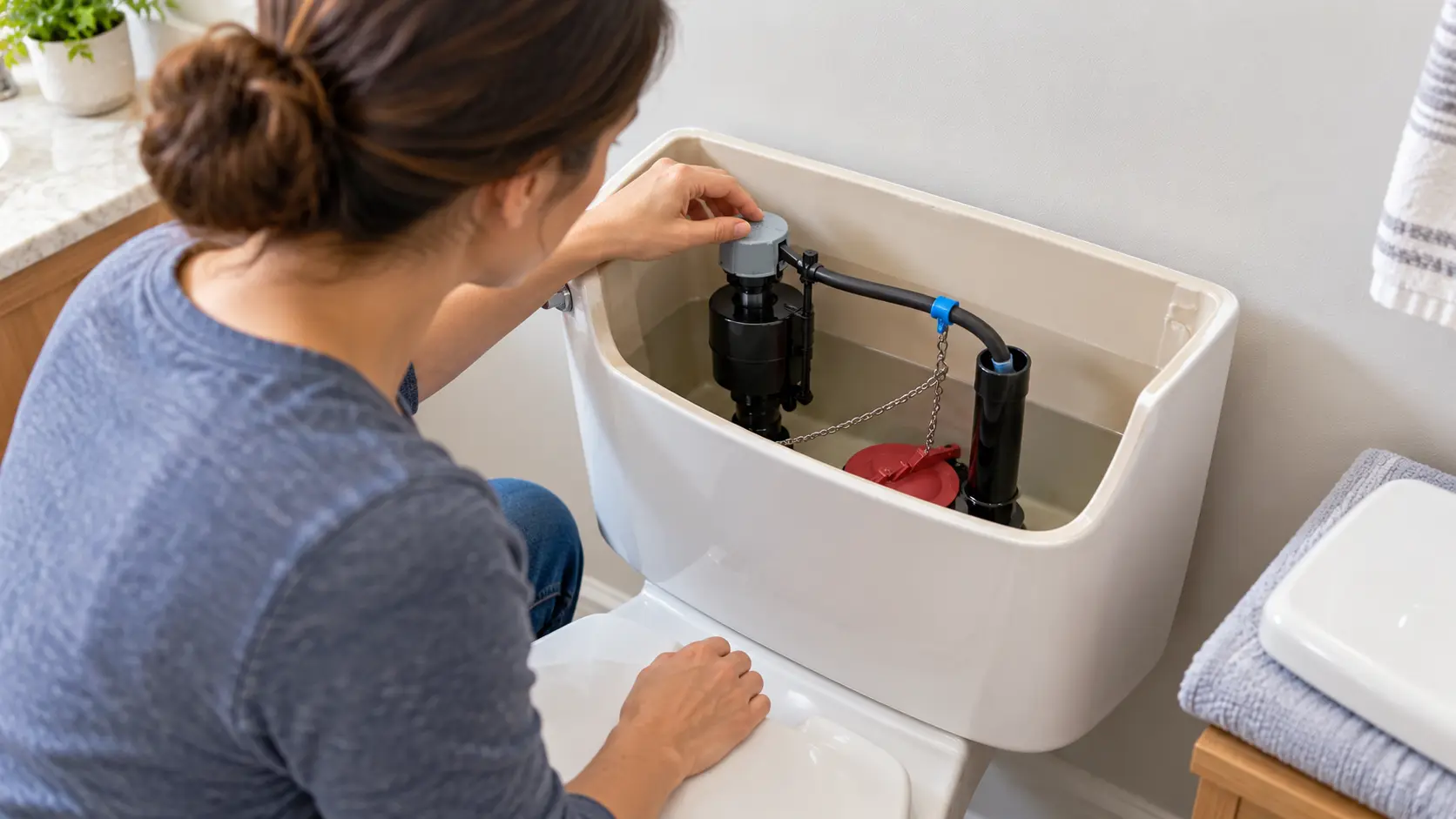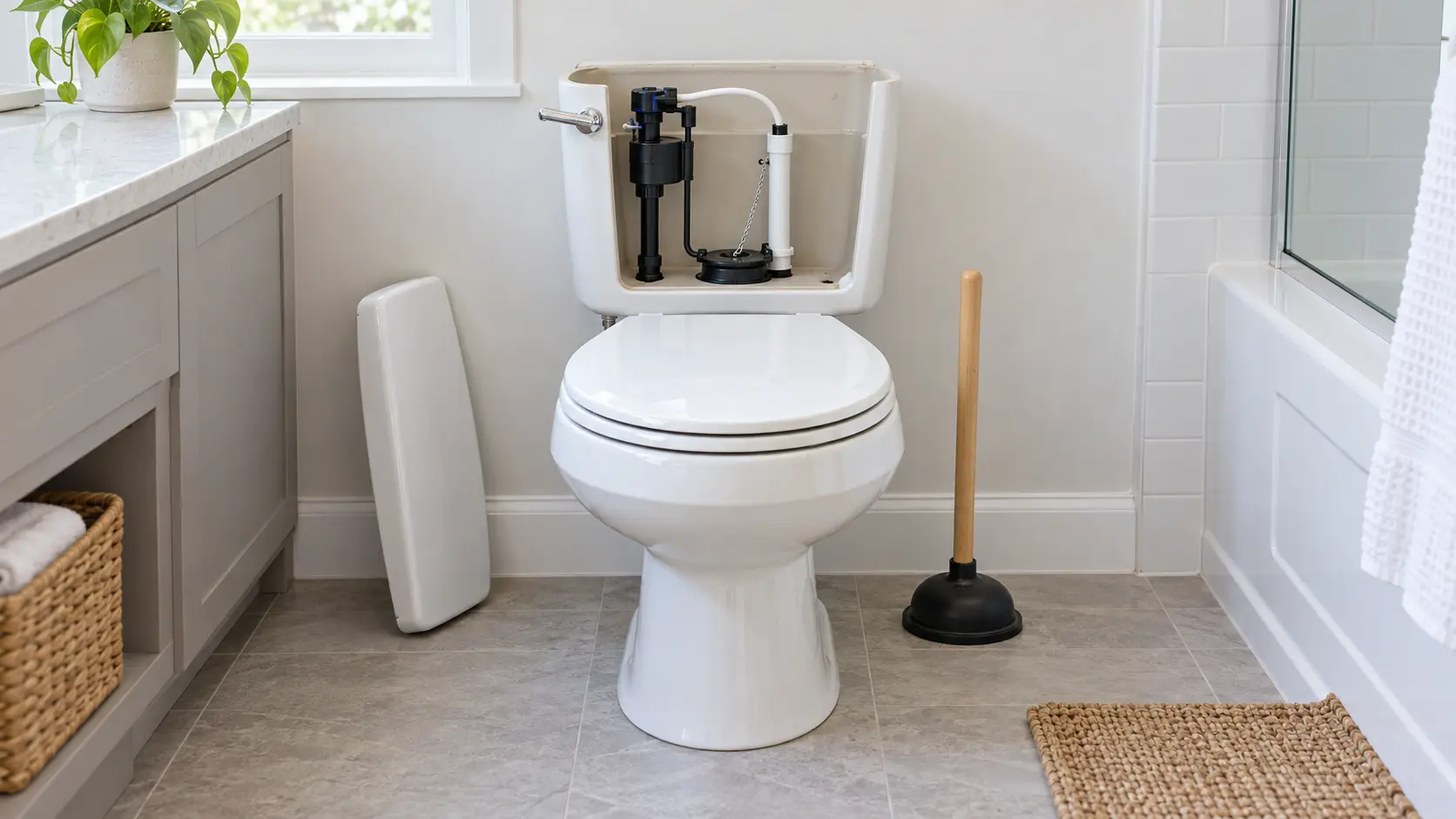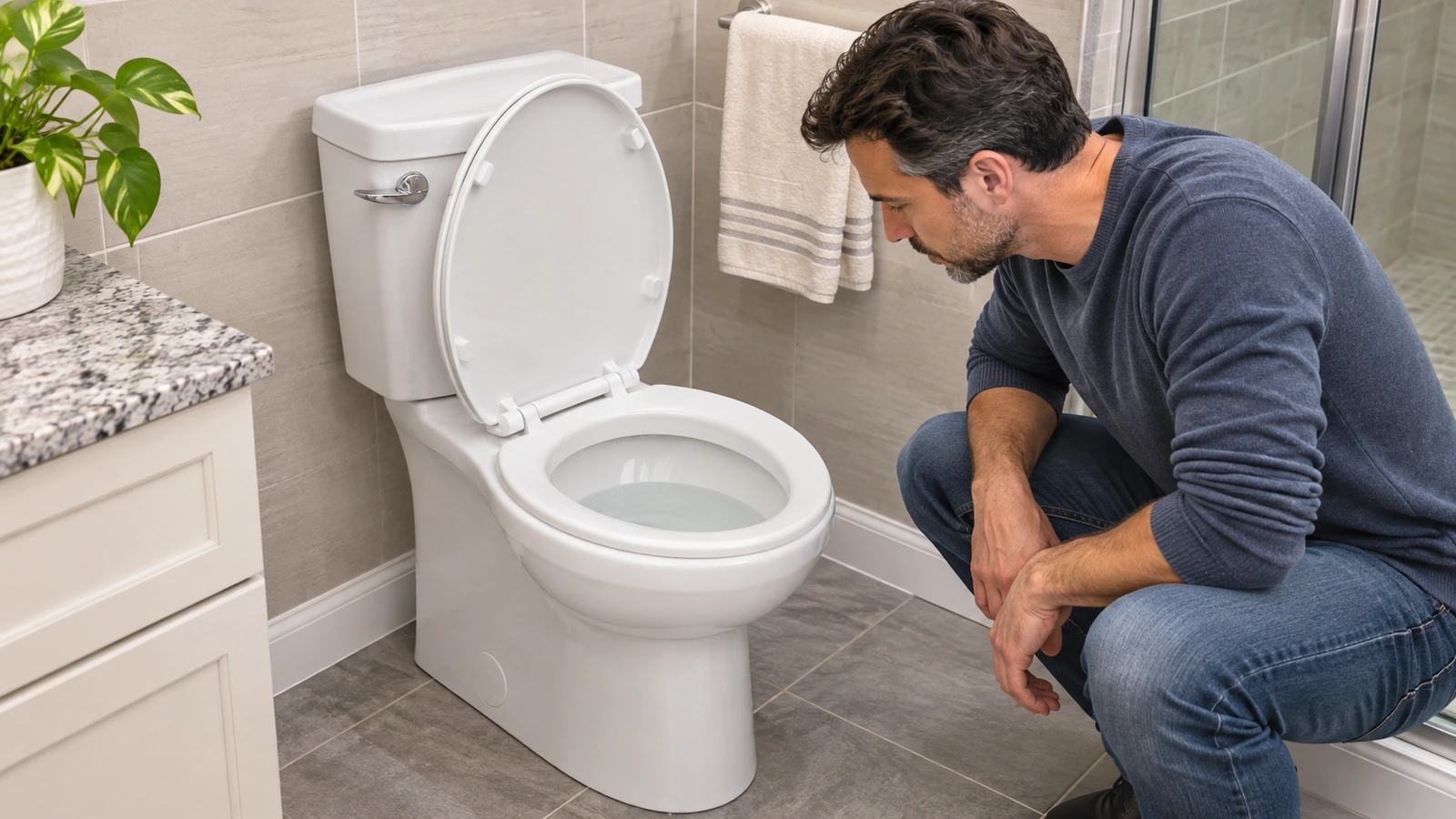
If your toilet won't flush all the way, the most useful clue is what the water does, not simply whether the handle moves. A weak flush can mean the toilet releases less water than intended, the bowl fails to clear efficiently, or the trapway or drain is restricting flow. Those situations can look similar, but they do not call for the same fix. Begin by identifying whether the bowl swirls without clearing, rises and slowly drains, works only on some attempts, or seems to improve when you hold the handle. Then compare that behavior with the tank's normal refill and the flush setting for your particular model. This guide focuses on observing an incomplete flush safely, rather than replacing every component in the toilet.
Stop if the bowl water rises toward the rim
Do not make another test flush when the bowl is already high, draining abnormally slowly, or close to overflowing. If it is safe and accessible, close the toilet's water-supply shutoff valve without forcing it. Avoid contact with wastewater. Repeated backups, sewage entering another fixture, or an active overflow call for a plumber. For broader clog and complete no-flush troubleshooting, see our toilet won't flush guide.
What does “not flushing all the way” actually mean?
Homeowners use this phrase for several different experiences: paper stays behind, the bowl fills and empties slowly, the first attempt seems weak, or some tank water remains after the handle is pressed. Before interpreting any of those signs, distinguish three parts of a normal flush. They are connected, but a problem in one part does not prove a fault in another.
The bowl should clear waste, but it should not become dry
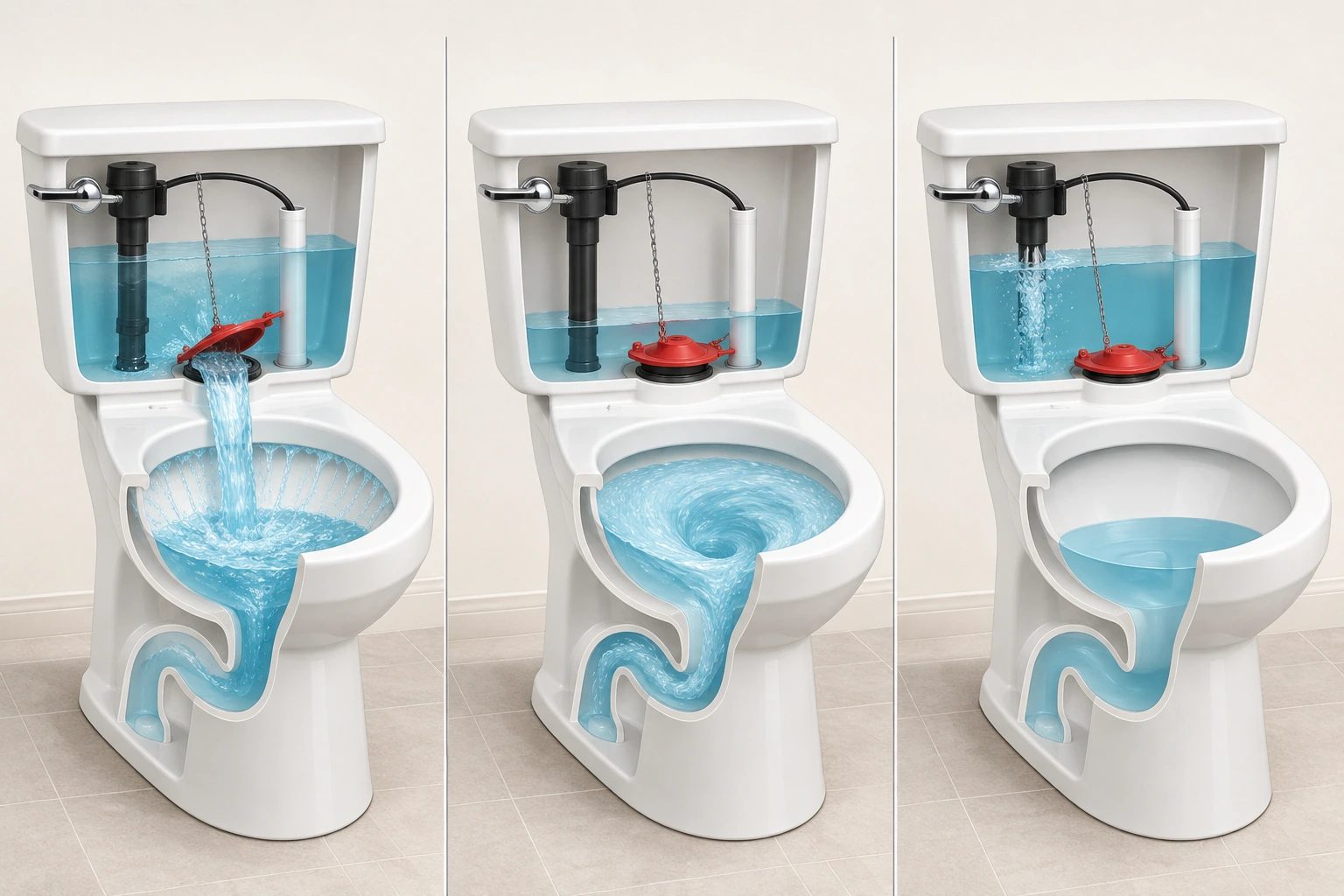
On a typical gravity-fed toilet, water released from the tank passes through passages into the bowl, helps establish a siphon in the trapway, and carries waste toward the drain. Afterward, clean water remains in the bowl to maintain the trap seal. If the bowl ends up holding water after a successful flush, that is not, by itself, an incomplete flush. The meaningful question is whether waste clears and the bowl returns to its designed resting level. KOHLER's explanation of the gravity flush cycle describes the release, siphon, and refill sequence.
Water left in the tank may also be normal
Do not assume a flush is faulty because the tank did not empty. Some flush valves are engineered to use only part of the stored tank water while the remaining water helps provide the intended hydraulic head. KOHLER explains this for some of its systems in its flush-valve guidance. The proper release volume and valve behavior depend on the model; there is no universal rule requiring an empty tank or a specific number of seconds that the valve must stay open.
Watch three phases, not just the handle
For a routine flush that does not risk overflow, note three moments: release (does the tank send water into the bowl?), evacuation (does the bowl clear promptly, swirl without clearing, or rise too high?), and refill (does the system return to its usual resting levels?). These observations narrow the possibilities without taking apart the toilet. If any flush behaves like a blockage, stop testing rather than trying to obtain a better comparison.
Match the exact weak-flush pattern before checking parts
The following table is a symptom interpretation guide, not a list of confirmed diagnoses. Match the closest pattern, then read only the section that applies. If water is high or backing up, the safety response takes priority over any observation suggested elsewhere on this page.
| What you notice | What it can suggest | Safe next observation | Stop or escalate when |
|---|---|---|---|
| The bowl rises high and then drains slowly | Possible partial trapway or drain restriction | Stop flushing; note whether other fixtures also back up | Water approaches the rim, repeats, or affects other drains |
| Water swirls, but paper or waste remains | Weak bowl wash, an incomplete siphon, or a restriction | Recall the flush mode; note whether the tank had fully refilled | It happens repeatedly or the bowl starts rising |
| One flush is weak but another works | Possible incomplete refill, variable valve behavior, or intermittent restriction | Note whether the tank had completed its refill before each ordinary use | The pattern persists or requires repeated forced flushing |
| Holding the handle changes the result | Possible flush-release difference on some designs, not proof of a bad flapper | Identify the model and type of flush mechanism from the manual | A sealed/pressure-assisted system is involved or drainage symptoms coexist |
| Tank seems normal, but bowl wash is uneven | Possible mineral or debris restriction in a rim or jet passage | Look only at visible, accessible buildup; check care instructions | Cleaning method or chemical compatibility is uncertain |
| A light flush fails for paper, but full flush works | Reduced-volume mode may be inappropriate for the waste | Check the labeled full-flush control and the model manual | Normal full-flush operation still fails or water rises |
Two observations can appear together. For example, a poor bowl wash and a partial restriction may both reduce clearance. Do not diagnose a flapper from a swirling bowl alone or declare a drain clear merely because some water eventually leaves it. Manufacturer guidance from TOTO's product FAQ distinguishes a high bowl that drains slowly from other flush-performance questions.
When water swirls but the bowl does not clear
Swirling water without effective evacuation is often described as a toilet that almost flushes. The direction or intensity of visible movement does not tell you, by itself, whether the tank release, bowl passage, or drain is responsible. Start by deciding whether the water level remains relatively normal or climbs higher than usual.
Weak wash is not exactly the same as poor drainage
If water enters the bowl but leaves paper behind without a dramatic rise, an insufficient bowl wash or a siphon that never develops normally is one possibility. If the water instead rises substantially and then seeps away over an extended period, a partial restriction is more concerning. There is overlap: a blockage can sometimes look like poor wash, and visible swirling does not rule out an obstruction. Observe the whole flush cycle only when the bowl is at a safe normal level and there has been no backup.
Check whether the intended flush mode was used
Dual-flush toilets commonly offer a smaller-volume option for liquids and a larger one for solids and toilet paper. An otherwise functional toilet can leave paper behind if the wrong option is selected. TOTO specifically advises using the full-flush choice for paper and solid waste in its dual-flush FAQ. Controls differ by model, so identify the button, lever, or actuator labeling rather than assuming that left, right, short press, or long press always means the same thing. Do not try a stronger flush if the bowl is already rising.
When swirling points to more than a mode choice
If the correct full-flush mode is selected and clearance repeatedly remains poor, look at the pattern rather than increasing the number of attempts. Did the tank finish refilling before use? Does the bowl wash look uneven? Is the water level gradually climbing? Record those details and stop if they indicate restriction. A plumber can compare them with the exact toilet's expected flush action. Repeatedly holding the lever or flushing again is not a reliable diagnostic test.
When the bowl rises and then drains slowly
This is the branch that should interrupt ordinary weak-flush checks. A bowl that climbs toward the rim and slowly recedes is not simply evidence that the tank used too little water. It may mean water cannot pass through the trapway or downstream line at its normal rate. KOHLER's water-not-leaving-bowl guidance identifies clogging and possible vent restrictions as relevant causes.
Why you should not repeat a flush to compare results
The bowl can appear to recover after several minutes because water slowly passes an obstruction. That does not prove the obstruction has cleared. Another normal tank discharge may arrive faster than the bowl can drain, making an overflow more likely. Stop, keep children and pets away from contaminated water, and do not pour harsh drain chemicals into the toilet. If water is approaching the rim, manage the water supply only when you can do so without forcing a valve or exposing yourself to wastewater.
One toilet versus several affected fixtures
If only one toilet shows the problem, the trapway or local branch drain may be involved. If a nearby shower, tub, or another toilet backs up, or if you hear unusual drainage sounds elsewhere, the concern can extend beyond that fixture. These are clues, not a homeowner diagnosis of a blocked roof vent. KOHLER's poor-flush guidance notes that other-drain sounds, bubbles, and slow drainage can point toward the waste or vent system. A qualified plumber should assess repeated or multiple-fixture symptoms.
Use the general no-flush guide for clog basics
If you are dealing with a bowl that does not clear, the priority is no longer a weak-flush timing investigation. Our general toilet no-flush troubleshooting guide explains the broader clog-versus-mechanism distinction. It also covers when a toilet plunger or closet auger may be appropriate. This article does not repeat those procedures because the immediate task is to recognize a possible blockage and avoid an overflow.
Why one flush is weak but the next works
An inconsistent flush can be more revealing than a consistently weak one. Some homeowners notice that only the first flush after a short interval is ineffective, while others see the opposite. The order matters. Record what happened before each ordinary use instead of deliberately producing multiple flushes for a test.
Was the tank finished refilling?
After a normal flush, the fill valve typically restores water to a model-specified level. If the next use occurs before refill is complete, a gravity toilet may not have the same available flush volume. This is only one possibility and is not an invitation to modify the fill valve blindly. On a conventional, safely accessible tank, note whether the water had reached the marked fill line before ordinary use. Do not apply a universal time threshold or waterline measurement; refill behavior differs across models.
Did the release mechanism behave consistently?
Some gravity toilets use a flapper and chain; others use a canister or a different actuator. An intermittently sticking or incorrectly fitted component may change how the valve opens or closes from one use to the next. But the visible symptom alone cannot establish which part is at fault. If it is safe to remove a conventional tank lid, set it on a stable, protected surface and observe only accessible parts. Do not put fingers into moving components during operation or disassemble concealed mechanisms. Have the model number ready before any adjustment or part replacement.
A successful second flush does not rule out a clog
A partial obstruction can sometimes pass water or waste intermittently. If any attempt causes high water, slow drainage, bubbling, or repeated backups, treat that as a drain-side warning rather than relying on the successful attempt for reassurance. Avoid performing a series of repeat flushes to reproduce the problem. A short description of the intermittent pattern helps a plumber more than repeated overflow risks.
Why holding the handle can change the flush
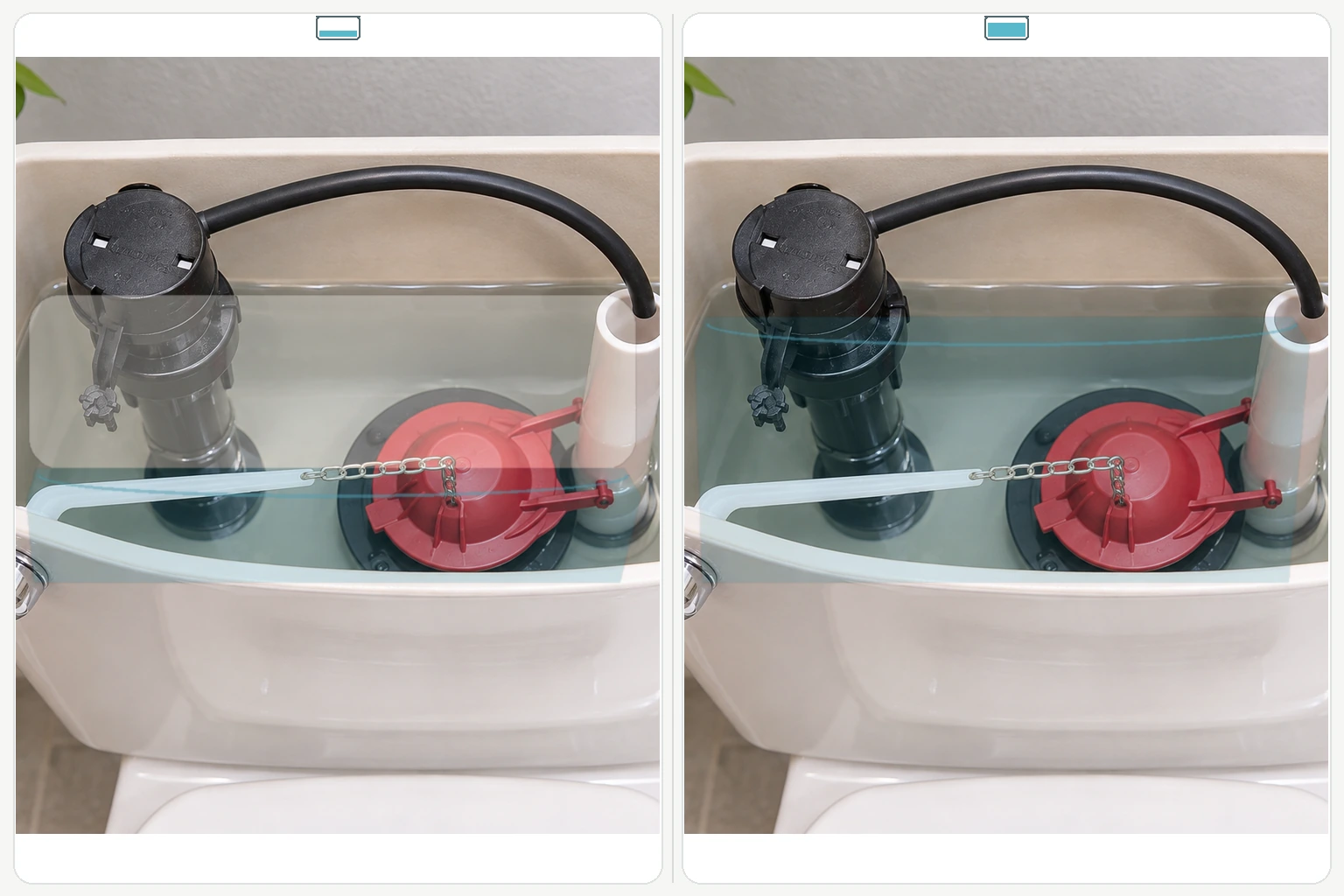
If the flush seems stronger when the handle stays down, it is tempting to assume the flapper always closes too quickly. On some traditional gravity systems, extra handle travel can change how much water is released. But a correct diagnosis depends on the flush valve design, water level, and whether the bowl is draining freely. KOHLER also includes a handle-holding symptom among clues that can accompany poor waste-stack or vent performance, so that observation is not definitive proof of a chain problem.
Identify the mechanism before interpreting its movement
On a flapper design, the handle and chain usually lift a hinged valve. A canister design, dual-flush control, or proprietary flush tower follows a different operating sequence. Watch only the normal, user-accessible operation of a conventional mechanism, then use the exact manufacturer's instructions to understand what movement is expected. Do not assume every handle should be held for a certain number of seconds.
Do not try to make every tank empty all the way
A valve closing while water remains in the tank is normal on some models. Enlarging the lift, forcing the handle, or changing chain length to empty the tank can waste water and make the toilet function incorrectly. Refer to KOHLER's model-family explanation as an example, not a specification for every manufacturer. The right test of flush performance is correct bowl clearance and safe refill behavior.
When the handle is not the real issue
If holding the handle coincides with gurgling, a bowl that rises high, or slow waste evacuation, look beyond the handle. A restricted drain or vent may need professional assessment. Even without those clues, an uncertain mechanism, recurring problem, or pressure-assisted design is a reason to stop at observation rather than improvise adjustments.
If bowl wash is uneven but tank refill seems normal
Sometimes the tank appears to be refilling as designed, yet water enters the bowl weakly or leaves areas of the bowl poorly rinsed. Mineral deposits or debris in a rim or jet passage are plausible explanations on certain toilets. However, bowls have different water-delivery designs, and a clean visible rim does not prove that every concealed passage is clear.
Look for visible deposits, not a universal hidden-jet design
Hard water can leave deposits around accessible bowl openings. KOHLER identifies rim-hole restriction as one possible cause of poor wash on applicable models. Other toilets distribute water differently, so an illustration of rim holes should not be used as an exact repair map for every bowl. An uneven wash warrants careful observation and a check of model-specific care guidance, not immediate disassembly.
Keep cleaning within the model's approved instructions
For routine visible surface deposits, use only products and methods permitted by the toilet manufacturer. Do not insert sharp metal tools into hidden passages, pour concentrated acids through the tank, or use generic drain-opening chemicals as a shortcut. A manufacturer may publish a procedure for a particular bowl family, but that does not automatically make it safe for another toilet's seals, glaze, or internal parts. If you cannot confirm the recommended method for the model, a plumber or the manufacturer's support team can help.
Never combine cleaning products
Household cleaners can react dangerously. The CDC warns against mixing bleach or disinfectants with other cleaners. Do not copy online Q&A recipes that combine chemicals or call for aggressive internal bowl treatment. If a previous cleaner is already in the toilet, do not introduce another product to try to speed up the process. Follow the product label and get professional advice if you are unsure what was used.
Model-specific features that can change the answer
A toilet that looks conventional from the outside may have a very different flush system inside. The model name, flush button, or actuator style can matter more than a generic weak-flush tip. The distinctions below are reasons to consult the manual, not instructions to open sealed equipment.
Gravity flapper, canister, and dual-flush toilets
Traditional flapper systems, canister valves, and dual-flush assemblies can release different designed volumes and close at different times. A symptom that suggests improper lifting on one design may be normal operation on another. For a dual-flush unit, confirm that the intended full-flush setting was selected for solids and paper; if the correct setting still leaves waste, move back to the symptom table rather than assuming the buttons are reversed or defective.
An American Standard VorMax just installed or serviced
American Standard publishes a specific priming procedure for certain VorMax toilets after installation or part replacement. That procedure is not a recommendation to flush repeatedly whenever an older toilet is working poorly. Use only the applicable instructions for the exact VorMax model, and never perform priming attempts when water is rising, drainage is impaired, or a blockage is suspected.
Pressure-assisted, powered, or concealed systems
Pressure-assisted toilets and powered flush systems do not always behave like ordinary gravity tanks. If you see a sealed pressure vessel, powered component, or inaccessible in-wall tank, identify the model from an accessible label or paperwork. Do not open a pressure vessel, bypass a safety feature, work on energized components, or apply conventional flapper adjustments to a different system. Follow the manual and use qualified service when the fault is not covered by an ordinary homeowner operation.
When to stop checking and call a plumber
Observation is useful only while the toilet and surrounding area are safe. Stop routine troubleshooting when water approaches the bowl rim, sewage leaks or backs up, more than one fixture is affected, the bowl repeatedly drains slowly, or you suspect a solid object or deeper drain obstruction. Stop as well for visibly cracked porcelain, an unstable toilet, water near electrical equipment, a shutoff valve that is stuck, or a mechanism that would require unsafe access.
What to tell the plumber
A precise symptom description can prevent unnecessary part swapping. Report the toilet brand and model if known, whether it is gravity, dual-flush, or pressure-assisted, and which flush setting was used. Describe the bowl level during the attempted flush: did it rise, swirl, drain slowly, or clear waste while leaving unusually high water? State whether the tank had refilled before ordinary use, whether the behavior changes between uses, and whether other fixtures make unusual sounds or back up.
What not to do while waiting
Avoid repeated flushes, makeshift modifications to the lift chain or valve, chemical drain openers, unapproved acid treatments, and roof-vent investigations. Do not force a supply shutoff valve that does not move normally. If the bowl is already high, leave the toilet out of service and keep the area protected from overflow. A professional can determine whether the issue is a fixture restriction, internal component, branch drain, or building vent problem.
Frequently asked questions
Why is my toilet not flushing all the way even though it is not visibly clogged?
A visible absence of debris does not rule out a partial trapway obstruction. A weak flush can also involve the intended water release, refill state, or bowl wash. If the bowl rises and drains slowly, prioritize a possible restriction. If it does not rise, note the flush mode and whether the tank refilled normally; consult the exact model guidance before changing parts.
Why do I have to flush twice to clear the bowl?
Two attempts may appear to help when the tank was not fully ready, a flush component behaves inconsistently, or an obstruction sometimes lets water pass. A successful second attempt does not prove the drain is clear. Do not make deliberate repeat flushes when the bowl is rising, draining slowly, or at risk of overflow.
Should the toilet tank empty completely during every flush?
No. Some gravity toilets are designed to retain water in the tank after the flush. Judge the result by proper bowl clearance and model-specified operation, not by whether the tank empties. Never adjust a mechanism solely to force a complete tank drain.
Why does my toilet flush completely only when I hold the handle?
Holding the handle can affect water release on some gravity models, but it does not prove that the flapper or chain is defective. Identify the flush-valve type, read the model manual, and pay attention to slow drainage or gurgling, which can suggest other plumbing concerns.
Can a low-flow toilet flush effectively?
Yes. Water volume alone does not determine performance. The EPA WaterSense program evaluates both water efficiency and flushing performance for certified toilet models. If a particular toilet clears poorly, focus on its actual symptom and design rather than assuming all efficient toilets are weak.
The practical takeaway
A toilet that won't flush all the way needs a more specific description than “weak flush.” A bowl that rises and drains slowly calls for stopping and considering a blockage; a normal-level bowl that swirls without clearing points to a different set of possibilities; and a toilet that works intermittently deserves attention to refill and model-specific flush behavior. Use the symptom table to decide what you can safely observe. If the problem persists, or the bowl or drain acts unsafe, stop and get qualified plumbing help.
Manufacturer and safety references
This guide uses manufacturer-specific information only within its stated scope. The installation, operation, and service instructions for your exact toilet model take priority over general internet advice.
- KOHLER: How a Toilet Flushes
- KOHLER: Poor Flush and Toilet Water Not Leaving Bowl
- KOHLER: Flush Valve Closing Fast or Not Emptying All Tank Water and Poor Toilet Rim Wash
- TOTO USA: Product FAQ
- American Standard: How to Prime a VorMax Toilet
- CDC: Cleaning and Disinfecting with Bleach
- U.S. EPA: Residential Toilets