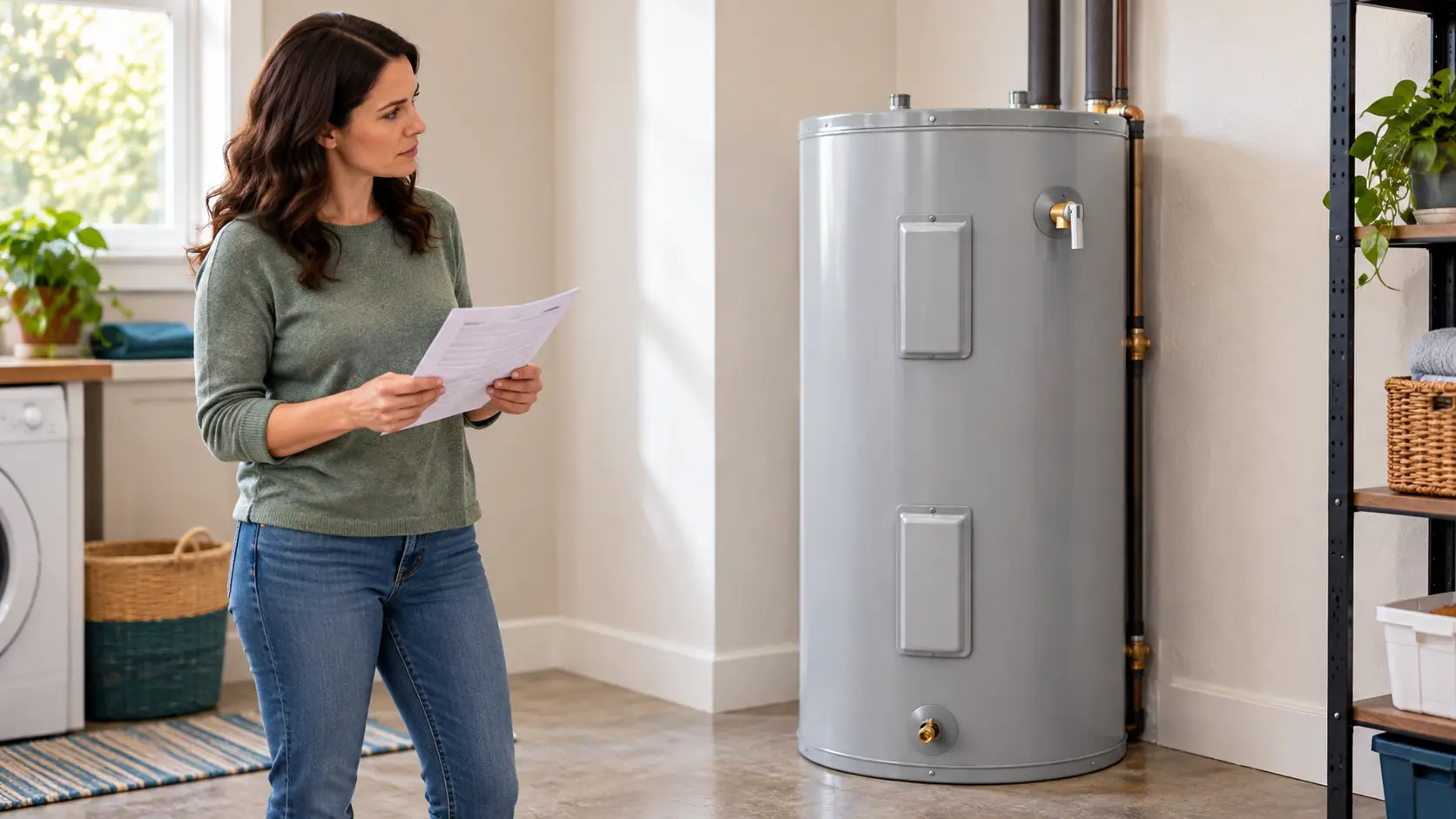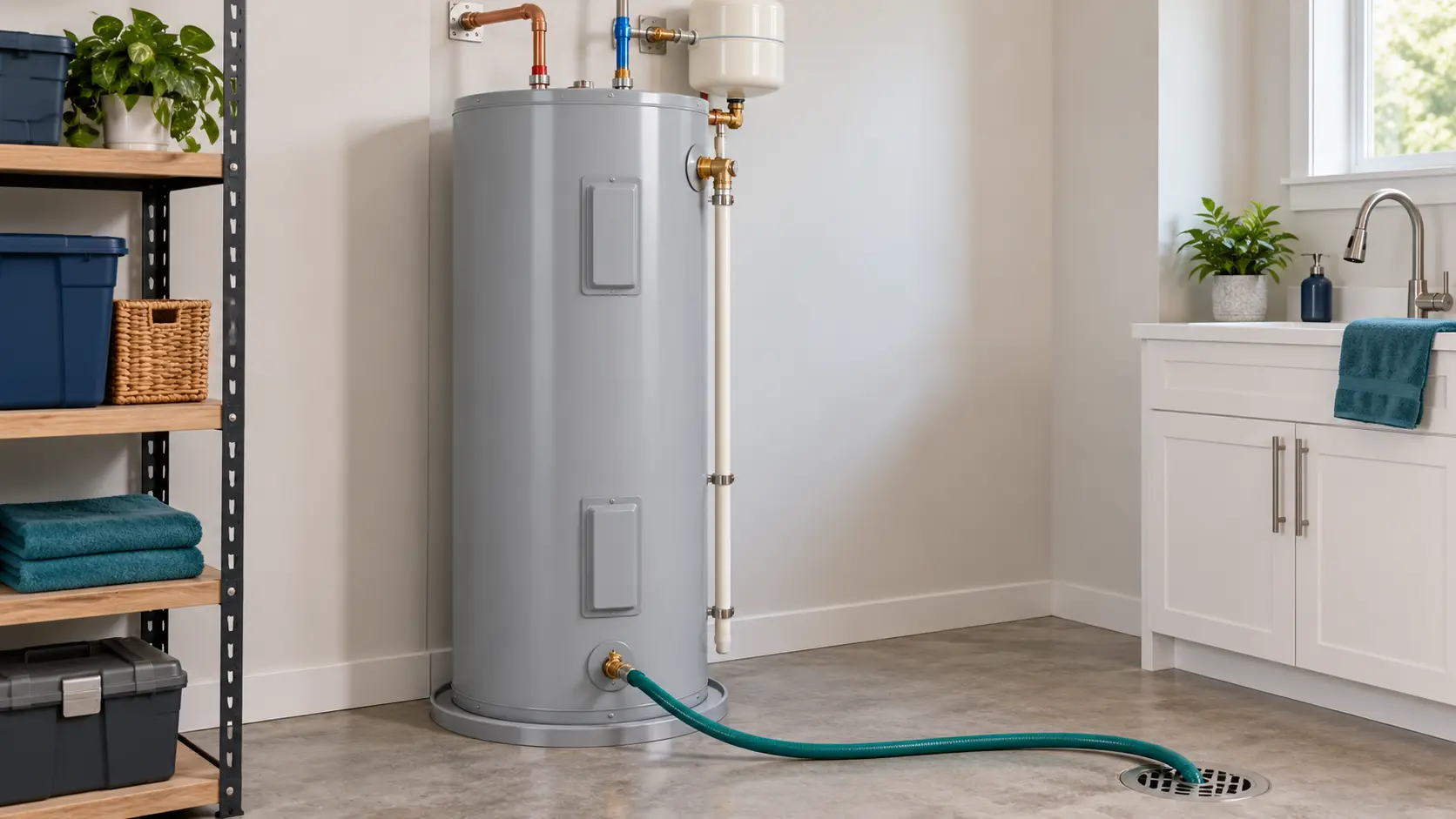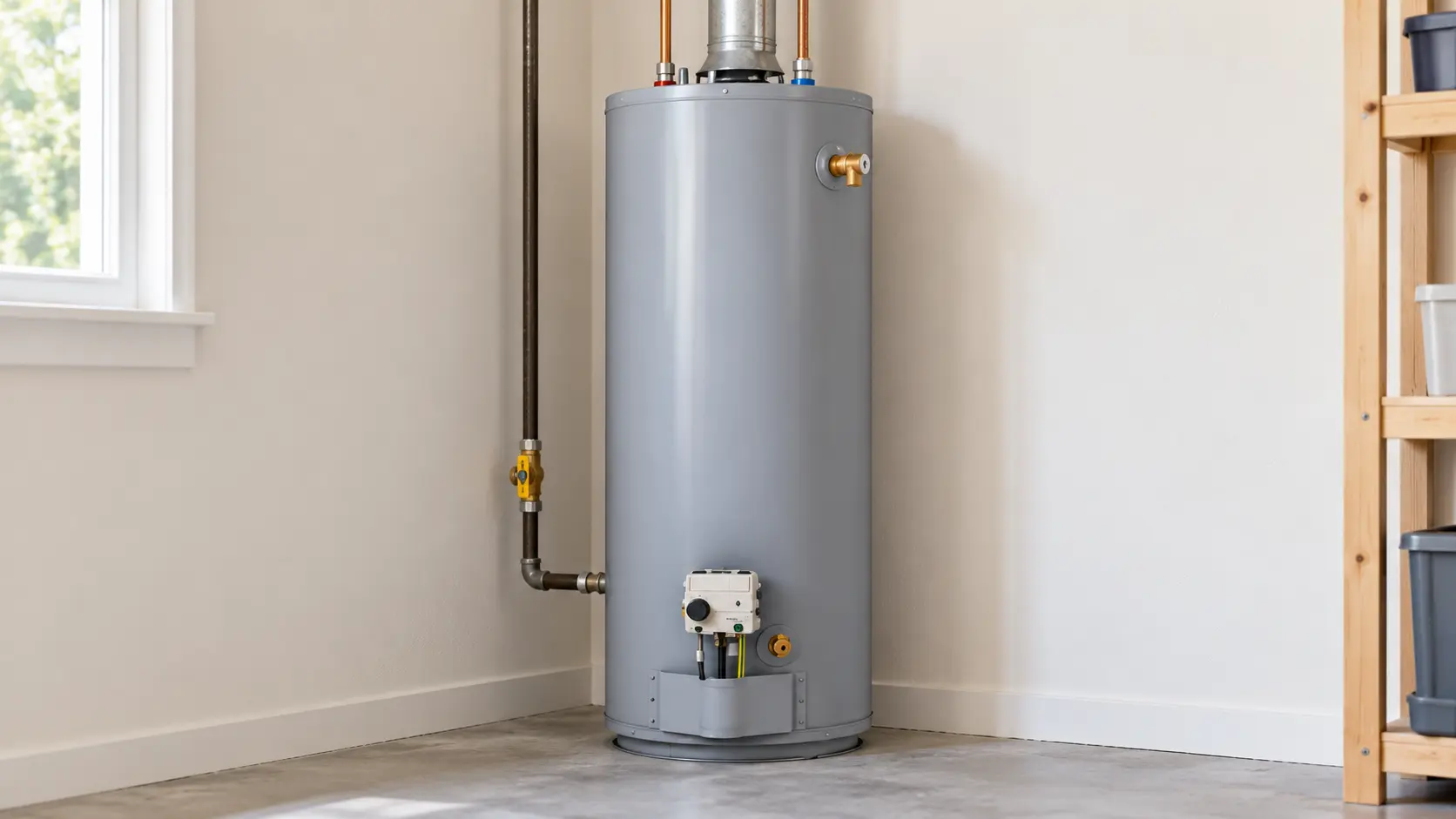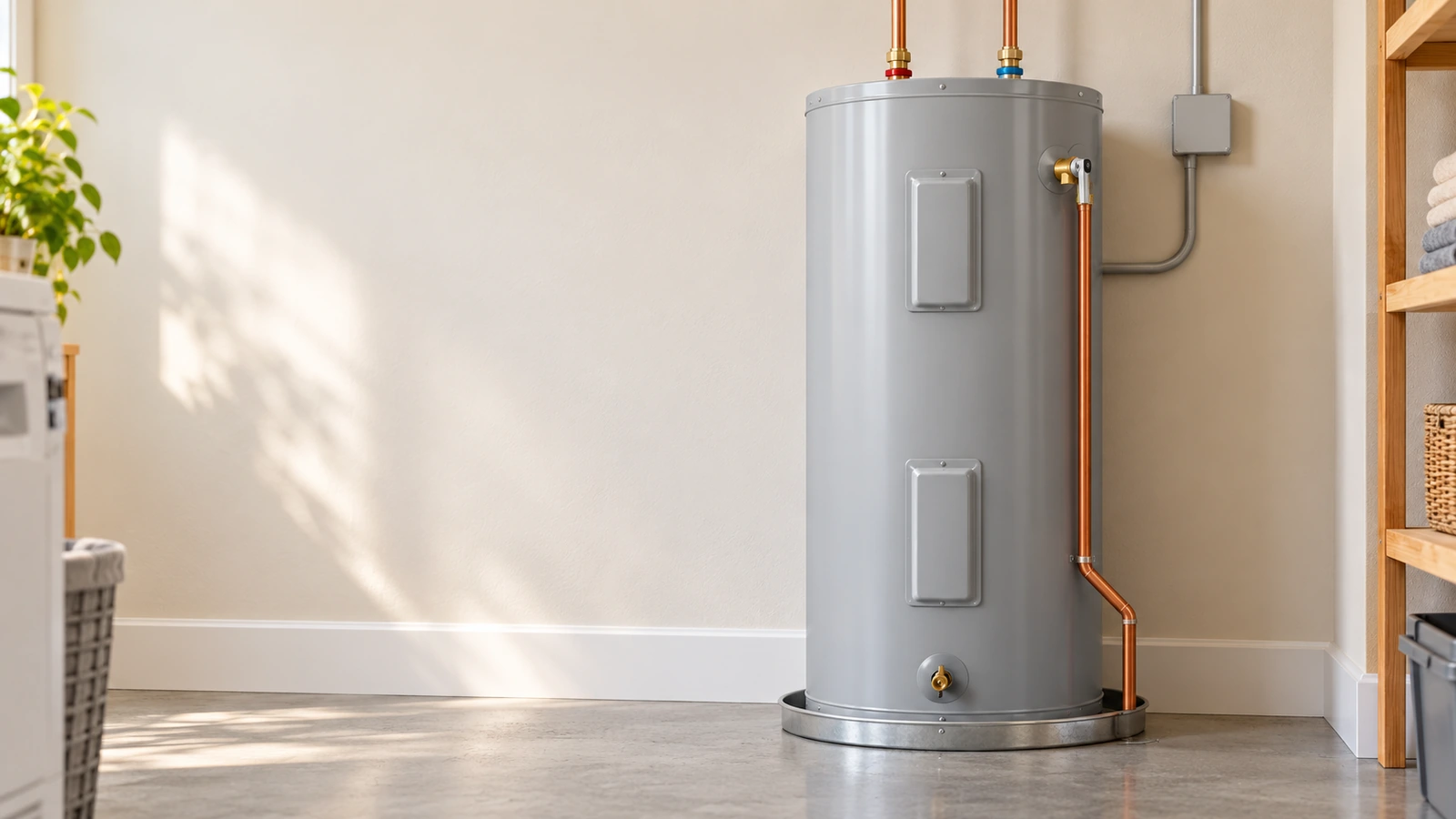
If your electric water heater is not heating, the first clue is what the water feels like and where the problem occurs. Completely cold water at every faucet points to a different set of possibilities than a shower that stays lukewarm or a tank that runs out of hot water too quickly. Common causes include interrupted electrical power, a failed heating element or thermostat, a tripped over-temperature safety control, and problems outside the heater, such as a mixing valve.
This guide focuses on conventional residential electric tank water heaters that were previously working. It explains what you can check without opening the appliance and what a qualified professional may need to diagnose. For a new unit that has never heated properly, use our new water heater not heating after installation guide instead. If you have a gas, tankless, or heat-pump model, start with our general water heater troubleshooting guide.
Safety first: water and electricity are a dangerous combination
Do not remove the heater's electrical access panels, junction-box cover, insulation, or protective guards. Do not test live voltage, touch wiring, replace heating elements, or press a concealed high-limit reset as a general DIY fix. An ordinary-looking heater may have energized components behind its covers.
Stop and seek qualified help if you find water near electrical equipment, smell burning, notice scorched parts, hear electrical arcing, have a breaker that trips again, see uncontrolled very hot water, or observe significant discharge from the temperature-and-pressure relief line. Stay away from wet electrical equipment; only disconnect power if it can be done safely from a dry location.
Quick answer: what to check first
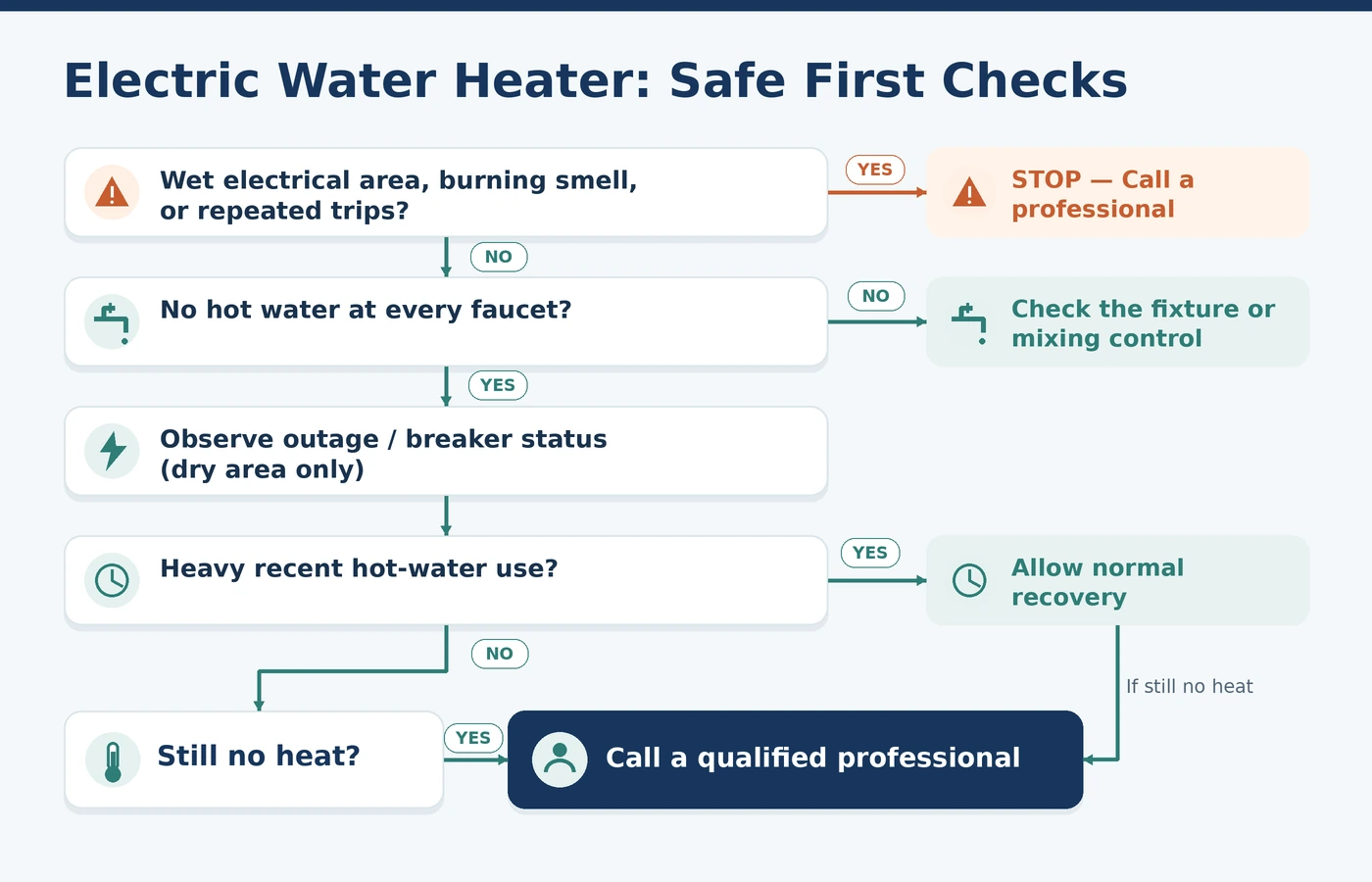
Before assuming the electric hot water heater has failed, make a few non-invasive observations. They help identify whether this is a whole-house heating issue, normal hot-water depletion, or a problem at a single fixture.
1. Try more than one hot-water faucet
Check a sink and another shower or faucet, allowing normal time for water in the pipe to clear. Keep hands away from unexpectedly hot water. If only one outlet is affected, investigate that fixture first.
2. Confirm the heater type and model
Read the exterior label without removing covers. A standard electric storage tank differs from a heat-pump, tankless, or digitally controlled unit; your exact manual takes priority.
3. Observe the normal power controls
From a safe, dry location, note whether there has been a household outage or whether the labeled breaker or normal disconnect appears off or tripped. Never remove electrical covers or repeatedly reset a tripping breaker.
4. Think about recent hot-water demand
Back-to-back showers, laundry, and dishwashing may temporarily use up the stored hot water. If the tank later recovers normally, demand may be the explanation rather than a failure.
Also look from a safe distance for pooling water, dripping fittings, an unusual odor, or obvious signs of overheating. If you see a leak, follow our water heater leaking guide and prioritize electrical safety.
Electric water heater symptoms: what they may mean
Manufacturer troubleshooting guides separate no hot water, not enough hot water, and slow hot-water recovery. That distinction matters: a part failure that reduces the available hot water may not be the same failure that stops heating entirely.
| What you notice | Possible explanation | Next sensible action |
|---|---|---|
| Cold water at every fixture | Interrupted power; upper element or thermostat; tripped energy cut-off (ECO); occasionally a plumbing or mixing issue | Check only exterior clues, then arrange service if the cause is unclear |
| Only one shower or sink stays cold | Fixture cartridge, anti-scald stop, or thermostatic mixing control | Compare other outlets; have the affected fixture evaluated |
| Some hot water, but much less than before | Demand beyond tank capacity; lower element/thermostat on applicable models; hot-side leak; mixing valve; dip tube | Review recent usage and whether the problem is persistent |
| Tank recovers unusually slowly | Cold incoming water; high demand; heating-element issue; mineral scale; electrical supply/control fault | Compare against normal performance and obtain service if the change persists |
| Water becomes dangerously hot | Thermostat/control, grounded element, or mixing-valve problem | Stop using affected hot-water outlets and call qualified service |

If only one faucet is cold, the heater may be working
Suppose the kitchen sink gets hot water, but one shower does not. The problem may be in the shower mixing valve, cartridge, or anti-scald limit rather than the heater. Some homes also have a central thermostatic mixing valve that can change the delivered temperature at multiple outlets.
Compare another fixture before assuming a heating element is burned out. Do not remove plumbing controls or make blind temperature adjustments: a misadjusted mixing valve can expose someone to scalding water. A plumber can confirm whether a fixture or central mixing valve needs repair.
Why an electric water heater has no hot water at all
When several faucets deliver only cold water even though the tank previously worked, start by separating a power-supply problem from an internal heating/control fault.
Power to the water heater is interrupted
Electric tank heaters need their specified electrical supply to heat water. A tripped breaker, failed disconnect, utility interruption, electrical control, or wiring problem can interrupt that supply. Check whether other circuits are affected and look at the normally accessible breaker/disconnect only when the area is completely dry and safe.
A breaker that has tripped is not proof that the heater only needs a reset. If it trips again, feels hot, is associated with electrical smells, or you do not know why it tripped, stop and contact a qualified electrician or water-heater technician. Do not bypass protection, remove the service-panel cover, or try to check voltage yourself.
The upper element or upper thermostat has failed
On many conventional two-element electric storage tanks, the upper heating element heats the top portion first. The upper control also participates in directing heating demand to the lower element. If the upper element or control fails, the tank may deliver little or no hot water even though the breaker looks normal.
That is a possible explanation, not a way to identify a failed part from symptoms alone. Professional testing can distinguish an element failure from a faulty thermostat, a loose connection, or loss of power.
The high-temperature energy cut-off has operated
Many electric storage heaters include an energy cut-off (ECO) that interrupts heating when tank temperature becomes excessive. It is commonly associated with a red reset control located behind an access cover on conventional designs. If the ECO operates, the tank can stop producing hot water.
Do not treat the hidden red button as a routine DIY reset. A tripped ECO can signal overheating caused by a thermostat or heating-element defect. A. O. Smith's residential manual advises having a qualified person investigate and repair the cause before power is restored. Never defeat the ECO or keep resetting it.
Why the water is lukewarm or runs out too quickly
An electric water heater can still produce some hot water while performing far below normal. Here the pattern of usage and the amount of hot water available can be more informative than whether the unit appears to have power.
Recent demand exceeded the stored supply
A storage heater holds a limited amount of heated water. Several showers, a filled bathtub, or simultaneous laundry and dishwashing may draw it down faster than the heater can recover. Think back to your household's typical demand and whether the tank usually performs better under similar conditions.
If the heater works normally after a suitable recovery period, your demand may be temporarily exceeding its capability. The tank's first-hour rating, element wattage, incoming water temperature, and household usage are more useful than an arbitrary promise that every heater should recover in a certain number of minutes.
A lower heating element or thermostat is not operating
On a common two-element electric storage heater, the lower element provides much of the ongoing heating needed after hot water has been drawn. A failed lower element or lower thermostat may leave you with a small amount of hot water that runs out unusually fast or replenishes slowly. A. O. Smith and Bradford White describe this pattern in their conventional electric-tank troubleshooting charts.
Do not buy an element solely because you get a short warm shower. A technician should establish that the part is faulty, identify the model's voltage and wattage requirements, and rule out other electrical or plumbing problems before replacement.
A mixing valve, dip tube, or hot-water leak is affecting delivery
A thermostatic mixing valve can blend in too much cold water or fail in a way that reduces delivered hot-water temperature. A damaged dip tube can also interfere with the tank's intended flow pattern. An unnoticed hot-water-side plumbing leak may continuously draw off heated water.
These conditions can resemble a heating problem. Record whether every fixture is affected, whether the water becomes colder during extended use, and whether there is an unexplained continuous water flow or leakage. A plumbing professional can evaluate mixing, distribution, and concealed leaks.
The temperature control is set low
Some heaters have an exterior digital control, while many conventional tanks house thermostats behind electrical access panels. Read the settings section of your specific model manual, and only use controls expressly intended for normal homeowner access.
Do not turn the temperature up at random to solve weak heating. Higher stored-water temperatures can cause serious burns, and a mixing-valve problem may be mistaken for a tank-temperature problem. Seek help for settings that require opening electrical covers.
Why an electric hot water tank is heating slowly
Recovery is the time the heater needs to replenish hot water after use. If your tank used to recover reliably and now takes much longer, several explanations deserve consideration:
- Colder incoming water: in colder seasons the heater may need more time or energy to reach the same delivery temperature.
- Repeated high demand: water can be drawn faster than the tank can reheat it, particularly with overlapping hot-water activities.
- Lower heating element or thermostat trouble: on compatible two-element tanks, a failure may reduce heating performance without making all hot water disappear.
- Mineral scale or sediment: deposits can affect parts and, on some models, accompany noise or reduced performance. A service technician can determine whether that is relevant.
- Supply or control issue: incorrect supply voltage, damaged wiring, or a failed control requires professional evaluation.
If maintenance is due, use the water heater flushing guide only when the exact manufacturer's instructions and your ability make it safe. Flushing is not a substitute for fixing a failed heating element, and you should not drain or refill an electric tank as an improvised no-heat test.
What the heating elements, thermostats, and ECO actually do
The familiar tall electric tank often has two heating-element/thermostat locations—one higher and one lower on the tank. This is an illustrative conventional design, not a universal diagram for every electric water heater.
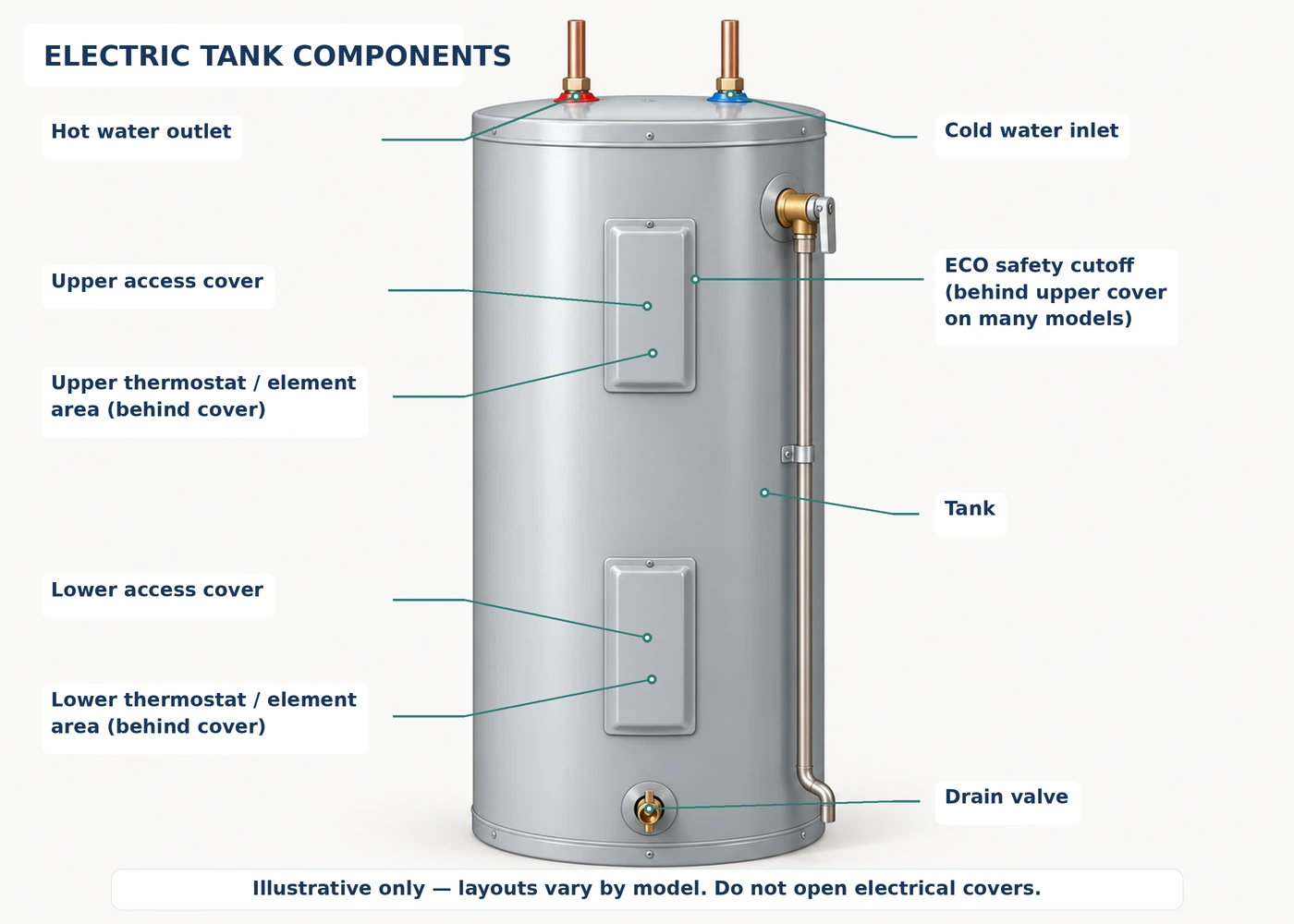
Heating elements
Electrical components that transfer heat into tank water. On some dual-element systems, the upper and lower elements perform different roles during a heating cycle.
Thermostats or controls
Controls sense tank temperature and direct heating. Their number and operating sequence vary with heater design.
ECO/high-temperature limit
A safety control intended to interrupt heating after an over-temperature condition. If it operates, investigate the cause before restoring service.
Mixing valve and dip tube
Plumbing components that help control delivery temperature and water flow. A defect can imitate a heating problem even when elements are functioning.
Some electric water heaters instead use a single element, a heat pump, electronic sensors, or specialized control modes. For those models, component functions and troubleshooting differ. The exterior model label and the matching manual—not this conceptual diagram—determine the correct procedure.
Which checks are safe for a homeowner—and when to stop
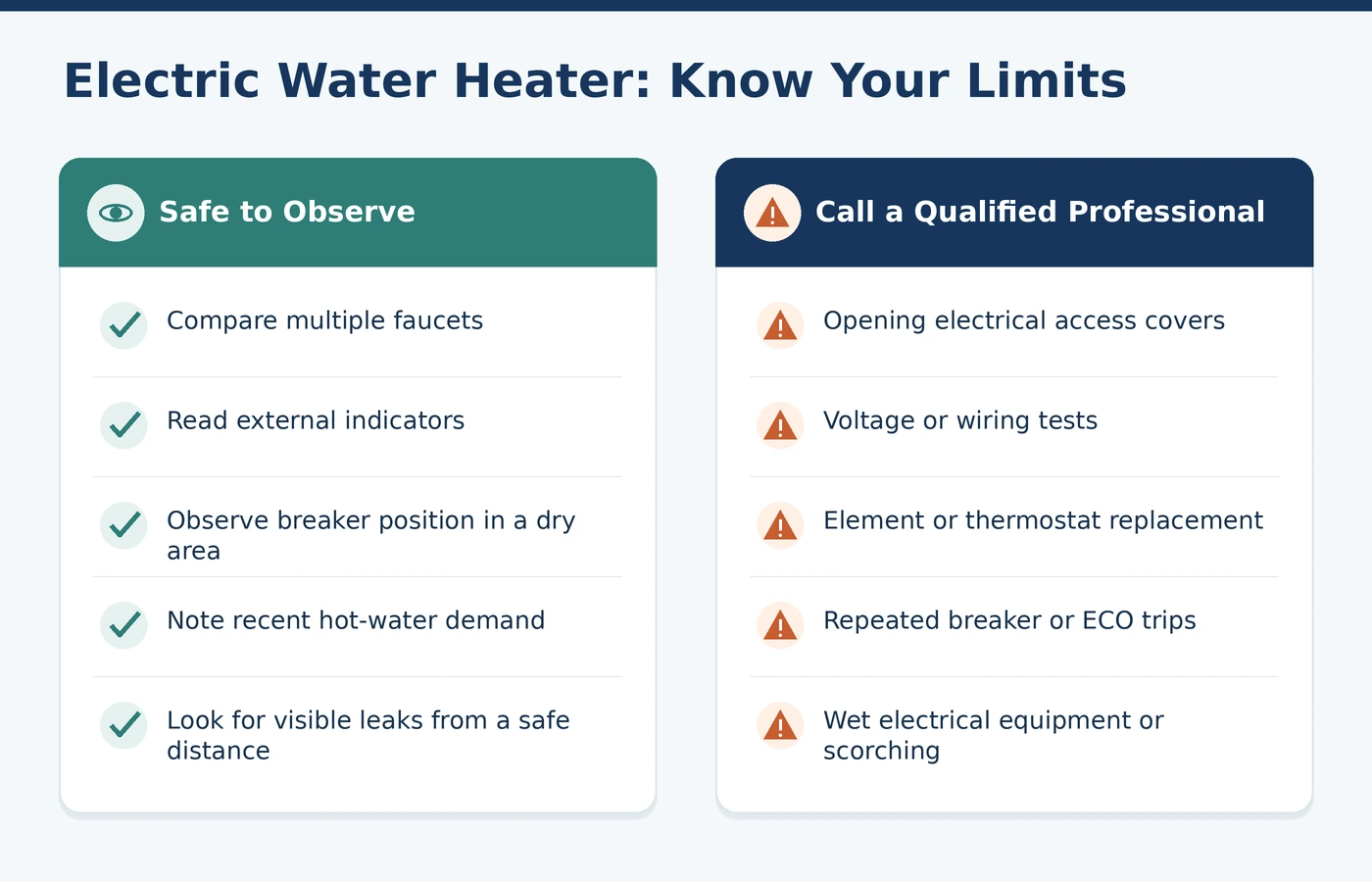
The most valuable homeowner contribution is an accurate description of the symptoms. It can save time without requiring exposure to electrical parts.
| Reasonable exterior observation | Leave to a qualified professional |
|---|---|
| Compare hot water at different faucets | Disassemble or repair a concealed mixing valve or plumbing connection |
| Read the outside model/serial label and accessible display | Remove access panels, insulation, electrical guards, or junction-box covers |
| Note an outage or visible normal breaker position from a safe, dry area | Diagnose voltage, wiring, breaker faults, elements, or thermostats |
| Record recent showers, laundry, and normal recovery behavior | Replace or test heating elements and temperature controls |
| Observe visible leaks or relief-line discharge from a safe distance | Test or block the T&P relief valve; repair wet electrical equipment |
For non-urgent service, write down the model and serial number, approximately when the problem began, whether all fixtures are affected, what the water temperature seems like, and whether the tank eventually recovers. These facts help a technician decide what to inspect without guessing which part to replace.
Should you repair or replace an electric water heater?
A cold shower by itself is not proof the entire tank needs replacement. Some confirmed component failures may be repairable, while significant tank leakage, recurring failures, an aging unit, or an uneconomical quote may favor replacement.
- Ask for a confirmed diagnosis: heating element, thermostat, wiring, mixing valve, and tank failures have different remedies.
- Check the written warranty: parts, tank, and labor coverage differ by manufacturer, model, and installation circumstances.
- Assess the tank itself: corrosion or a leaking tank body changes the decision more than an isolated replaceable part.
- Compare total costs and future use: include qualified labor, recurring problems, household hot-water demand, and the efficiency of an appropriate replacement.
If the heater is newly installed or under warranty, consult the installer or manufacturer before authorizing repairs that may affect coverage. Do not purchase electrical replacement parts until their suitability and the actual failure have been confirmed.
Frequently asked questions
Why is my electric hot water heater not working even though the breaker is on?
A breaker that appears on does not establish that the correct voltage is reaching the heater or that its elements and controls work. An upper element, thermostat, ECO, wiring, or mixing problem may still be involved. Electrical verification belongs to qualified personnel.
Can a bad lower heating element cause no hot water?
On many conventional two-element tanks, a bad lower element more often causes less hot water or slow recovery, while some heat may remain available. A failed upper element can produce a different pattern. Actual symptoms vary by wiring, control design, and other faults.
Why does my electric water heater make only lukewarm water?
Possible reasons include a lower-element or thermostat problem, excessive demand, a mixing valve, a temperature-control issue, or a plumbing fault. Check whether all fixtures are affected and whether the symptom occurs even after the tank has had a reasonable opportunity to recover.
Should I press the red reset button?
Do not open an electrical access panel to reach a concealed ECO reset as a generic troubleshooting step. The control may have operated because the tank overheated; a qualified person should determine and correct the cause before returning the heater to service.
How long should an electric tank water heater take to heat up again?
There is no reliable universal time. Tank size, element wattage, water-temperature rise, operating mode, and how much hot water was used all affect recovery. Compare with your model's manual and its normal behavior. A sustained, unexplained slowdown deserves service.
Why does the electric water heater breaker keep tripping?
Repeated tripping can indicate a potentially serious electrical problem involving the circuit, heater wiring, or a component. Do not keep resetting it or bypass the breaker. Have a qualified electrician or water-heater service professional investigate.
Does this guide cover hybrid or tankless electric water heaters?
No. This guide primarily covers conventional electric storage tanks. Hybrid and tankless electric units have different sensors, modes, electrical loads, and troubleshooting procedures. Use the exact model manual and our general troubleshooting guide as a starting point.
Manufacturer manuals and technical sources
Technical causes and safety boundaries in this guide are based on manufacturer documentation for residential electric water heaters. Model-specific manuals take precedence; the service procedures in these documents are not instructions for an unqualified homeowner to perform electrical repairs.
- A. O. Smith — Residential Electric Water Heater Use & Care Guide (PDF; see troubleshooting pp. 17–19).
- Rheem — Residential Electric Side-Connect Use & Care Manual (PDF; see troubleshooting p. 16).
- Bradford White — Residential Electric Water Heater Service Manual (PDF; qualified-service reference).
- A. O. Smith — Is Your Hot Water Not Getting Hot? Common Causes & What To Do About Them.
Home System HQ publishes research-led homeowner information. This article does not replace the safety instructions for your specific heater or the judgment of a qualified professional.