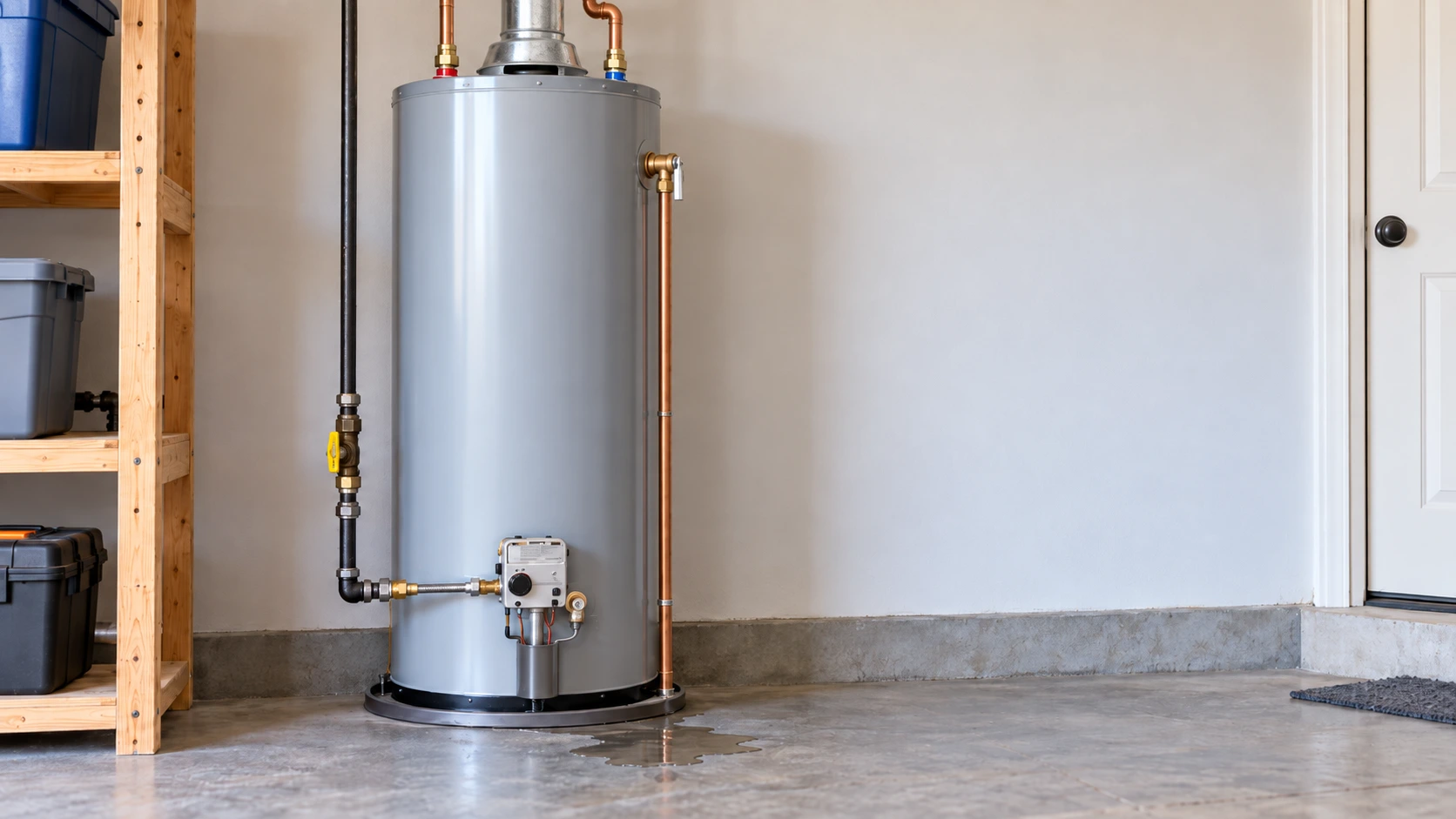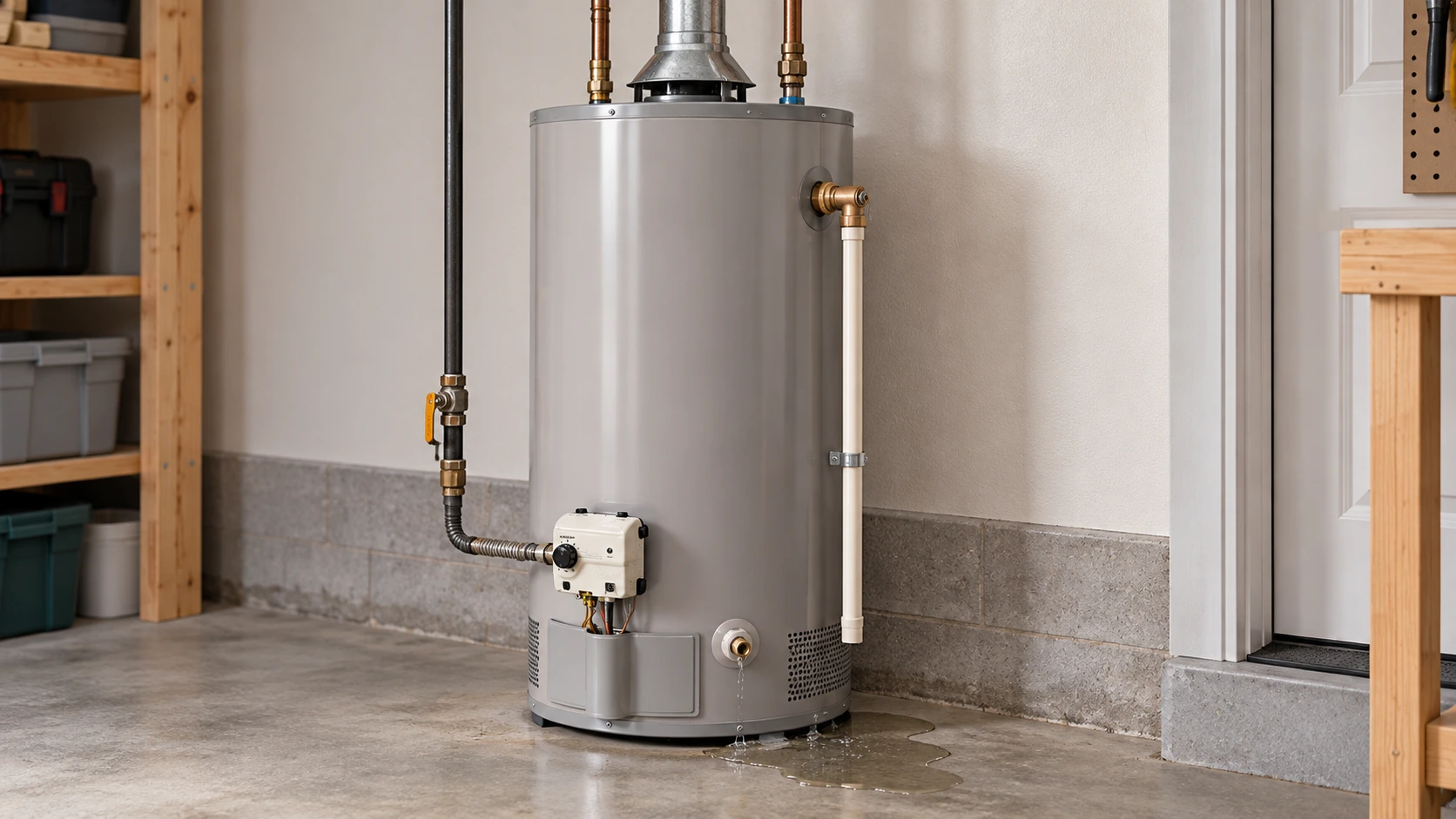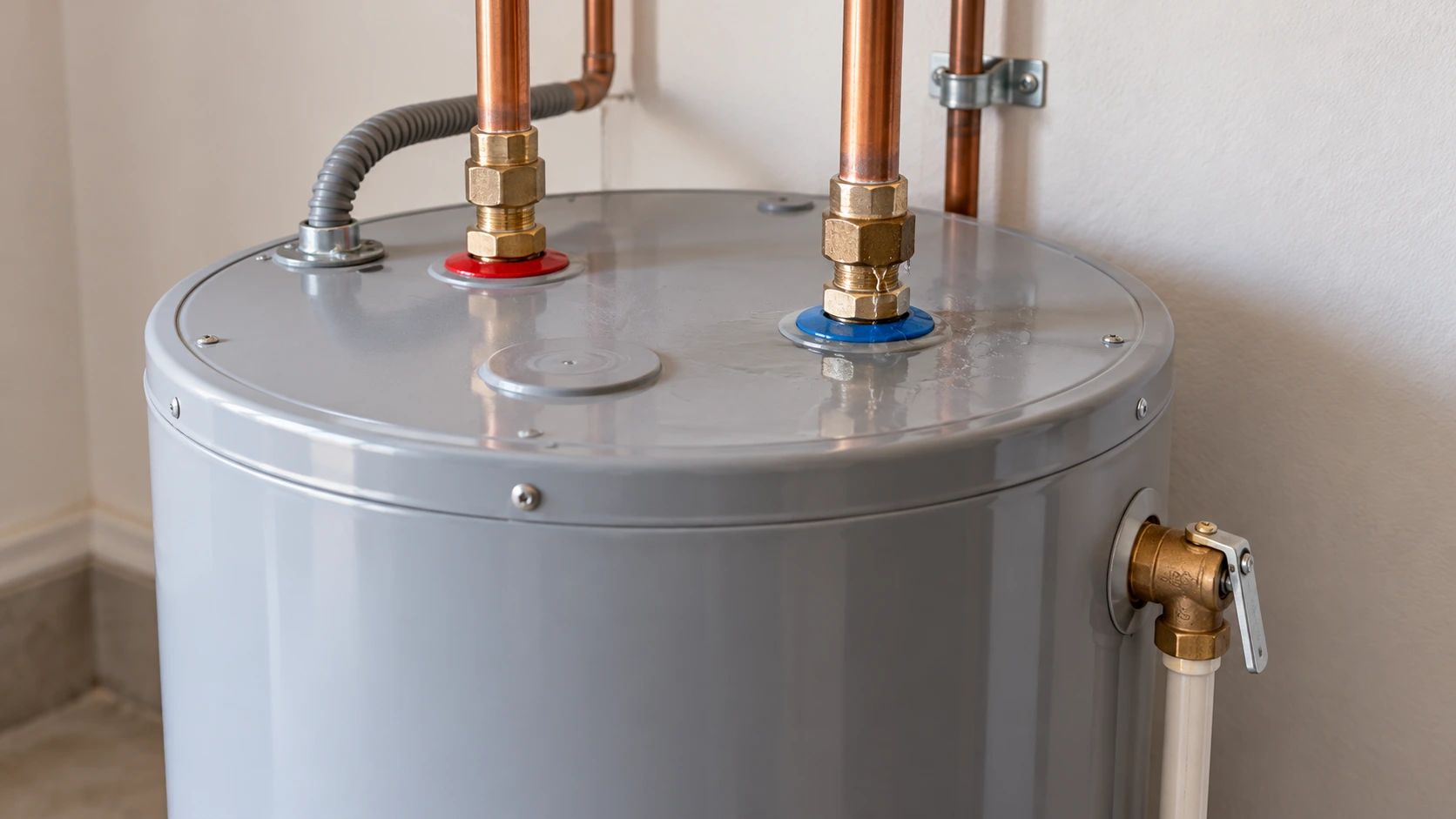
If there is a leak on top of your water heater, the first question is where the water starts—not whether you need a new tank. A loose or failing pipe connection, moisture around a top-mounted port, a nearby valve, or condensation can leave water on the heater's top cover. A damaged tank connection is another possibility, but it needs a different response.
Safety first: an active leak can involve hot water, electricity, gas, or a pressurized tank.
If you smell gas, hear a suspected gas leak, or a carbon monoxide alarm sounds, leave the area. From a safe location, contact emergency services and your gas utility. Do not operate switches, breakers, phones, or appliance controls inside the affected area.
If water is spraying, the floor is flooding, or water has reached electrical equipment, stay clear of the hazard. Do not enter standing water to reach a breaker or valve. Get qualified or emergency help.
Quick answer: what to do about water leaking from the top
- Treat an active leak as a problem to address promptly. Do not keep operating a water heater with an unexplained active leak.
- If there is no immediate hazard and controls are dry and safely accessible, follow your model's instructions for turning off its heating source. If possible, close the heater's clearly identified cold-water supply valve to limit additional water damage.
- Look from a safe position for the highest point where moisture first appears: a pipe or shutoff valve above, a hot/cold connection, an anode-port area, a T&P valve or discharge line, or the tank jacket itself.
- Take a photo and contact a qualified plumber or water-heater service professional if the source is unclear, the leak recurs, or any safety device or tank opening may be involved.
Never energize or fire a water heater that may be empty. Do not force a seized shutoff, open electrical covers, disconnect pressurized fittings, or touch a T&P relief valve to investigate a leak.
Where can a water heater leak from the top?
On many residential storage-tank water heaters, the hot-water outlet and cold-water inlet connect near the top. Other components or pipework may also be nearby. The top cover can collect water in shallow recesses, so the wettest spot may not be where the leak began.
Part locations vary among gas, electric, and individual manufacturer models. For example, a temperature-and-pressure (T&P) relief valve can be top-mounted on one model and side-mounted on another. An anode rod may have its own opening or be combined with a hot-water outlet.
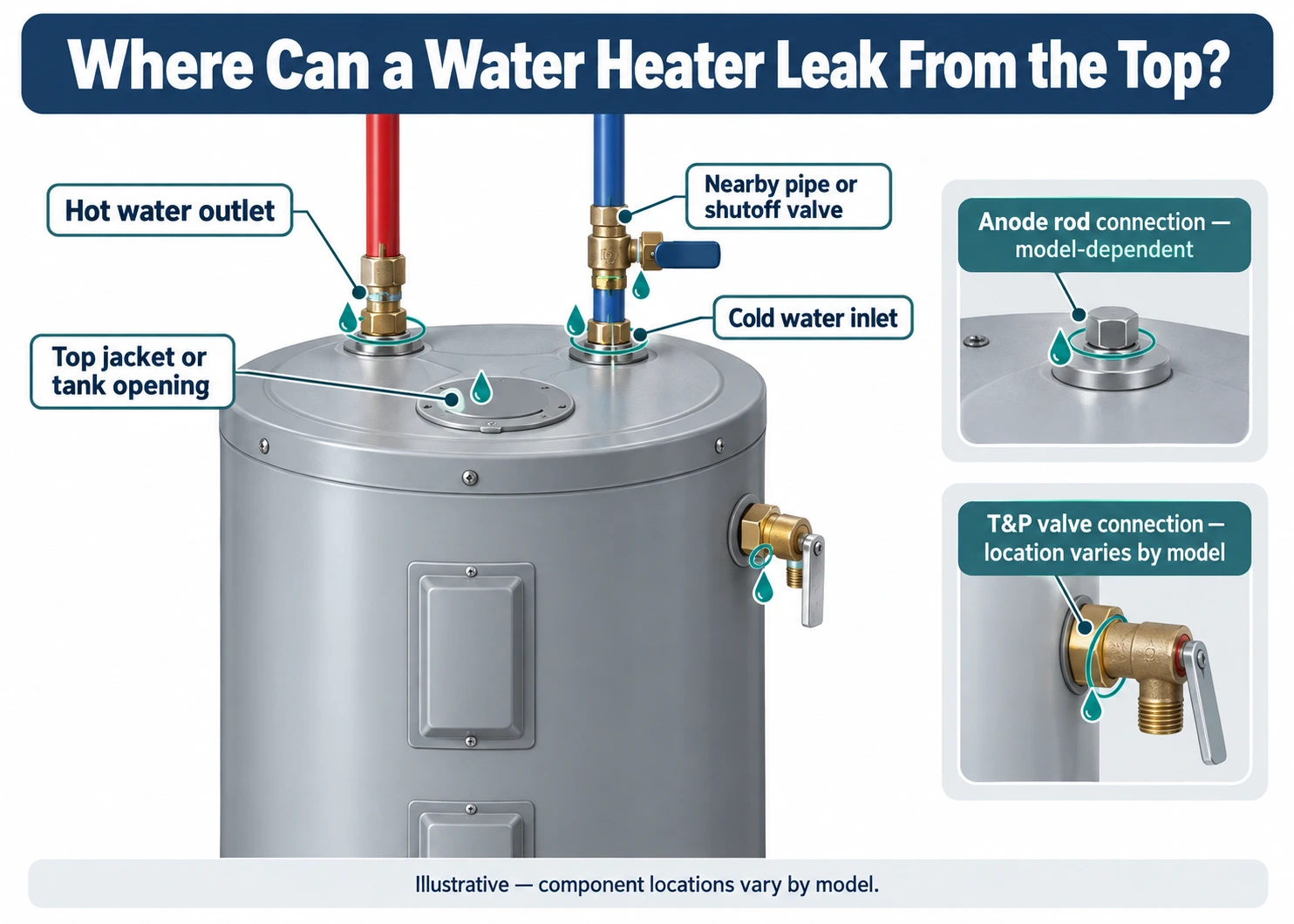
| Where water first appears | What it may mean | Safe next step |
|---|---|---|
| Hot or cold pipe/fitting above the heater | Plumbing connection, flex connector, valve, or upstream pipe leak | Note the highest wet point; arrange plumbing repair |
| Recess around a top inlet/outlet | Moisture near a threaded joint, a pipe dripping from above, or water tracking across the cover | Do not assume the tank has failed; have the source identified |
| Anode opening, if present | Water around the anode-port connection or another nearby source | Do not remove the anode rod; request model-specific service |
| T&P valve or discharge piping | Relief-valve operation or a leaking valve-to-tank connection | Do not cap or operate the valve; seek prompt professional assessment |
| Tank jacket, seam, or around a welded tank opening | Possible internal tank or welded connection failure, but water may have run from higher up | Stop use and arrange prompt professional diagnosis |
| Cold pipe covered in beads of moisture | Possible condensation under humid conditions | Observe the pattern safely; investigate persistent or growing moisture |
Seven possible causes of water leaking from the top of a water heater
These are possible sources, not a ranking by frequency. Your heater's model and the actual leak location matter more than which cause appears first in a list.
1. A leaking hot-water outlet or cold-water inlet connection
This is an important first area to consider when the top of a tank is wet. Water can escape from a pipe connection, flex connector, or the connection where plumbing meets the heater. A small seep may collect in the shallow well around an inlet or outlet, then run down the outer jacket.
What to notice: new moisture at the boundary between two connected parts, mineral deposits, a damp trail below a connection, or water that returns near the same location. White deposits or rust are useful clues, but neither alone proves which part is leaking.
What to do: record the location and have the fitting or piping evaluated. Do not apply a universal “tighten it a quarter turn” rule; joints use different sealing methods and overtightening can make a leak worse.
2. A shutoff valve, supply hose, or pipe above the tank
Sometimes the heater itself is not leaking. Water may start at the cold-water shutoff valve, a nearby coupling, an overhead water line, or a connected expansion-tank pipe and then drip onto the heater's top. This is especially confusing when the top cover is the first surface where water becomes visible.
Look for a traceable wet path above the tank. If an expansion tank is installed above the heater, distinguish a leak in its connecting plumbing from a pressure-control issue elsewhere in the system. Those are not the same diagnosis.
3. Water around the anode-rod connection
Anode rods help protect the steel storage tank from corrosion. On some models the anode enters through a dedicated top port; on others it is incorporated into the hot-water outlet. Water can appear around an anode connection if that connection is leaking—or simply because another source is directing water into the recess.
An old or depleted anode rod does not by itself prove that a current top leak is coming from the anode port. Removing a rod involves the pressurized hot-water system and may require substantial force. Leave that diagnosis and service to a qualified professional.
4. A T&P relief-valve discharge or threaded connection
The temperature-and-pressure (T&P) relief valve protects the water heater against excessive temperature or pressure. Depending on the model, it may attach near the top or on the side. It normally has a discharge pipe leading toward an approved termination point.
There are important differences between water coming out of the discharge pipe, water seeping around the valve's threads, and water escaping at the welded opening in the tank. A. O. Smith's technical guidance treats these as separate conditions. Replacing the valve would not fix a welded tank connection failure.
Recurring discharge can be associated with thermal expansion in a closed plumbing system, but high temperature, high pressure, and valve-related problems also require consideration. Watts states that a T&P valve should not discharge during normal water-heater operation.
5. Excess water pressure or thermal expansion
Water expands as it heats. In a closed water-supply system, a backflow preventer or check valve can limit the ability of that extra volume to move back into the supply. The resulting pressure rise may cause the T&P valve to release water. This does not mean thermal expansion directly caused a pipe fitting on top of the heater to leak, and it does not prove that the T&P valve itself is defective.
A plumber may need to assess the supply pressure, closed-system arrangement, expansion controls, and relief-valve condition. Do not try to diagnose pressure problems by increasing thermostat temperature or manipulating the relief valve.
6. Condensation or moisture from somewhere else
In a humid utility room, moisture can condense on a cooler incoming cold-water pipe and drip onto the heater. Some gas water heaters can also produce temporary combustion-related condensation under particular operating conditions, but that occurs in a different area and should not be treated as a universal explanation for water pooled on top.
A clue, not proof: moisture that beads on a cold pipe during humid conditions may suggest condensation. However, an intermittent plumbing leak can also appear and disappear. If water repeatedly collects, leaves a wet trail, or continues to increase, do not dismiss it as condensation.
For gas models, leave venting, combustion, and flue-condensate concerns to qualified gas-appliance personnel; do not remove the vent or draft hood to look for a leak.
7. Corrosion or failure at a tank opening or the tank itself
Corrosion around a top opening, water emerging from a jacket seam, or a leak that persists after outside plumbing sources are ruled out can raise concern about the pressure vessel. But pooling on the top cover alone is not enough to condemn the tank: water from an external connection can travel into the same recesses.
Technicians must distinguish a serviceable threaded connection from the welded tank spud or the storage tank. A. O. Smith Bulletin 52 states that a leaking welded tank spud is not repairable and the heater should be replaced. A confirmed tank leak also calls for replacement according to A. O. Smith Bulletin 51.
How to check a top leak safely without dismantling the heater
The goal is to collect useful observations for the repair professional—not to perform a pressure, electrical, or gas-system test yourself.
Step 1: Identify hazards and stop use
Check from a safe distance for spreading water, hot spray, gas odor, a CO alarm, and wet electrical components. Follow the emergency guidance above if any are present. Otherwise, use model-specific shutdown instructions only if safely accessible.
Step 2: Look above the heater first
Observe the cold inlet, hot outlet, connected pipes, nearby shutoff, and any visible expansion-tank piping. Do not move hot pipes, reach into a vent, or touch wet controls.
Step 3: Note where water first appears
If the exterior is cool, dry, and safe to approach, you may observe whether fresh water returns at a visible connection. Do not put hands beneath a leaking fitting or into a stream of unknown-temperature water.
Step 4: Record the pattern
Photograph the visible wet area from a safe position. Note whether the leak is steady, intermittent, linked to heating, or appearing after heavy water use. Find the model number from accessible documentation or a safely visible label.
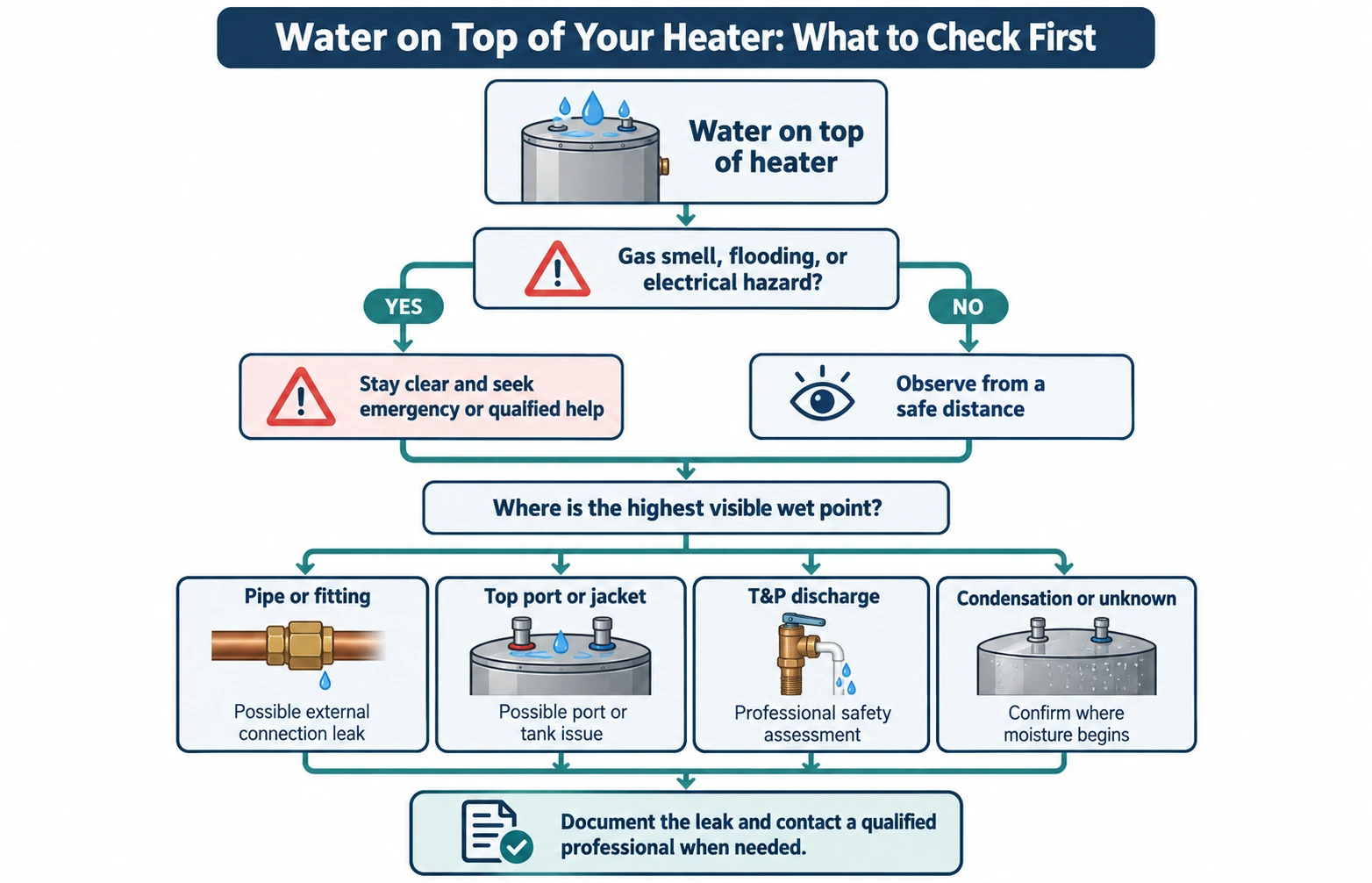
If the leak is significant and the cold-water shutoff is accessible without approaching a hazard, closing it can reduce further water entering the heater. A heating source also needs to be shut down according to the unit's manual; if the controls are wet, there is gas odor, or you cannot identify the safe procedure, leave isolation to trained personnel. Do not switch the heater back on until it has been inspected and confirmed safe and full of water.
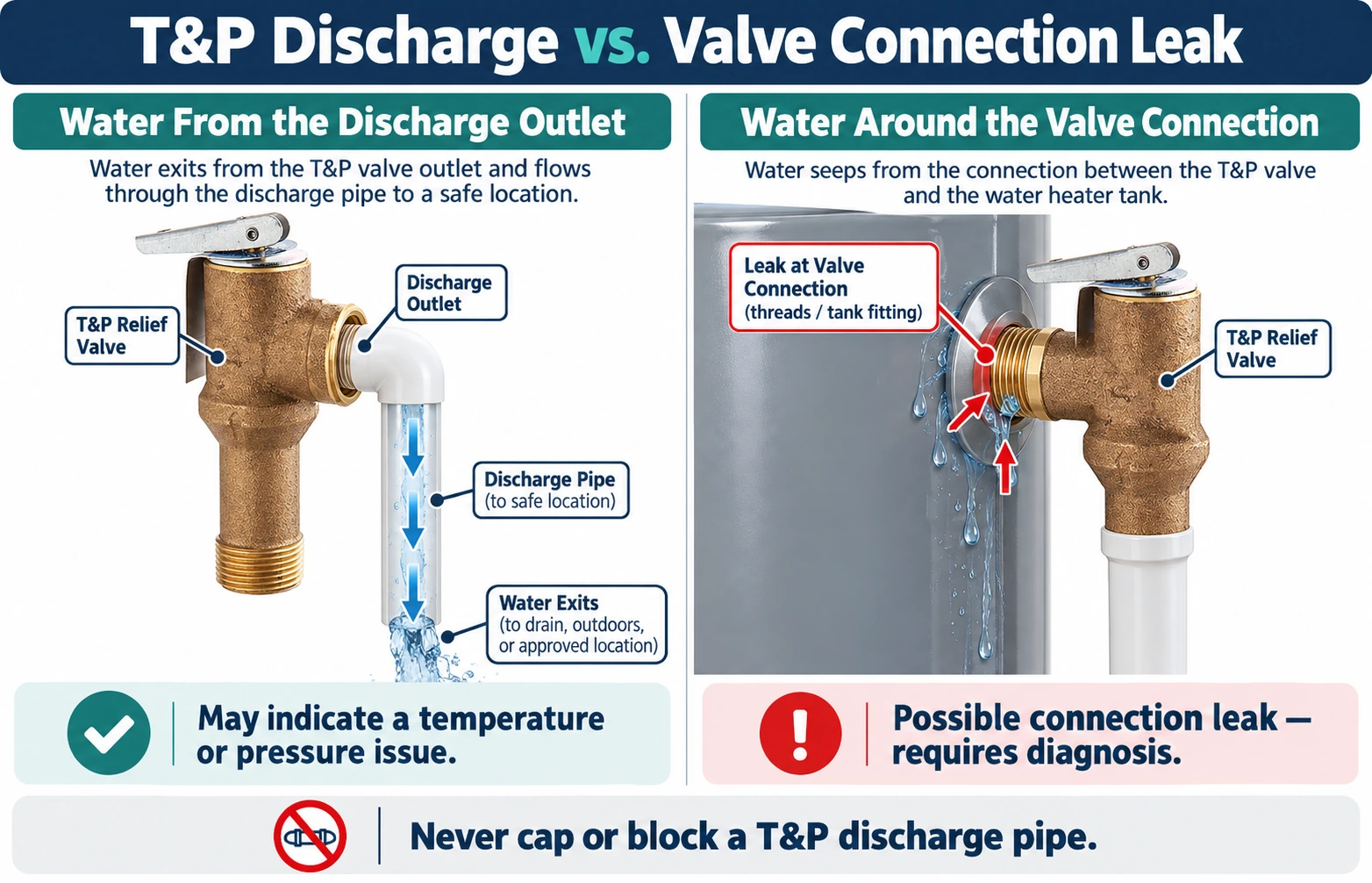
Is the T&P valve leaking, or is water escaping from its connection?
These descriptions sound similar but lead to different diagnoses. A T&P valve has a safety outlet and a threaded connection to the tank. The tank opening around that connection may also have a welded joint, hidden or partly obscured by the outer jacket.
Water from the discharge pipe
The safety device may be opening because of temperature or pressure conditions, including closed-system thermal expansion. Do not block it; have it evaluated promptly.
Water around valve threads
The connection may be leaking independently of relief-valve operation. Diagnosis and any resealing require the correct shutdown and service procedure.
Water at the welded tank opening
A confirmed welded-spud leak is a tank problem, not a routine valve replacement. Professional assessment typically leads to heater replacement.
Can a water heater leaking from the top be repaired, or should it be replaced?
There is no reliable repair-or-replace decision based only on “water on top.” The source determines the first decision. Heater age, corrosion elsewhere, warranty, expected service life, and the cost of professional repair can then affect what makes economic sense.
| Confirmed source | Typical direction | Important qualifier |
|---|---|---|
| External supply hose, pipe, valve, or fitting | Often a plumbing/component repair | Check fitting type, corrosion, and whether the tank connection is intact |
| Anode or other serviceable threaded port | Potentially serviceable | Depends on actual leak path and model-specific parts |
| T&P discharge | Investigate pressure, temperature, expansion, and valve condition | Never disable the safety valve merely to stop water |
| Temporary condensation | May not require water-heater repair | Only after an active leak or vent-related issue is ruled out |
| Confirmed welded spud or storage-tank leak | Heater replacement | Do not patch or weld the pressure vessel as a homeowner fix |
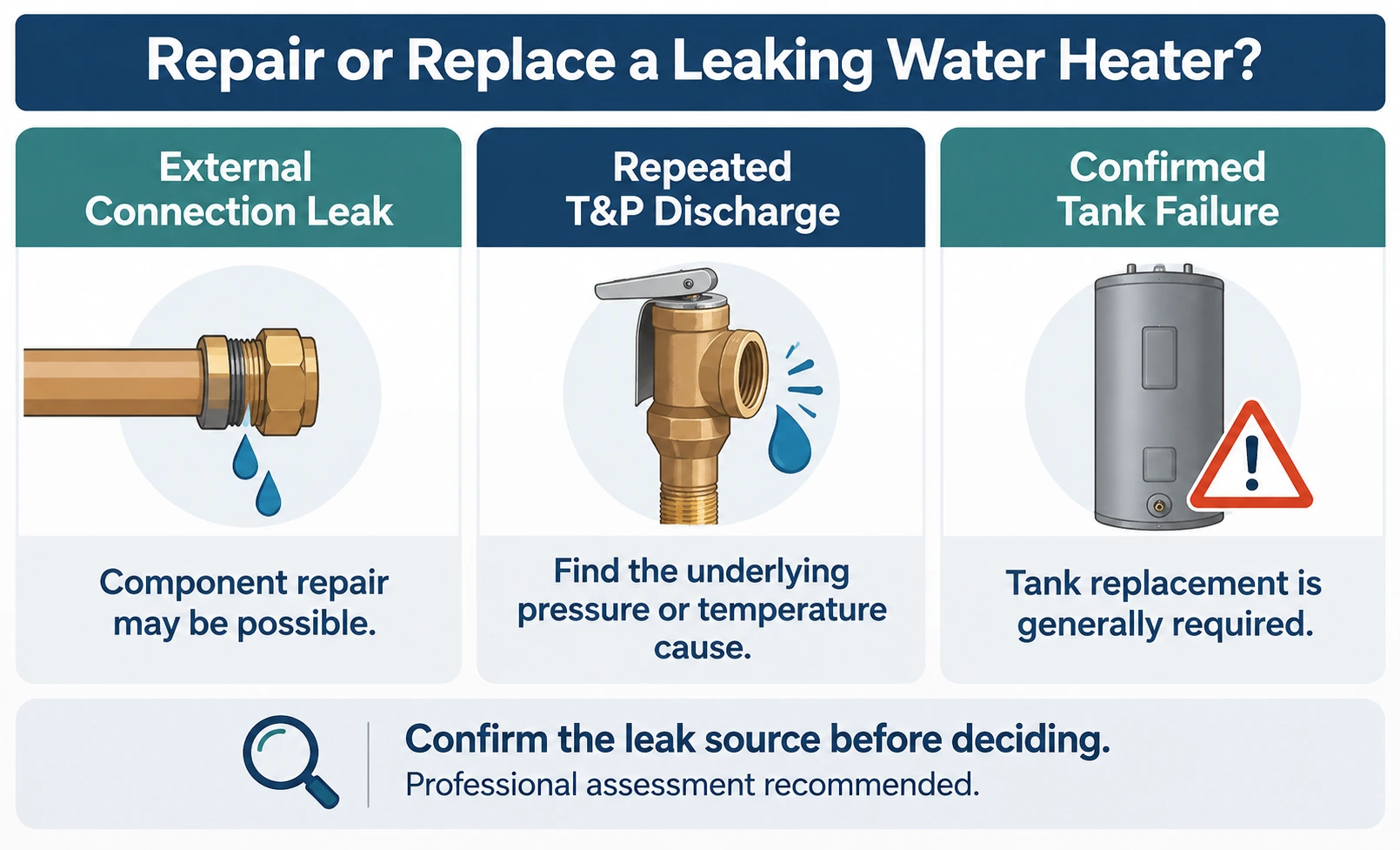
A plumber can tell you whether the leak involves an ordinary water connection, a replaceable component, or the tank itself. Ask for the specific location of failure and whether any repair addresses the source rather than only where the water collected. If replacement is recommended, review the manufacturer's warranty and discuss installation changes needed to prevent repeat problems.
When should you call a plumber immediately?
Arrange prompt professional help when the leak is active or recurring and you cannot confidently identify a harmless source. Treat the following as particularly urgent:
- Water sprays, flows continuously, or creates a growing puddle.
- Water is near electrical wiring, outlets, controls, a panel, or standing-water hazards.
- Water appears to be coming from the tank jacket, a welded opening, or corrosion-damaged metal.
- The T&P relief valve releases water repeatedly or releases substantial hot water.
- Gas odor, suspected flue or vent damage, or a carbon monoxide alarm is present. Leave the area and contact emergency services rather than waiting for a routine service appointment.
- You cannot safely access a shutoff or identify the heater's correct shutdown procedure.
When booking service, provide the water heater's manufacturer and model (if safely known), photos of the highest visible wet location, the approximate amount of water, and when it appears. That information is usually more helpful than saying only that “the tank is leaking from the top.”
How to reduce the risk of another top-of-heater leak
No maintenance routine guarantees that a fitting, valve, or storage tank will never leak. However, a few practical steps help prevent small problems from becoming major water damage:
- Periodically look for moisture, corrosion, mineral deposits, or damaged accessible piping without moving connections.
- Keep the installation accessible and do not store items against controls, relief-valve piping, or ventilation openings.
- Ask a qualified plumber to evaluate recurring T&P discharge and any possible closed-system thermal expansion issue.
- Follow the maintenance and inspection schedule in your specific model's manual, including anode or relief-valve servicing by someone qualified to do it safely.
- Consider whether the water heater's drain pan and drain arrangement are appropriate for its location and local code requirements; a pan limits some damage but does not fix the source.
Frequently asked questions
Why is my hot water heater leaking from the top?
Common places to investigate are the hot/cold water connections, plumbing above the heater, an anode port, and—on models where it is nearby—the T&P valve. Condensation can also look like a leak. A confirmed tank-opening failure is more serious, but water pooled on top does not establish that diagnosis.
Can the water heater tank itself leak from the top?
Yes. A failed welded opening or another defect in the storage tank can cause water to appear at the top. However, an external fitting leak can produce the same visual symptom. Have a professional distinguish the tank from a serviceable threaded connection before deciding on replacement.
Why is there water pooling in the recessed areas on top of my heater?
Recesses around top connections can collect drips from a fitting, condensation from a pipe, or water running in from somewhere above. The location where water collects is not necessarily the location where it originates.
Is a small leak on top of a water heater dangerous?
Even a small unexplained leak deserves attention. It can worsen, damage the home, or involve a safety device or electrical component. T&P discharge in particular should not be treated as harmless simply because only a few drops are visible.
Can I keep using the water heater while it leaks from the top?
Do not continue normal use with an active, unexplained leak. If it is safe to do so, use the manufacturer's shutdown instructions and close the cold-water supply to limit damage. If you suspect gas, electrical, or pressure-related danger, step away and let qualified personnel handle isolation.
Will tightening the pipe fittings stop a top water-heater leak?
A serviceable fitting might be the source, but simply tightening it is not a universal remedy. Some joints rely on specific seals, and excessive force can damage fittings or tank connections. Identification and any repair should follow the correct component and model instructions.
Does a T&P valve dripping mean I need a new water heater?
Not necessarily. A relief valve can discharge because of thermal expansion or another pressure/temperature condition, while a leak at its threaded connection is a separate problem. A confirmed welded tank opening failure, by contrast, generally means replacing the heater. Have the root cause evaluated rather than replacing parts based on the drip alone.
Related water-heater guides
If you have not located the leak source yet, start with our general guide to water-heater leaks.
If water is collecting around the base rather than the upper connections, see water heater leaking from the bottom for that separate symptom.
Technical and safety sources
The following manufacturer and safety references inform this guide. A model-specific installation or service manual takes priority for the heater in your home.
- A. O. Smith — Bulletin 51: Puddle on Floor (leak-source categories and confirmed tank failure).
- A. O. Smith — Bulletin 52: Leaking Temperature and Pressure Relief Valve (discharge vs. threads vs. welded tank connection).
- Rheem — Water Heater Technical Bulletins (Bulletin 1223, How to Diagnose a Leaking Water Heater; service reference).
- Watts — Temperature and Pressure (T&P) Relief Valves (normal operation and thermal expansion).
- Bradford White — Model-specific Electric Water Heater Installation and Operation Manual (PDF) (illustrates model-dependent part positions).
- PG&E — Gas Safety (what to do if a gas leak is suspected).
- CDC — What to Do to Protect Yourself From Electrical Hazards (water and electrical safety).