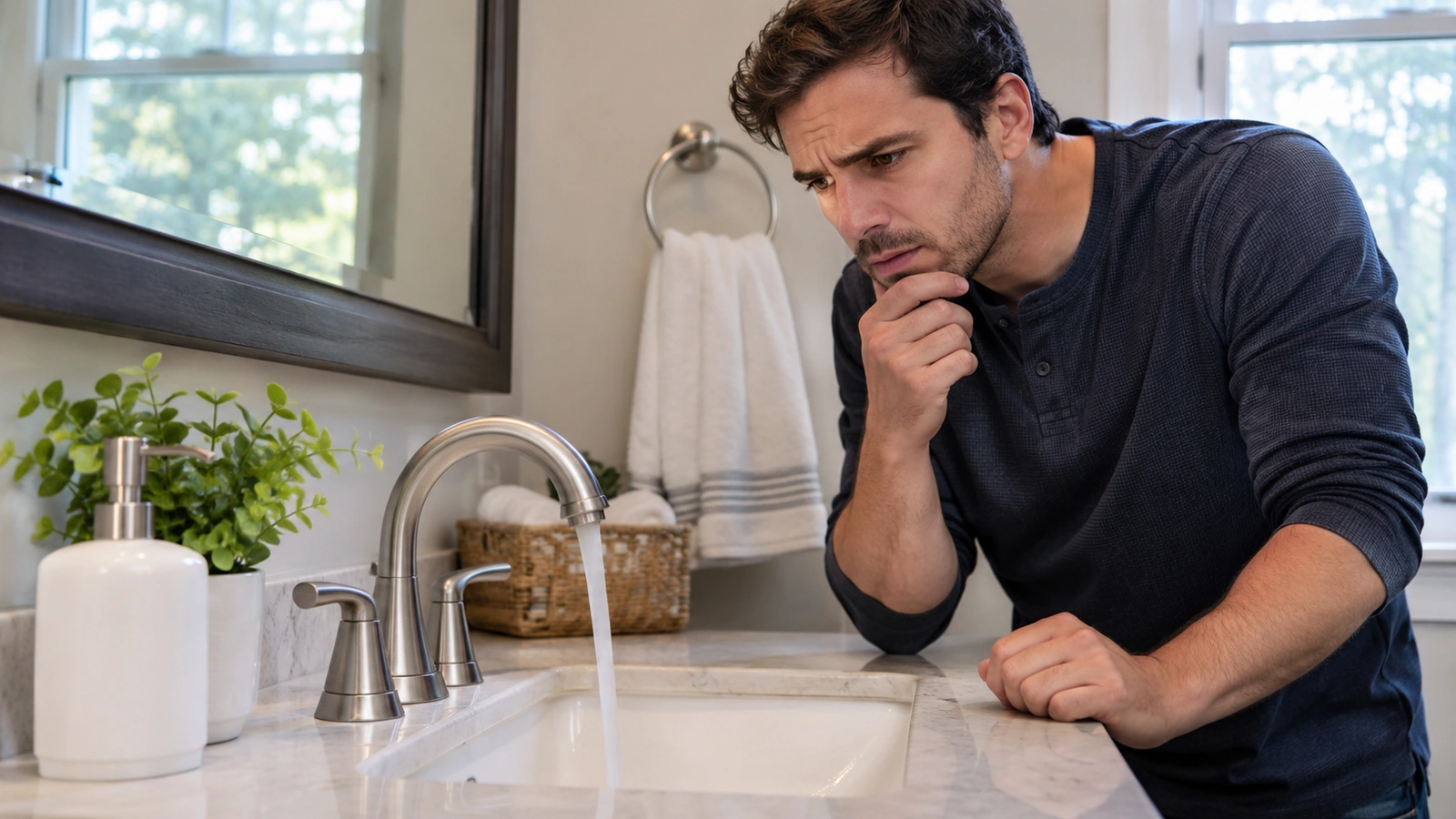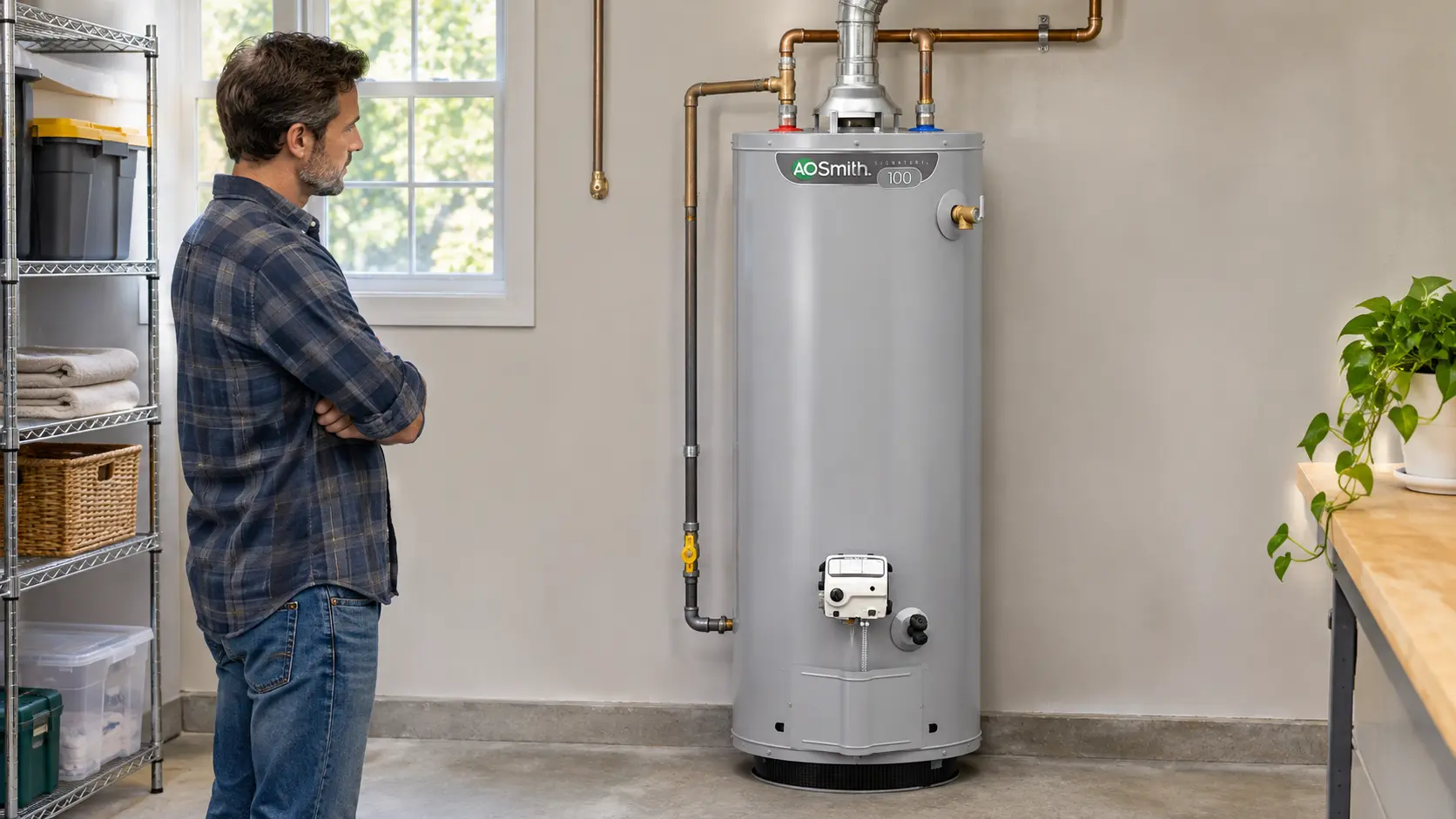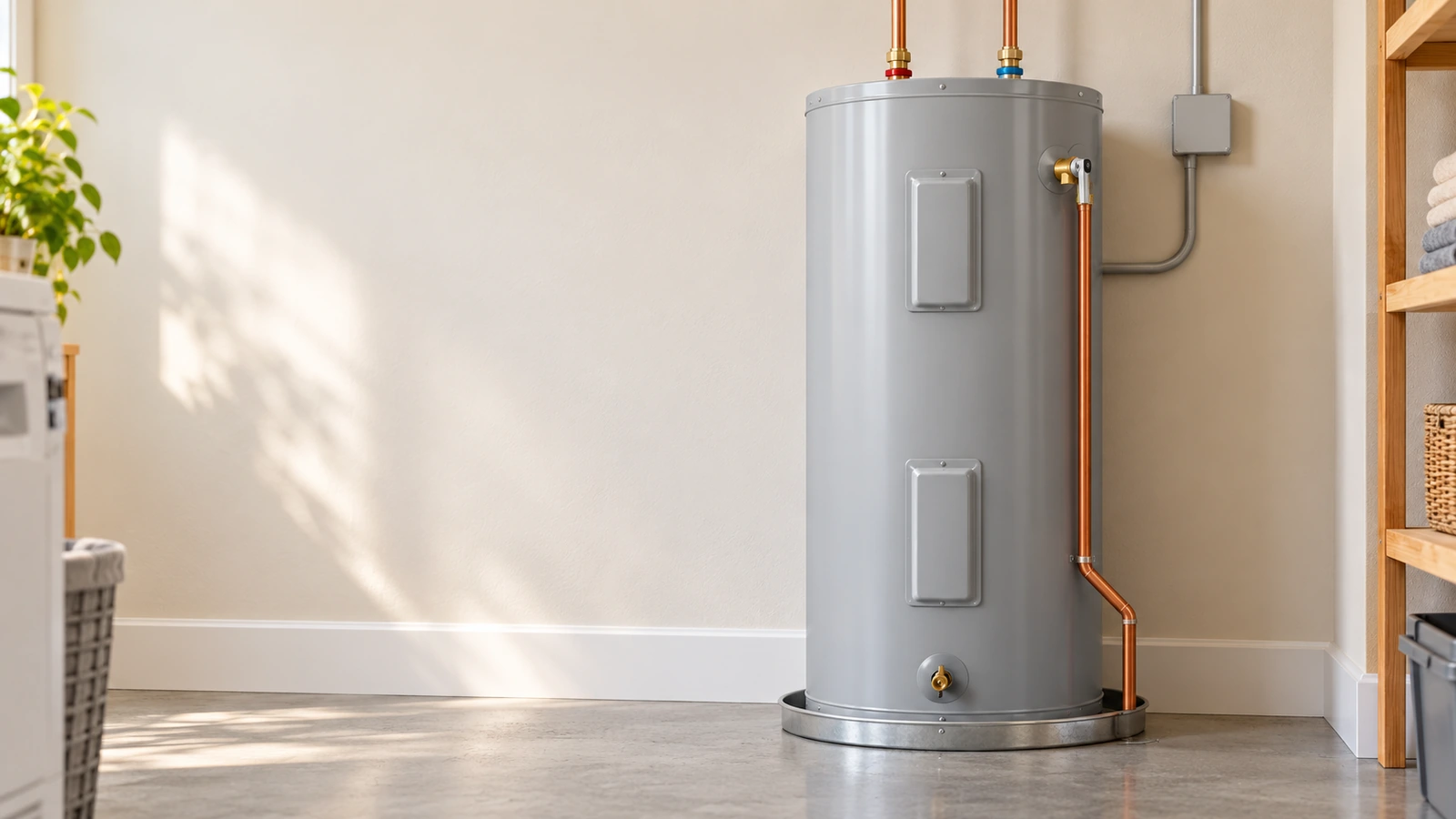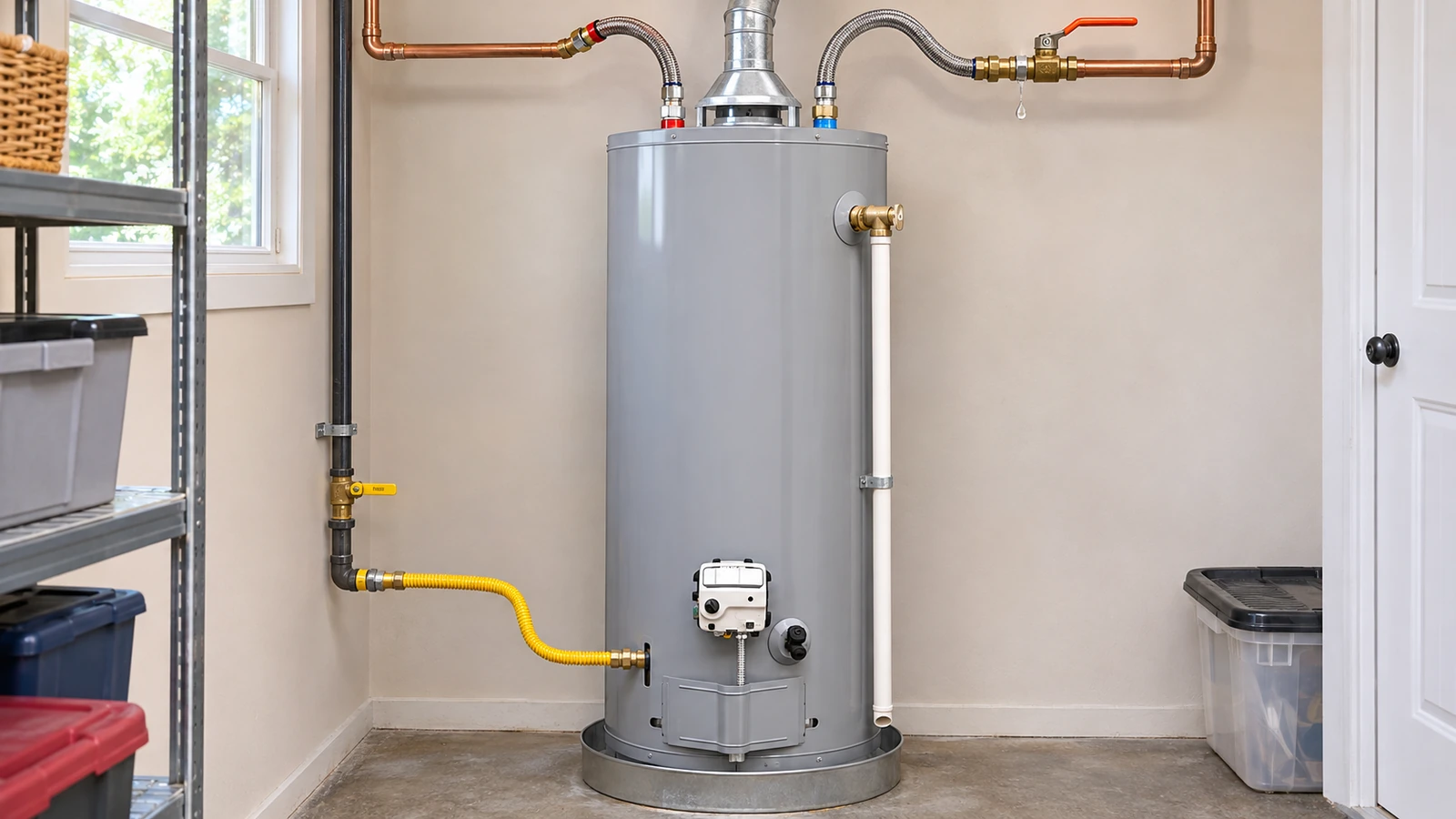
A water heater pipe leak can come from the pipe itself, a joint, a flexible connector, a shutoff valve, or a nearby line that is dripping onto the heater. Water running down the tank does not automatically mean the storage tank has failed. The useful question is where the first fresh water appears and whether it comes from ordinary water-supply plumbing or a safety-related discharge pipe.
If water is spraying, the puddle is growing quickly, hot water could scald someone, or moisture has reached electrical equipment, stop routine troubleshooting and get qualified help. If you smell gas or a carbon monoxide alarm sounds, leave the area and contact emergency services or your gas utility from a safe location.
Quick answer
When it is safe to observe the heater, trace the visible moisture to its highest starting point. A drip at a pipe joint is different from water emerging through a damaged pipe wall; both are different from water exiting the temperature-and-pressure (T&P) relief-valve discharge pipe. If a leak is active, follow your model's safe shutdown instructions and use the clearly identified water shutoff only if it is dry, accessible, and safe to operate. A qualified plumber should confirm the source before any pressurized connection is repaired.
Water heater pipe leaking? What to do first
Even a small drip deserves attention because it may worsen, damage floors or walls, or involve hot water. You do not need to determine which fitting to replace before taking sensible precautions.
Stop and get help for immediate hazards
Stay clear of spraying hot water, flooding near outlets or controls, exposed wiring, gas odor, or a carbon monoxide alarm. Never cross standing water to reach a shutoff or electrical panel. Suspected gas or CO trouble calls for evacuation, not a pipe inspection.
Limit water damage when access is safe
If the heater's cold-water supply valve is clearly identified and can be operated without reaching past hot spray, wet electrical parts, or unsafe piping, closing it may limit the leak. Follow the specific heater's instructions for shutting down its heating source. If either step is uncertain, let a professional handle it.
A valve located downstream of a leaking supply-pipe section may not stop water coming from that upstream section. Similarly, shutting off water to the heater does not necessarily depressurize every connected line. Do not treat a closed valve as permission to loosen or disconnect plumbing. Never fire or energize a heater that may be empty.
Is the water coming from a pipe, a joint, or the heater?
A puddle shows where water collected, not necessarily where the leak began. A small seep can travel around the underside of a pipe, follow a connector braid, or run down the heater's outer jacket before reaching the floor. For an outside-only observation, start higher than the puddle and look for the first visible point where fresh moisture returns.
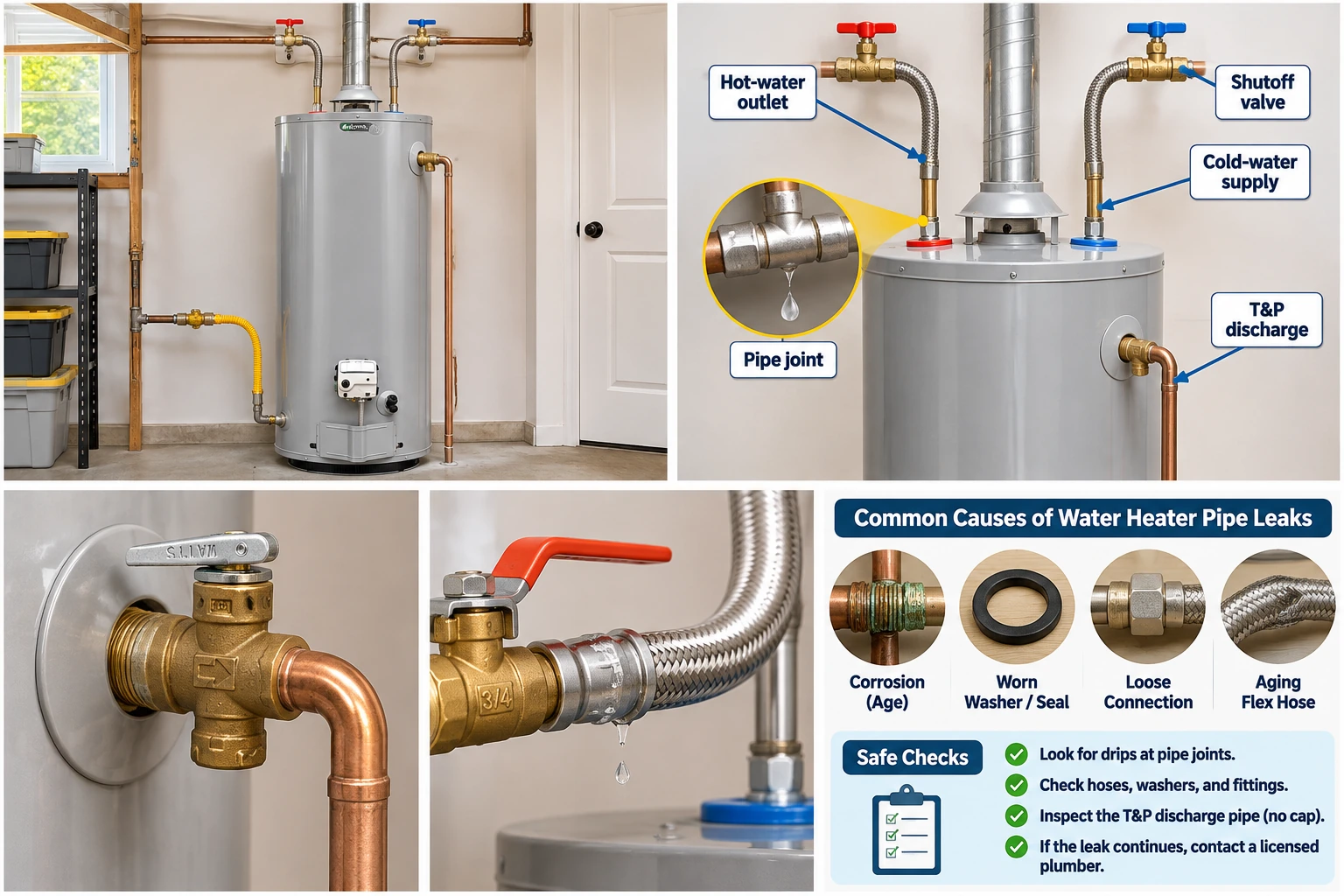
What the highest wet point can tell you
If a pipe section above the tank is wet but the fitting below is dry, the source may be farther upstream. If new water emerges at the boundary between two parts, the joint is a candidate. If a distinct spot on the pipe wall becomes wet without a higher trail, the pipe itself may be damaged. These are clues rather than definitive diagnoses: water can wrap around curved surfaces and make the apparent source misleading.
Could it be condensation rather than a pipe leak?
Cool incoming water piping can collect beads of moisture in a warm, humid utility room. A consistently damp cold pipe is not proof of a cracked line. However, a persistent drip, a localized wet spot at a connection, or a growing puddle still requires investigation. Avoid dismissing recurring moisture as condensation just because the pipe carries cold water. Gas-water-heater combustion condensation is a separate possibility addressed in the general water-heater leak guide.
Match the wet spot to the kind of pipe leak
Use the table as a description guide when speaking to a plumber, not as permission to disassemble the connection. A visible drip cannot establish the condition of hidden threads, seals, or the tank opening.
| First fresh wet point | Possible source | Safe next move |
|---|---|---|
| Middle of a water pipe, away from joints | Pipe-wall damage, corrosion, or water traveling from above | Photograph the spot and ask for pipe assessment |
| Seam between pipe and elbow, union, or coupling | Connection or joint seepage | Note the exact joint; do not tighten it blindly |
| End of a flexible water connector | Connector end, seal, or adjacent mating fitting | Do not bend, twist, or disconnect the hose |
| Cold-water shutoff valve | Valve body, stem area, or connected fitting | Do not force a stiff or corroded handle |
| Hot outlet or cold inlet near the tank | Water-line fitting or tank-side connection | Have the exact interface identified |
| Open end of the T&P discharge pipe | Relief-valve operation or another safety-related issue | Leave discharge path open; arrange professional evaluation |
| Tank jacket or welded opening | Water tracking down or a possible tank-related fault | Stop assuming a pipe-only repair; request inspection |
Cold-water supply line and shutoff valve
The cold supply pipe feeds the heater. Depending on the installation, it may include a shutoff valve, an elbow, a connector, or a transition between piping materials. A drip above the valve, at the valve stem, and below the valve are three different observations. Closing the heater's valve may not stop leakage from piping on the supply side of that valve.
Look from a safe position for fresh drops, mineral deposits, discoloration, or an existing water trail. A white mineral crust can show that water has been present, but it does not prove where today's active leak begins. Do not force a seized handle or assume every valve can be repaired by tightening a nut.
Hot-water outlet pipe and connector ends
The outlet carries heated water away from the tank. Its exposed piping and nearby fittings can be hot even when no faucet is running. A drip at the end of a flexible connector may involve the connector, its seal, or the rigid fitting to which it attaches. Water might travel along the connector's outside surface, making a dry-looking upper end appear responsible for a lower puddle.
Do not touch or reposition a suspect hot-water line to check it. Describe whether the water seems to start at the connector end, along the connector body, or farther along the rigid pipe. A plumber can select the correct repair after identifying the component and installation.
Pipe wall versus elbow, coupling, or threaded joint
These are easily confused. A wet patch on an uninterrupted section of pipe raises different questions from water that first appears around a joint between two components. Rigid copper, PEX, CPVC, and other approved water-line materials have different joining systems and service requirements. An adhesive, soldered, threaded, compression, or manufacturer-specific connection cannot be treated as though every joint uses the same seal.
A leak that appears only at a threaded area is not proof that the threads simply need another turn. Overtightening can deform a connection, damage the tank port, or make the leak worse. Avoid applying patch tape, epoxy, sealant, or a clamp to a pressurized hot-water line as a substitute for identifying the failure.
Recirculation or expansion-tank piping, if installed
Some homes have a hot-water recirculation return, a thermal expansion tank, or additional plumbing near the heater. Others do not. A drip from one of these connected water lines may run onto the water heater and resemble a tank leak. If the installation includes these features, photograph the route and the highest visibly wet connection instead of guessing which part has failed.
An expansion tank helps manage pressure changes in certain closed water-supply systems; a leak at its piping connection is not the same as proving the expansion tank is defective. Pressure diagnosis, support, and component replacement belong with a qualified plumber.
A T&P discharge pipe is not an ordinary leaking supply pipe
Many water heaters have a temperature-and-pressure relief valve with a pipe leading from the valve toward an approved discharge location. It is a safety path, not a water-supply line. A. O. Smith's Bulletin 52 distinguishes water leaving the valve through that outlet from water seeping at the valve's threaded attachment and from leakage at a welded tank opening.
Water coming out of the discharge pipe
This can indicate that the relief valve is opening due to a pressure, temperature, expansion, or valve-related condition. Repeated drips or a significant release of hot water need professional diagnosis. Do not block the pipe.
Water around the valve connection
Seepage at the valve's threads is different from discharge through its outlet. Water at a welded tank opening can be more serious still. A plumber must identify the actual leak path before recommending a component repair or tank replacement.
For detailed symptoms that begin on the top cover, around a top-mounted opening, or at the valve-to-tank connection, see water heater leaking from the top. This article stays focused on distinguishing pipe and connection leaks from other kinds of discharge.
What does the pattern of dripping tell you?
When the leak occurs can narrow the questions for a service professional. It cannot identify a failed component on its own.
A steady drip or stream
Fresh water that continues to appear at one pipe location suggests ongoing leakage. More water means greater urgency, but the flow rate alone does not distinguish pipe-wall failure from a joint leak. A spray or rapidly increasing puddle is not a wait-and-watch situation.
Water appears mainly while the heater is reheating
If the water actually exits the T&P discharge pipe, heating-related pressure changes may be part of the investigation. Thermal expansion in a closed system is one possibility; it is not proof that a supply fitting or the relief valve itself is defective. A. O. Smith's thermal expansion guidance explains why relief-valve drips can accompany heating cycles.
Moisture follows heavy hot-water use
The timing may help identify a temperature-related or operating-condition pattern, but it does not reliably distinguish condensation, a connector seep, or relief discharge. Note the time, visible starting point, and amount without forcing the heater to run another test cycle.
Mineral deposits, rust, or a stained connector
Deposits and corrosion are useful details for a plumber. They may mark an older leak path, deterioration, or water from a different nearby source. Do not scrape away corrosion, scrub a suspect joint, or assume a corroded fitting can safely be tightened.
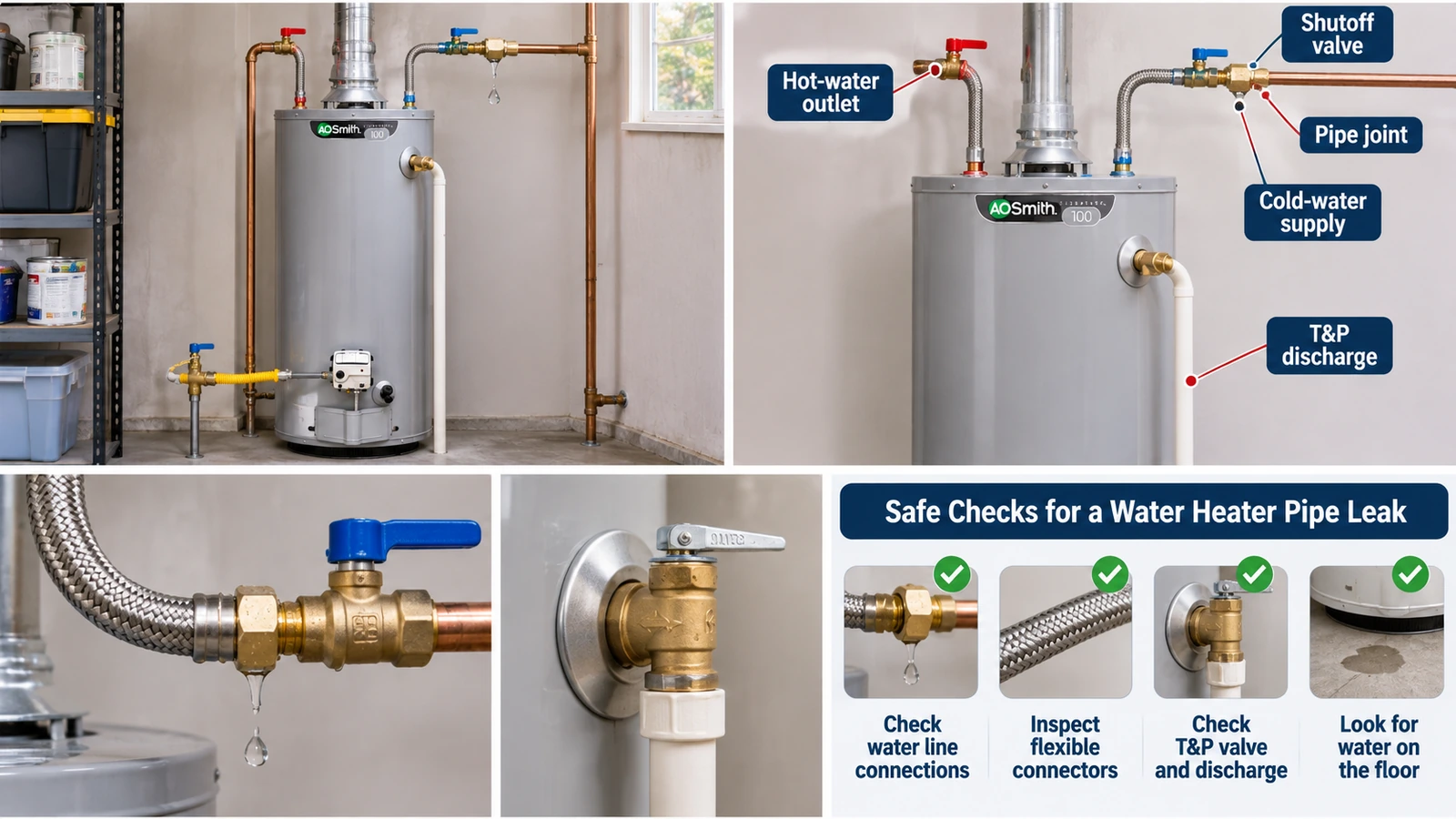
Safe checks you can make without taking anything apart
The aim is to document the visible problem, not to perform a plumbing pressure test. These observations apply only when the area is dry, stable, and free of immediate gas, electrical, and scald hazards.
- Check the surroundings first. Look for hot spray, spreading water, a wet receptacle or control, damaged wiring, gas odor, or a CO alarm. If any serious hazard is present, leave the unsafe area and get the appropriate help.
- Identify the heater and its external connections. From a safe position, distinguish the ordinary cold supply and hot outlet from a gas line, a drain line, and the T&P discharge. Part positions vary; use the model label or owner documentation rather than relying on a generic diagram alone.
- Trace the visible water path. Look above the puddle for fresh water at a pipe wall, connector end, elbow, valve, or discharge outlet. Do not reach behind a hot pipe or underneath a dripping connection.
- Observe without disturbing the plumbing. If a cool, accessible exterior surface is already safe to approach, you may observe whether moisture returns after it is dry. Do not test by twisting a connector, pulling a valve handle, opening a panel, or running repeated heating cycles.
- Record what is visible. Take a wide photo of the piping layout and a closer photo of the wet spot from a safe distance. Note whether the leak is continuous, intermittent, or associated with hot-water use. Record the heater's manufacturer and model if available without unsafe access.
- Arrange appropriate service. A licensed plumber or qualified water-heater service professional can determine whether the line, fitting, valve, relief system, or tank opening needs attention. Avoid returning a heater with an active unexplained leak to normal service until it has been assessed.
What will a plumber check or repair?
The correct repair depends on the exact failed part, not simply on the phrase “water heater pipe leaking.” A qualified professional may first isolate the water and heating sources using the method required for the installed equipment, then inspect the relevant water-line connection and nearby components.
External water pipe, connector, or fitting
When the problem is confirmed to be an external serviceable water line or connector, the repair may involve replacing the affected section or connection with parts and joining methods appropriate for the material, temperatures, pressure, and local requirements. A plumber can also assess whether the line is supported correctly or subject to damaging movement. There is no single tightening or sealant instruction that safely applies to all installations.
Shutoff valve or nearby water-line component
A leak at a valve stem, body, or connection is not automatically the same failure. A plumber will distinguish whether the valve itself, its connection, or upstream plumbing needs service. If the shutoff is corroded, inaccessible, or not actually isolating the leak, that changes the work required. Do not force the valve or assume it safely isolates all connected piping.
Relief discharge, pressure, or tank-side opening
When water is coming from the T&P discharge, the service question shifts to temperature, pressure, thermal expansion, and valve operation. When water seeps from an attachment or a welded opening, the question is whether an ordinary replaceable component or the tank structure is involved. A. O. Smith's Bulletin 51 separately lists inlet/outlet piping leaks and confirmed tank leaks; its guidance states that a confirmed leaking storage tank should be replaced.
Ask the service professional to identify the specific wet interface and explain which part is being repaired. That is more meaningful than receiving a recommendation based only on the water collecting at the bottom of the heater.
When should a leaking water heater pipe be treated as urgent?
| Situation | Response |
|---|---|
| Spraying water, scalding hot discharge, or fast-growing flooding | Keep people away from the water. Seek prompt plumbing or emergency help. Do not reach through the spray to operate controls. |
| Water on wiring, receptacles, breakers, or controls | Do not touch affected electrical equipment or stand in water to reach it. Have the hazard made safe by qualified personnel. |
| Gas odor or a CO alarm | Evacuate and call emergency services or the gas utility from outside the affected area. Do not operate switches or appliance controls inside. |
| Repeated or heavy T&P discharge | Do not block the outlet or treat it as an ordinary plumbing drip. Arrange prompt qualified assessment. |
| Visible damage, corrosion, or suspected tank opening failure | Stop normal use and have the source evaluated; a pipe-only repair may not address the issue. |
| Small, stable seep at an external water connection | Document the source and arrange a plumber rather than letting the leak continue or attempting a universal DIY fix. |
Guidance from the American Gas Association covers emergency action for suspected gas leaks. The Electrical Safety Foundation International explains why water-damaged electrical equipment requires particular caution.
Does a water heater pipe leak mean you need a new heater?
Not necessarily. A leaking external water-supply component and a leaking storage tank are different failures. A confirmed pipe or fitting problem may be serviceable without replacing the heater; a confirmed failure of the tank itself or a welded tank opening is a more serious situation. The water trail must be traced before anyone draws that conclusion.
External pipe or fitting
Often evaluated for a localized plumbing repair, provided the adjoining equipment and tank connection are sound.
Tank-side or welded opening
Needs careful professional identification. A confirmed welded tank-spud or storage-tank leak generally points toward heater replacement.
Source not confirmed
Do not buy a replacement heater based on a puddle or mineral deposits alone. First establish where the water originates.
Once the leak source is verified, a plumber can consider the heater's condition, age, warranty, the condition of connected piping, and the cost and reliability of the proposed repair. For problems not clearly limited to a pipe, the broader water heater leaking guide covers other possible sources, including drain valves, electric element areas, condensation, and the tank itself.
How to reduce the risk of another piping leak
No visual inspection guarantees that a pipe or connector will never fail. Periodically looking at accessible water piping can, however, help you notice moisture or deterioration before a large leak develops.
- Look for new drips, damp insulation, stains, corrosion, and mineral deposits at accessible water-line connections without moving the pipe.
- Keep the area around the heater clear enough that valves, visible piping, and safety labels can be inspected without obstruction.
- Have visibly damaged, stressed, poorly supported, or deteriorating water connectors evaluated rather than waiting for a spray leak.
- Report recurring T&P discharge to a qualified plumber; do not cap the line or assume a new valve alone will solve the cause.
- Follow the maintenance guidance for the exact water-heater model and ask a professional about recurring pressure or expansion concerns.
Frequently asked questions
Why is the pipe on top of my water heater dripping?
Water may be coming from a hot or cold inlet/outlet fitting, an upstream pipe, a flexible connector, a nearby valve, or condensation on a cold-water line. Water may also be flowing toward the top from another source. If the wet area is concentrated around ports or the top cover, use the top-of-water-heater leak guide for a more detailed location-based discussion.
How can I tell if the pipe itself or the fitting is leaking?
Look for the highest visible place where new water appears. Moisture centered on an uninterrupted pipe section suggests a different possibility from water emerging at the seam between joined parts. However, water can travel around pipe surfaces, so only an appropriate inspection can confirm which part needs repair.
Is a dripping T&P discharge pipe the same as a leaking supply line?
No. A T&P discharge pipe carries water released through a temperature-and-pressure safety valve. It is not a hot or cold supply line. Never plug or restrict its outlet. Repeated or heavy discharge needs a professional diagnosis of the relief system and related conditions.
Can I keep using hot water if a water heater pipe is leaking?
Avoid continuing normal operation with an active, unexplained leak. A small external seep can worsen, and it may be difficult to rule out scalding, electrical, or pressure-related risks. If it can be done safely, follow the heater's shutdown instructions and arrange service; otherwise get qualified help without approaching the hazard.
Should I tighten a leaking water heater pipe connection myself?
Do not assume that tightening will solve the problem. Different joints rely on different sealing methods, and excessive force can damage fittings or the tank-side connection. Have the component and exact failure identified before repair.
Why does a pipe seem to drip only when the heater heats water?
Heating-related timing can point to pressure changes, an intermittent plumbing seep, or another operating condition. If water exits the T&P discharge pipe, thermal expansion may be one factor, particularly in a closed water-supply system. Timing alone does not prove a particular cause or justify testing the safety valve yourself.
Who should I call about a leaking pipe, and what should I tell them?
A licensed plumber or qualified water-heater service professional is the usual contact for a water-supply pipe or fitting leak. Describe the highest wet point, how quickly water appears, whether the leak is on a hot or cold water line, and whether it emerges from a T&P discharge outlet. Photos and a safely accessible model number can help. For gas odor, a CO alarm, or a dangerous electrical situation, use the appropriate emergency response instead of a routine service call.
Related guides and technical references
For leaks involving the heater as a whole, see Water Heater Leaking? Causes and What to Do. For water collecting specifically around the upper connections or top ports, see Water Heater Leaking From the Top? Causes and What to Do.
The following manufacturer and safety materials inform this guide. Your exact heater's use-and-care manual and applicable installation requirements take precedence over general examples.
- A. O. Smith — Bulletin 51: Puddle on Floor (pipe connections, other leak sources, and tank-failure distinction).
- A. O. Smith — Bulletin 52: Leaking Temperature and Pressure Relief Valve (discharge, threaded connection, and welded spud differences).
- A. O. Smith — Bulletin 45: Thermal Expansion (closed-system pressure and relief discharge).
- Watts — T&P Relief Valves (safety-valve function).
- American Gas Association — Using Natural Gas Safely (suspected gas leaks).
- Electrical Safety Foundation International — Water-Damaged Electrical Equipment (electrical safety).