Quick answer
Low water pressure in the house can come from a temporary utility problem, a partly closed shutoff valve, a failing pressure-reducing valve, a leak, or restrictions in pipes or water-treatment equipment. If only one faucet has a weak stream, start with that fixture rather than assuming the whole house has a pressure problem. Check where the weakness occurs, when it started, and whether other homes are affected before replacing parts.
A weak shower or slow-filling sink is frustrating, but it does not point to one specific repair. Sometimes the incoming water pressure is genuinely low. Other times the pressure is adequate and the flow is restricted by an aerator, valve, filter, or pipe. The safest way to troubleshoot is to narrow down the problem first.
Check for urgent problems first
If water pressure suddenly drops and you see active flooding, a burst pipe, or water entering walls or floors, stop using the affected plumbing and close an accessible household shutoff valve only if you can do so safely. Contact a plumber for suspected private-side damage and your water utility for a possible main or service interruption. If your utility issues a drinking-water advisory, follow its specific instructions; low pressure by itself does not prove the water is contaminated.
First, find out where the water is weak
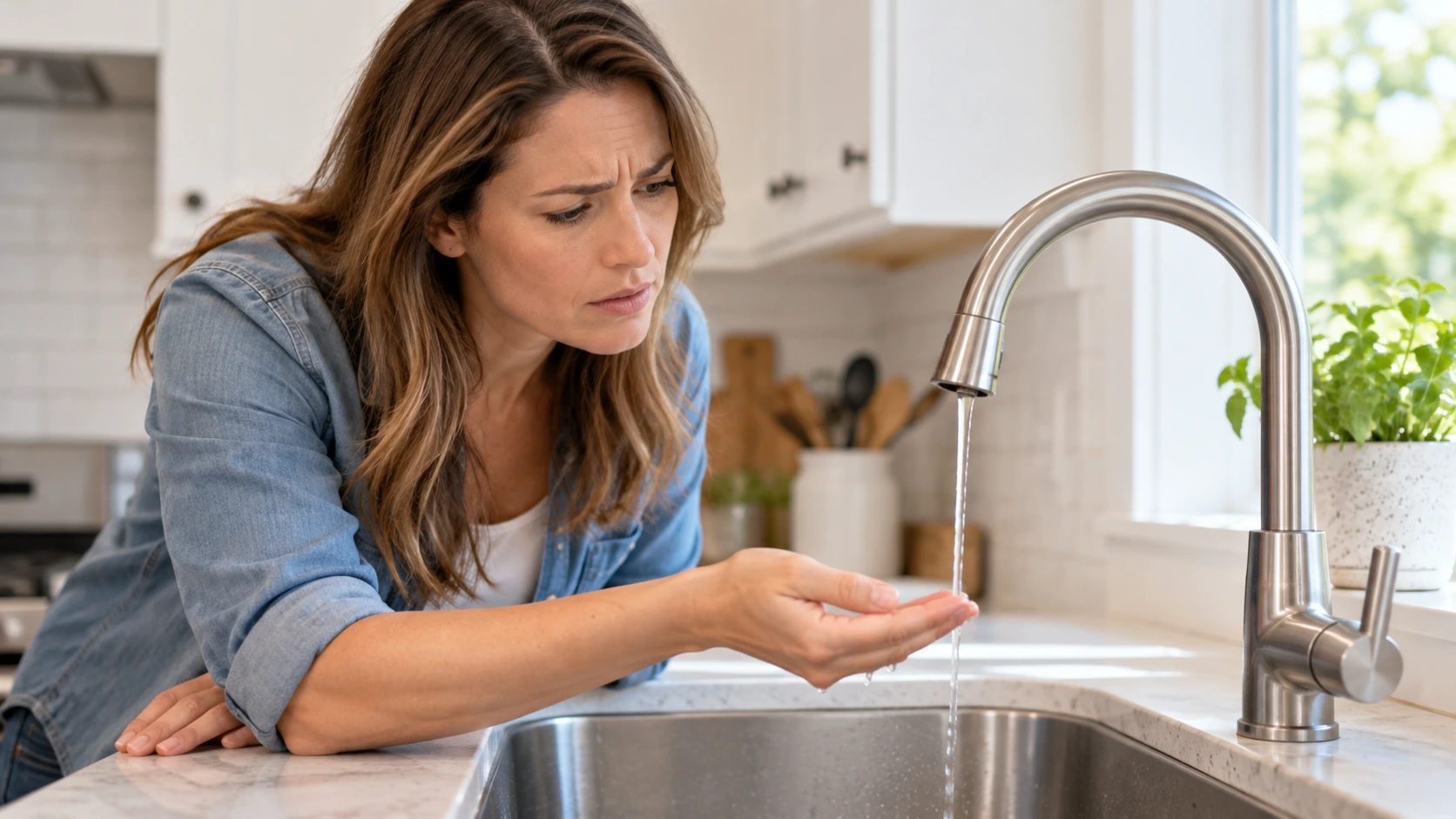
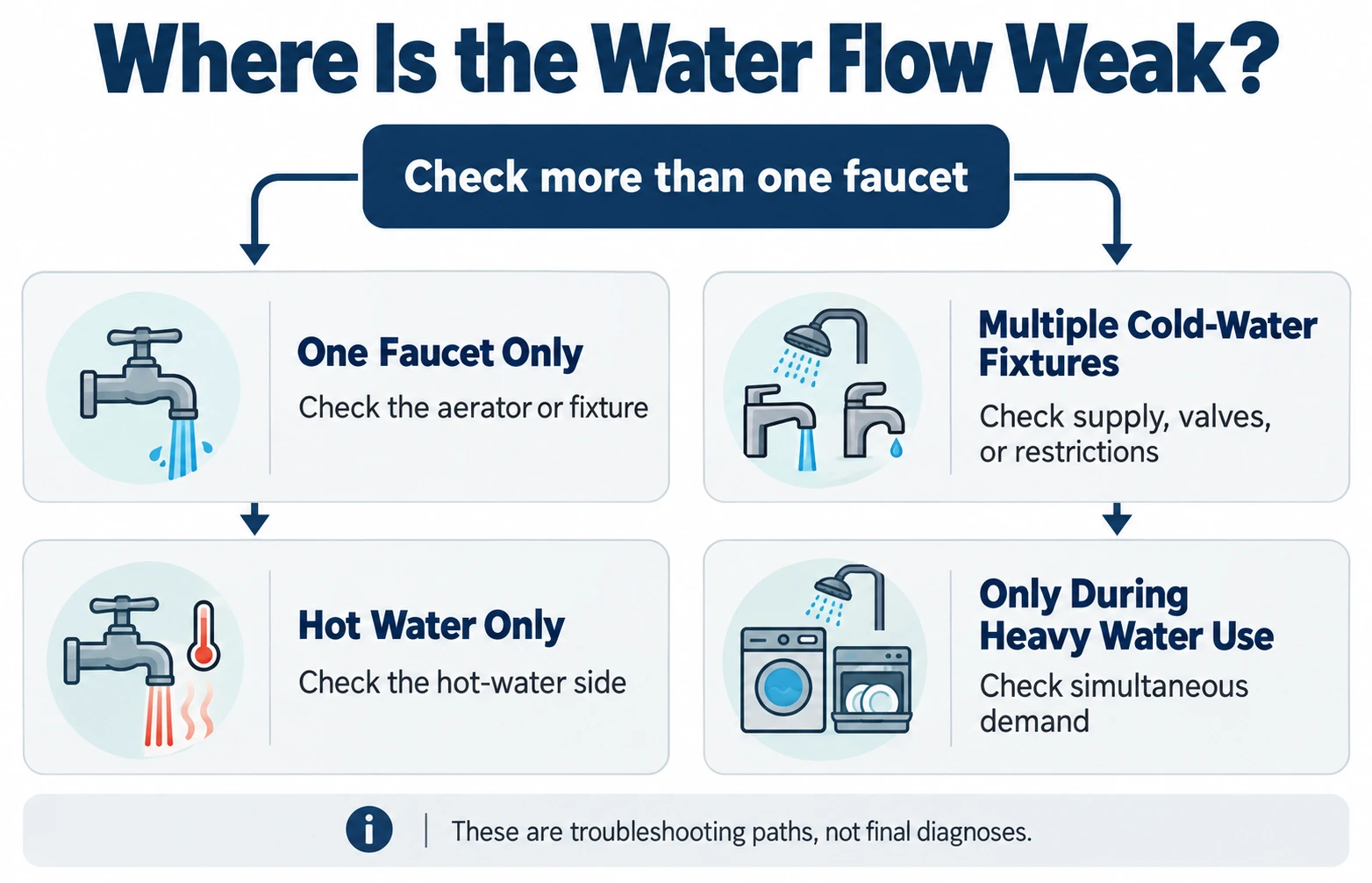
Compare the cold-water flow at two or three fixtures, preferably in different parts of your home. Check whether the hot side behaves differently, whether the problem began suddenly, and whether it happens only when other water-using appliances are running. These simple observations often prevent an unnecessary repair.
Try to make the comparison fair: use the same faucet at roughly the same handle position, then repeat it with other household water use turned off. A low-flow bathroom faucet, a high-volume tub spout, and a showerhead are designed to deliver different streams, so their appearance alone is not a reliable pressure comparison. What matters most is whether an outlet has changed from its normal performance and whether several outlets show the same pattern.
| What you notice | Possible direction | What to check first |
|---|---|---|
| Weak at one faucet | Localized restriction or fixture issue | Aerator, spray-head screen, fixture instructions |
| Weak at multiple cold-water fixtures | Supply, household valve, regulator, restriction, or leak | Utility alerts, visible valves, other homes |
| Hot water weak but cold is normal | Hot-side fixture or water-heating distribution issue | Compare hot water at a second fixture |
| Sudden drop everywhere | Utility work, service issue, valve change, or leak | Outage notices, neighbor observations, visible leaks |
| Gets weak when multiple taps run | Flow capacity or restriction under demand | Repeat with other water uses turned off |
| Gradually worse over months | Deposits, aging piping, or treatment-system restriction | Fixture screens, filter service history, plumber assessment |
The table suggests where to investigate; symptoms alone cannot identify a failed component.
Three examples of what the pattern can tell you
- Kitchen faucet weak, bathtub normal: look first at the kitchen faucet's aerator or sprayer and its accessible supply connections—not the main pressure regulator.
- Every faucet suddenly weaker after nearby utility work: check utility updates and ask whether neighbors noticed a change. If the issue persists after service returns, the utility may have restoration guidance for fixture screens.
- Shower weak only while laundry or irrigation runs: the home's available flow under simultaneous demand may be limited. That does not, by itself, prove the pump or PRV is defective.
Low water pressure vs. low water flow: why the difference matters
Pressure is the force driving water through the plumbing, commonly measured in pounds per square inch (psi). Flow is the amount of water delivered over time, often expressed in gallons per minute (gpm). They are related, but they are not interchangeable.
For example, a partially clogged faucet aerator may deliver only a thin stream even if pressure elsewhere in the home is normal. Likewise, an old pipe with significant internal buildup can limit water delivery when multiple fixtures are in use. Turning up a pressure regulator is not an appropriate fix for every restriction.
Pressure problem
A gauge reading at an appropriate household supply point may be lower than expected, possibly pointing to a supply or system-level issue that needs further diagnosis.
Flow restriction
The stream is weak at certain fixtures or when demand increases, even though a no-flow pressure reading may look ordinary.
California Water Service and WaterOne both explain why a weak-looking stream should not automatically be treated as a low incoming-pressure diagnosis.

What causes low water pressure in a house?
These are common possibilities, not a checklist of parts that all need replacing. The most likely next step depends on whether the problem is local, whole-house, sudden, or gradual.
1. Utility-side work or supply changes
A main repair, temporary interruption, or nearby system change can affect several homes. This is especially worth checking if the weak flow began abruptly or if neighbors report the same symptoms.
What to do next: Look for a notice from your actual water provider and note when the issue started. Ask whether the utility has restored normal service before paying for work inside the home. Supply pressure can also vary with local geography and where a property sits in the distribution system; a comparison with a house elsewhere in town may be misleading.
2. A partially closed household shutoff valve
A valve that was not fully reopened after plumbing work may restrict the amount of water the home receives. Depending on where the valve sits, several fixtures may be affected while some individual branches appear normal.
What to do next: Think about recent service, renovation, or winterization. Inspect only a clearly identified, accessible household shutoff; follow its valve type and normal operating position. Do not force a stiff or corroded valve, operate a buried curb stop, or break a utility seal. If the valve leaks or will not move normally, ask a plumber to handle it.
3. Pressure-reducing valve (PRV) trouble
Some houses have a PRV on the incoming water line to control downstream pressure. A restricted, incorrectly set, or malfunctioning regulator can contribute to broad pressure or flow complaints. But a weak stream at one sink is not good evidence that the PRV has failed.
What to do next: Identify whether the home even has a PRV and record any suitable pressure reading with its measurement location. A professional can compare pressure and water delivery at appropriate points, check the installed regulator model, and determine whether service is needed. Avoid turning its adjustment screw or opening a strainer based on a general online tip.
4. Clogged fixtures and supply components
Mineral scale or small particles can build up in a faucet aerator, pull-down spray head, showerhead, or fixture-specific inlet screen. When only one outlet is weak, these parts are often more sensible places to investigate than the home's main supply.
What to do next: Compare that fixture's hot and cold sides, and check a second nearby fixture. Clean a removable aerator only as its manufacturer directs, keeping track of small washers and screens. If several fixtures became weak after work on a whole-house filter, review its service instructions instead. Do not assume a clogged sink drain causes weak water coming out of the faucet; supply and drainage are separate systems.
5. Leaks in a supply line
A substantial leak can waste water and, under some conditions, reduce the pressure or flow available at fixtures. A very small leak may not create noticeable pressure symptoms at all, so weak flow alone cannot confirm or exclude a hidden leak.
What to do next: Look for unexpected wet ground, damp walls, unexplained running-water sounds, or a rising water bill. If your meter is accessible and the utility permits it, use the no-use check later in this guide. A changing meter reading signals possible leakage or unnoticed use; it does not reveal where the leak is. Call a plumber promptly for suspected concealed damage and act immediately if water is actively damaging the home.
6. Aging or restricted pipes
Deposits and corrosion can narrow the passage inside older pipes, especially some galvanized steel installations. A home may show acceptable no-flow pressure at a test point yet struggle to deliver enough water when showers, faucets, or appliances run together.
What to do next: Notice whether the problem grew worse gradually and affects several outlets, especially under demand. Pipe age and visible corrosion are clues, not proof that every line needs replacement. A plumber can assess the service line, branch piping, fittings, and pressure loss under flow before recommending repairs. Raising pressure does not remove deposits or restore an undersized pipe's capacity.
7. Heavy simultaneous water use
A shower may become noticeably weaker while irrigation, a washing machine, or another shower is running. The combined demand can reveal the limits of the supply, piping, pump, or treatment equipment, even if each fixture seems fine when used alone.
What to do next: Repeat the same faucet check after the other uses stop and compare the result. If performance recovers, write down which loads trigger the change. Spacing out water-heavy activities may help in the short term, but frequent severe drops deserve an assessment of available flow and system restrictions before buying a booster pump.
8. Private well equipment
Homes supplied by private wells depend on the pump, pressure tank, well yield, and installed treatment equipment. A pump with limited output may not keep up with several simultaneous uses, and a pressure tank cannot permanently make up for insufficient pump or well capacity.
What to do next: Observe whether pressure rises and falls repeatedly, whether the pump cycles unusually often, and whether weakness follows heavy use or dry conditions. Keep the observations for a qualified water-well professional. Do not open electrical controls, adjust a pressure switch, or change tank air pressure from generic instructions.
How to troubleshoot low water pressure safely
Work through these low-risk checks in order. Stop if a step requires opening pressurized equipment, removing an unfamiliar valve, or working near damaged electrical equipment.
- Check for service alerts. Look at your water utility's outage or maintenance page. If pressure changed suddenly, ask whether nearby homes are affected. Homes using private wells can skip the municipal-utility check.
- Compare more than one outlet. Try cold water at a kitchen faucet and a bathroom faucet, then another accessible point. Compare the hot side separately. Note whether the issue is isolated or widespread.
- Repeat the check without competing demand. Make sure an irrigation zone, washer, dishwasher, or another shower is not running. A difference under load helps distinguish a capacity restriction from a constant issue.
- Inspect easy-to-reach fixture screens. If only one faucet is weak, follow its manufacturer guidance for cleaning a removable aerator or spray-head screen. Protect the finish and retain small parts. Do not disassemble an unfamiliar cartridge solely because the water stream looks weak.
- Look at the identifiable house-side shutoff. If you know which valve controls household supply, confirm it is not obviously partly closed. Do not force stiff hardware or tamper with a utility-sealed meter, curb stop, or unfamiliar underground valve.
- Check treatment and filter service history. If you have a water softener or whole-house filter, review its maintenance schedule. Compare its behavior or use a bypass only when the manufacturer's instructions permit it and doing so is appropriate for your drinking-water setup.
- Measure pressure or screen for a leak. If a suitable connection and meter are safely accessible, use the methods below. Record what you find rather than replacing a PRV or pump based on a single number.
How to check home water pressure with a PSI gauge
For a home on a municipal supply, a purpose-made water pressure gauge with a compatible hose-thread connection can provide useful evidence. The U.S. EPA WaterSense program describes a basic static-pressure check at an outdoor hose bibb.
EPA-based test steps
- Choose an accessible, undamaged hose bibb with matching threads. Do not force the gauge onto a worn or leaking outlet.
- Turn off other water-using fixtures and systems, including irrigation and appliances that may fill automatically.
- Attach the gauge securely by hand as directed by its manufacturer. Position it so you can read it safely.
- Open the hose bibb fully and read the pressure in psi. Note the time and exact measurement point.
- Close the tap, release any residual pressure as the gauge instructions specify, and remove it without forcing fittings.
EPA WaterSense reference
45–60 psi
EPA's recommended incoming service-pressure range for good fixture performance. It is not a universal legal requirement or a pass/fail diagnosis for an individual home.
Important: The gauge shows the pressure at that connection at that time with water use off. An outdoor tap might be on an unregulated irrigation line or different pressure zone, so its reading may not represent the indoor, PRV-controlled supply. A normal static reading also cannot rule out a flow restriction that appears only while water is running.
If the reading is much lower than the EPA reference, look at the other evidence: utility notices, symptoms throughout the house, and signs of a leak. Ask the utility or a plumber to investigate when the cause remains unclear. Do not turn a PRV adjustment screw based only on one reading.
How to interpret the number without jumping to conclusions
- Low reading, multiple fixtures weak: the result supports checking supply conditions, accessible valves, leaks, and the pressure-control arrangement with the utility or a plumber. It does not identify which component is responsible.
- Reading looks ordinary, one faucet weak: a localized screen, valve, or fixture restriction remains plausible; a static gauge reading does not measure the water delivered at that faucet.
- Reading looks ordinary, whole house weak under demand: there may still be a restriction or flow-capacity problem. Further assessment can involve measurements taken while water is flowing, but the test setup and interpretation should be handled by a qualified professional when the plumbing arrangement is unclear.
How to check the water meter for a possible hidden leak
If your home has a readable water meter, EPA WaterSense recommends comparing readings during a period when no water is used. This can help detect an otherwise unnoticed leak, even when the pressure symptoms are unclear.
Two-hour no-use meter check
- Find the correct meter for your property. Only access it in a way your utility permits; do not open sealed or hazardous enclosures.
- Make sure no water is being used, including toilets refilling, irrigation, ice makers, appliances, and automatic water systems.
- Write down or photograph the reading and time.
- Avoid water use for two hours, then check the meter again.
- If the reading increased, you probably have a leak or unrecognized water use. Check obvious fixtures and contact a plumber for an unexplained result.
A meter change can indicate water use or leakage; it does not pinpoint a leak or prove it caused the weak flow. Some utility meters are inaccessible or read differently—follow your local utility's instructions.
If the reading increases, first consider whether something used water without your noticing, such as an automatic irrigation cycle, a toilet refilling, or a treatment unit operating. If you can account for none of these and the result repeats, document the readings for a plumber or your utility. If the reading stays unchanged, that is reassuring for the test period but does not necessarily rule out every small or intermittent leak.
If a toilet is quietly refilling during your no-use test, our Toilet Keeps Running: Causes and Fixes guide explains how to check for that separate water-wasting problem.
What about the pressure regulator, water softener, or pipes?
A pressure-reducing valve (PRV) is intended to control downstream supply pressure. If a home already has one, it may be part of the diagnosis when multiple outlets are affected. However, its adjustment range, plumbing layout, and maintenance steps depend on the model and installation.
For example, Watts provides model-specific instructions that call for confirming adjustments with a pressure gauge and for installation by a licensed contractor. Those directions do not authorize a generic “turn the screw clockwise” fix for every homeowner. Replacing a PRV, disassembling its strainer, or working on pressurized service piping is best left to a qualified plumber.
Water softeners and whole-house filters can sometimes restrict flow if they need service. A filter cartridge may have a rated flow limit or replacement interval. Read the exact system instructions before switching valves, bypassing treatment, or changing cartridges. Where water treatment protects against contamination, bypassing it may not be appropriate.
In older homes, buildup inside galvanized pipes or an undersized service arrangement can limit water delivery. Such problems generally require inspection rather than a household pressure adjustment. A plumber can distinguish a pipe-flow issue from incoming service pressure and advise on appropriate repairs.
Low water pressure if your house uses a private well
A private well does not work like a municipal service line. Pump capacity, available well yield, pressure tank behavior, and treatment equipment can all affect what comes out of the taps. A pump that repeatedly starts and stops, large pressure swings, or declining flow at several fixtures are reasons to have the system assessed.
What to observe—but not repair blindly
Write down when the weakness happens, whether the pump cycles frequently, whether there have been recent power interruptions, and whether filter maintenance is overdue. Do not open a well cap, adjust a pressure switch, charge a pressure tank, or work on pump wiring without model-specific professional guidance. The National Ground Water Association recommends regular professional well-system inspections.
If you suspect a well problem, contact a qualified water-well systems professional rather than calling the municipal utility. A replacement pump or booster is not automatically the correct remedy, especially if the available water supply or piping is the real limitation.
For example, water that starts strong but weakens when several fixtures run can reflect demand exceeding the system's delivery capacity; repeated short pump cycles can suggest a different equipment issue. Those are observations to report, not instructions to replace a tank or alter switch settings. A specialist can assess pumping performance, pressure controls, treatment restrictions, and the available well yield together before recommending a solution.
When to contact the water utility, a plumber, or a well professional
Contact your water utility
Sudden widespread pressure drop, no water at multiple homes, announced service work, or an official drinking-water advisory.
Contact a qualified plumber
Persistent whole-house weakness, suspected hidden or active leaks, inaccessible or damaged valves, PRV diagnosis, corroded piping, or unclear gauge results.
Contact a well specialist
Pump short-cycling, pressure tank concerns, worsening well yield, or private-well electrical and pressure-control problems.
If the utility announces an advisory, follow the precise local notice. The CDC distinguishes boil water, do not drink, and do not use advisories; these are not interchangeable. Boiling does not make chemically contaminated water safe.
How to reduce the chance of low-flow problems returning
- Keep removable aerators and showerheads clean according to the fixture manufacturer's directions.
- Track scheduled service for filters and water softeners, including changes in flow after maintenance.
- Watch for unexpected bill increases, visible dampness, or meter movement during a no-use period.
- Keep notes of pressure readings with dates and test points rather than comparing numbers from different plumbing zones.
- Have persistent issues and aging piping evaluated instead of repeatedly raising pressure or buying boosters.
Frequently asked questions
Why is my water pressure low all of a sudden?
A sudden change may be related to utility work, a closed valve, an active leak, or another service issue. Check for damage and utility notices first, then compare several fixtures before attempting a repair.
What causes low water pressure throughout the house?
Possible causes include incoming supply changes, household shutoff restrictions, PRV trouble, significant leaks, restricted older pipes, and water-treatment equipment. Private well homes have additional pump and pressure-tank considerations.
Can a clogged faucet cause low water pressure in the whole house?
A clogged aerator generally affects that faucet's flow, not the entire home. If several outlets are weak, look for an upstream or shared restriction rather than assuming a single faucet is responsible.
Is 40 psi too low for a house?
EPA WaterSense recommends incoming pressure of 45–60 psi for efficient fixture operation, so 40 psi is below that recommended range. But whether a reading represents a problem depends on where and when it was measured, the home's system, and local requirements. One reading does not establish the cause.
Should I adjust my water pressure regulator?
Not as a first step. Confirm that the problem affects multiple fixtures and establish the measured pressure. PRV adjustment is model- and installation-dependent and may require a licensed plumber.
Why is my hot water pressure low but cold water is fine?
That pattern points toward a hot-side restriction or distribution issue rather than a general municipal pressure drop. Compare hot water at more than one fixture and check the applicable faucet or water-heating system guidance. Avoid opening a pressurized water heater or performing unverified valve work.
Official sources and technical guidance
These references support the general diagnostic principles in this guide. Exact plumbing arrangements, pressure limits, codes, and repair procedures vary by location and equipment.
- U.S. EPA WaterSense — Home Maintenance (service pressure, hose-bibb gauge and leak-meter checks)
- California Water Service — What to Do If Your Home Has Low Water Pressure
- WaterOne — Water Pressure and Low Flow
- WaterOne — Service Interruptions and Restoring Flow
- Moen Solutions — Low Water Flow at Sink Faucets
- Watts — LF25AUB-Z3 Pressure-Reducing Valve Instructions (model-specific PDF)
- National Ground Water Association / Wellowner.org — Water Pressure
- National Ground Water Association / Wellowner.org — Water Well Maintenance
- U.S. CDC — Drinking Water Advisories Overview